
Preparing an Australian Computer Society (ACS) employment reference letter can feel confusing for many applicants. You must match every date, job title and Information and Communication Technology (ICT) duty with your employment records.
One missing detail can make your work experience harder to assess. Copied Australian and New Zealand Standard Classification of Occupation (ANZSCO )wording, unclear duties or unverifiable signatures can also weaken your evidence.
In this blog, you will learn what to include and how to review the sample structure. Use it to check duties, dates, signatures and nominated occupation alignment before submission.
Key Takeaways
- An ACS employment reference letter shows the applicant’s ICT role, work dates, weekly hours and duties through employer-issued evidence.
- ACS uses the employment reference letter to check whether the applicant’s ICT experience supports the nominated occupation.
- A complete reference letter includes employer details, applicant details, employment dates, salary, work location, ICT duties and signatory details.
- Experience evidence may include payment records, employer statements, role evidence and translations that support the claimed work history.
- Australian and overseas employment evidence follows different presentation methods in the ACS application.
- The sample structure shows how employment details, ICT duties, multiple roles and signatory details should appear.
- An authorised employer, HR officer, manager, supervisor or host company representative can verify the employment record.
- A statutory declaration supports the application when an employer cannot issue or verify the reference letter.
- Common mistakes include missing weekly hours, unclear dates, copied ANZSCO duties, weak signer details and unsupported claims.
What is an ACS Employment Reference Letter?
An ACS employment reference letter is an employer-issued document for an ICT skills assessment. The letter shows where you worked, what role you held and which duties you handled.
ACS checks your listed ICT duties against your chosen occupation. This helps show whether your work experience fits the role you selected.
Your current or former employer should issue the letter. The details should match real work records, not copied duties or unsupported claims.
Why Does ACS Require Employment Reference Letters for Skills Assessment?
ACS asks for an employment reference letter to understand your real ICT work experience. It checks your role, work dates, weekly hours and ICT duties. This helps the assessing authority see whether your experience supports the occupation you selected.
1. Confirm work history: The letter shows your employer, position, employment dates and weekly work hours.
2. Review ICT duties: Your duties should explain specific tasks, tools, systems, projects and technical responsibilities.
3. Match occupation fit: Your role should connect with your nominated ICT occupation and ANZSCO category.
4. Verify paid work: Payslips, tax records or salary details can support your claimed professional experience.
5. Check evidence quality: Clear details support your reference, while vague duties and copied wording weaken it.
Also Read: ACS Skill Assessment Processing Time in 2026
What Should an ACS Employment Reference Letter Include?
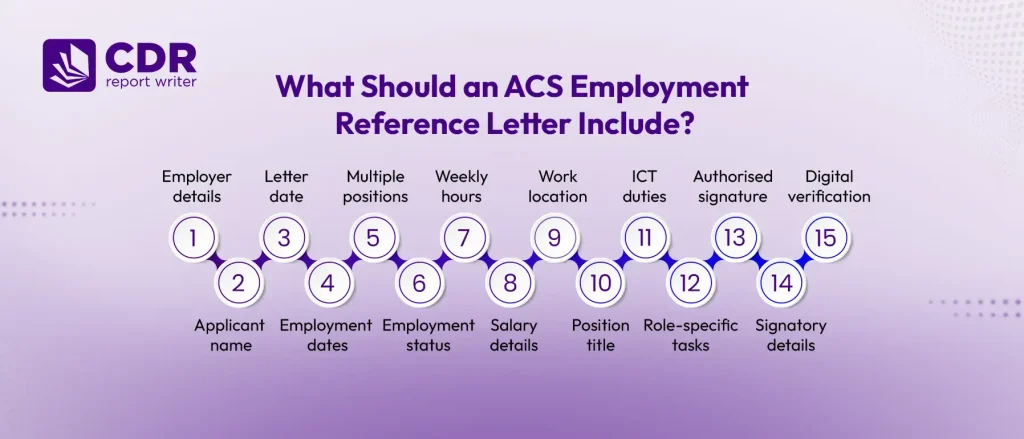
An ACS employment reference letter should include employer, applicant, employment, duty and signatory details. It should also show work dates, weekly hours, salary, location and ICT duties.
1. Employer details: Add company letterhead, employer name, business address and company website. These details help verify the organisation that issued the letter.
2. Applicant name: Use your full name exactly as shown in your assessment documents. Avoid shortened names, spelling differences or informal name versions.
3. Letter date: Include the date your employer issued the reference letter. This shows when the company confirmed your employment details.
4. Employment dates: Show start and end dates in DD/MM/YYYY format. If the role continues, write “current” or “till date” as the end date.
5. Multiple positions: Add a simple table when you held more than one role. Include position title, start date, end date and location.
6. Employment status: State whether the role was permanent full-time, part-time or contractor-based. This helps explain your work arrangement clearly.
7. Weekly hours: Mention the minimum number of hours you worked each week. This detail helps confirm the work volume for that role.
8. Salary details: Add annual salary before tax and benefits where company policy allows. Salary information can support paid professional experience.
9. Work location: State whether the role took place in Australia or outside Australia. Add this detail for each position listed.
10. Position title: Use the job title recorded by your employer. For example, a Software Engineer, a Database Administrator or a Systems Analyst.
11. ICT duties: List the duties you actually performed in the role. Mention tools, systems, projects, technical tasks and responsibilities.
12. Role-specific tasks: Keep duties connected to your daily work. Do not copy duties from ANZSCO codes or another reference.
13. Authorised signature: Ask an authorised company representative to sign and date the letter. The signer should have the authority to confirm your employment.
14. Signatory details: Add the signer’s full name, position title, phone number and work email. Avoid personal email addresses for verification.
15. Digital verification: Include a digital verification certificate if the letter uses a digital signature. The certificate should confirm who signed the letter.
What Experience Evidence Supports an ACS Employment Reference Letter?
You may need payment records, employer statements, role evidence and translations to support your ACS employment reference letter. These documents should confirm paid ICT work, at least 20 weekly hours, salary level and role complexity.
| Evidence Area | What to Check |
| Paid ICT work | Show paid Information and Communication Technology work for at least 20 hours each week. Unpaid internships, volunteer work and unpaid leave do not count as paid employment. |
| Occupation relevance | Match your duties with your nominated ICT occupation and Australian and New Zealand Standard Classification of Occupations category. |
| Role complexity | Show the systems, technical tasks, project scope and responsibilities you handled in the role. |
| Salary level | Include salary details, payslips, tax records or payment evidence where required. The salary should reflect the role level. |
| Age requirement | Claim work experience that started after you turned 18. Keep dates consistent across all documents. |
| Concurrent employment | Claim only one job for the same time period. Overlapping jobs may be treated as concurrent employment. |
| Australian employment | Record each Australian employment period separately in the application portal, including secondments to Australia. |
| Overseas employment | Record separate overseas work periods individually. Same-employer, similar-role work across non-Australian countries may fit one entry. |
| Recruitment agency work | Ask the host company to issue the employment reference letter. The host company confirms your actual role and duties. |
| Multiple roles | Break down each role under the same employer. List each title, date range, location and duty set separately. |
| Teaching experience | Use IT teaching only for recognised qualifications at the Australian Qualifications Framework diploma level or higher. |
| Research work | Separate thesis research from work experience. Ask your supervisor to confirm research work not tied to thesis requirements. |
| Self-employed work | Submit a statutory declaration when you cannot obtain an employer reference or when you claim self-employed experience. |
| Freelance work | Provide company statements on official letterhead with dates and weekly hours. Add matching invoices, bank statements or tax records. |
| Employer verification | Keep employer registration and company details accurate. Business registration checks may apply in the relevant country. |
| Document translation | Translate any original document that is not in English before submission. Follow the required translation format. |
Note: Submit only true and accurate records for each claimed work period. Do not add duties, employers or payment details that your evidence cannot support.
How Should You Present Employment Evidence for ACS?
ACS uses different presentation methods for Australian and overseas employment evidence. Record Australian work periods separately, including secondments to Australia. For overseas work, separate each period unless the same employer and similar role apply.
1. Australian Employment Evidence
- Record each Australian employment period as a separate entry.
- Include secondments to Australia by an overseas employer.
- Use the same employer name listed in your reference letter.
- Match the role title, work dates and weekly hours across all documents.
- Keep each Australian work period clear, consistent and easy to verify.
2. Overseas Employment Evidence
- Record each separate overseas employment period individually.
- Combine different countries only when the same employer and similar role apply.
- Use one reference when the duties, employer and role stay consistent.
- Create a separate entry when your role, country or duties change.
- Align overseas records with your reference letter and payment evidence.
Also Read: Reasons to Move to Australia in 2026
ACS Employment Reference Letter Sample Structure
Use the samples structure to understand how duties, tools, systems and responsibilities should appear in the letter. Your employer must issue the final letter from the real company records.
[Company Name]
[Company Address]
[Company Website] | [Company Phone] | [Company Email]
Letterhead
Employment Reference Letter
To Whom It May Concern,
This letter confirms that [Applicant Full Name] was employed by [Company Name] as a [Position Title] from [Start Date] to [End Date / Current].
The employment was based in [City, Country]. The role was [Full-time / Part-time / Contract], and the employee worked [Number of Hours] hours per week. The annual salary was [Salary Amount and Currency], where company policy allows salary disclosure.
During this employment period, [Applicant Full Name] performed ICT-related duties connected to [Nominated Occupation / ANZSCO Role]. The main responsibilities included:
- Analysing user, business and system requirements for ICT projects.
- Designing, developing, testing and maintaining software applications, databases or ICT systems.
- Using tools and technologies such as [Tools / Programming Languages / Platforms].
- Preparing technical documentation, reports, test cases and implementation records.
- Troubleshooting system issues and applying technical solutions to improve performance and reliability.
- Coordinating with project teams, stakeholders and users to deliver ICT outcomes.
- Maintaining system security, data accuracy and compliance with internal ICT procedures.
If the employee held more than one position with our organisation, the employment details are listed below:
| Position Title | Start Date | End Date | Location |
|---|---|---|---|
| [Position 1] | [DD/MM/YYYY] | [DD/MM/YYYY] | [City, Country] |
| [Position 2] | [DD/MM/YYYY] | [Current / Till Date] | [City, Country] |
This reference is issued to confirm the employee’s position, employment period, weekly hours, work location and ICT duties based on company employment records.
Sincerely,
[Authorised Signatory Name]
[Position Title]
[Company Name]
Work Email: [Official Work Email]
Phone: [Company Phone Number]
Note: This is a sample reference letter format for guidance only. The actual letter must be issued, signed and verified by the employer.
Who Can Sign an ACS Employment Reference Letter?
Your ACS employment reference letter should come from someone authorised to verify your work history. This person should confirm your role, dates, weekly hours and ICT duties from company records.
| Authority Level | Accepted Signer | Roles |
| Highest authority | Employer or company owner | Checks employer records to confirm your role, work dates and employment history. |
| HR verification | HR officer or people team representative | Reviews HR records to confirm your job title, employment status and weekly hours. |
| Work supervision | Manager or supervisor | Confirms the ICT tasks, systems, tools and projects you handled in the role. |
| Recruitment agency case | Host company representative | Verifies the duties you performed for the host company during agency placement. |
Note: Do not use friends, personal contacts or unauthorised colleagues as signers. They cannot verify your employment through official company records.
What If You Cannot get an Employer Reference Letter?
If you cannot get an employer reference letter, use a statutory declaration with supporting evidence. This applies when your employer cannot issue, confirm or verify your employment details.
1. Unavailable Employer: Explain why the company cannot provide the reference. Mention closure, refusal, missing records or unreachable management.
2. Self-employed Work: Use a statutory declaration to explain your contractor or sole-trader experience. Add evidence that supports each claimed project.
3. Freelance Experience: Provide company statements on official letterhead. Add invoices with matching bank statements or tax records.
4. Work Details: Include your role, dates, weekly hours, duties, tools, systems and project responsibilities. Keep each detail tied to real work records.
5. Evidence Accuracy: Submit only truthful employment and payment records. Do not add duties, employers or dates that your documents cannot support.
Common ACS Employment Reference Letter Mistakes to Check Before Submission
Small gaps in an ACS employment reference letter can make strong work experience look unclear. Missing hours, weak duties, copied wording, or incomplete signer details can reduce the strength of your evidence. Check these common mistakes to migrate to Australia as an ICT professional.
Missing Weekly Hours: Your work dates appear in the reference, but weekly work hours are missing.
2. Unclear Employment Dates: Partial dates, mixed formats or mismatched records make the work period unclear.
3. Copied ANZSCO Duties: The duty section repeats occupation wording instead of showing your real workplace tasks.
4. Generic ICT Duties: Broad lines like “handled IT work” skip the tools, systems and tasks you used.
5. Mixed Role Details: Promotions or transfers appear under one title without separate dates and duties.
6. Weak Signer Details: The signature appears, but the signer’s job title, work email or phone number is missing.
7. Missing Salary Details: Salary information is missing even when the employer can disclose it.
8. Unverified Digital Signature: A digital signature appears without a verification certificate.
9. Wrong Work Location: The stated location does not match the country or office in your application.
10. Unsupported Claims: Duties, dates or role details do not match payslips, tax records or employer documents.
Frequently Asked Questions
Yes, your job title can differ from your nominated ACS occupation. What matters more is whether your ICT duties, tools, systems and project work support the role you selected.
Yes, you can use an old employment reference letter if it still includes the required details. Check that it shows your work dates, weekly hours, salary details, location, duties and authorised signer details.
No, your ACS reference letter should not copy ANZSCO duties word for word. It should explain the real tasks, systems, tools and responsibilities you handled at work.
You should not treat the ACS reference letter as a self-written document for your employer to sign. You can share a checklist, but your employer should verify the details from company records before issuing it.
If your company changed its name, your evidence should clearly connect the old name with the new one. Business records, payslips, tax records or company documents can help show the same employer history.