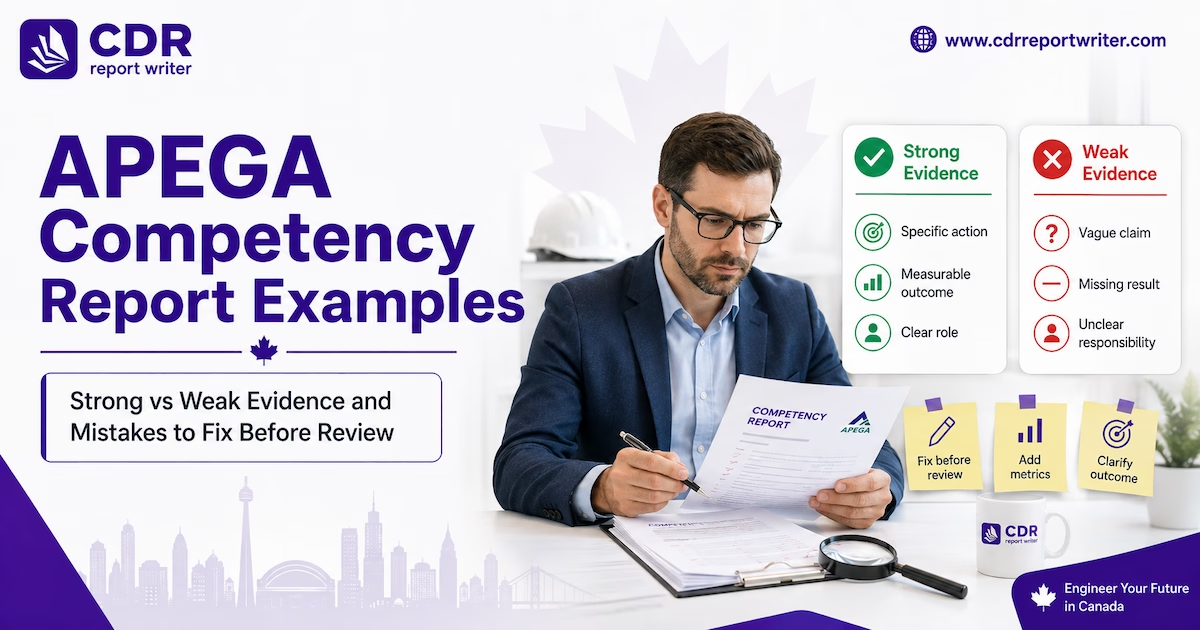
A strong APEGA competency example is evidence of what you personally did, decided, and achieved in a real engineering situation. It is not a job description, a project biography, or a polished claim that the team succeeded. The assessor must be able to see the problem, your responsibility, the reasoning behind your Actions, and the relevant Outcome.
The practical method is simple: interpret the selected competency, choose one verifiable project, make a short evidence note, and draft the response as Situation, Actions, and Outcome (SAO). Keep the Situation focused, use most of the available space for several first-person Actions, and close the loop with a supported result. Then test the example against the descriptor, self-rating, Work Record Validator List (WRVL), Canadian-equivalent requirement, and validator’s direct knowledge.
This engineering guide reflects APEGA’s framework current after July 18, 2026. APEGA’s live competency descriptors instruct applicants to write in first person, use 2-3 paragraphs, and stay within a maximum of 1,800 characters. The fictionalized fragments below are planning demonstrations, not text to copy. Your application must contain genuine projects, calculations, decisions, validators, and outcomes; editing cannot replace missing competence or guarantee a registration result.
Key highlights
- Start with the competency descriptor, not with the project you most want to showcase.
- Choose one defined event in which you exercised relevant judgement or professional behaviour.
- Use a brief Situation, several specific first-person Actions, and an Outcome tied to the competency.
- Explain what you did, how you did it, and why the decision was appropriate.
- Indicators are prompts; they are not mandatory boxes and should never be copied as evidence.
- Make the narrative, self-rating, WRVL entry, and validator assignment tell the same verifiable story.
- For eight engineering competencies, make Canadian or Canadian-equivalent evidence explicit.
Quick Answer: How Should an APEGA Competency Example Be Written?
To write an APEGA competency example, select a real project that directly demonstrates the competency. State the Situation and your responsibility briefly; describe several Actions you personally took, including the method, judgement, and reason; then state the Outcome and its evidence. Write in first person, keep the response within APEGA’s current limit, choose only a score the example supports, and assign a validator who directly knows the work.
Working formula: Specific context + personal engineering or professional Actions + supported Outcome + evidence-aligned score + direct-knowledge validator.
APEGA uses the plural word Actions because a convincing example normally contains more than one contribution. The common search phrase Situation-Action-Outcome refers to the same broad SAO logic, but the current engineering form expects several actions. Relevant keywords do not establish competence; the facts must answer the descriptor.
Turn your experience map into focused first-person examples
Writing support can help organize applicant-owned evidence, separate overlapping competencies, and preserve the technical decisions that matter within the portal limit.
Before Writing: Understand What the Competency Actually Assesses
Read the current competency title, assessment statement, Canadian-equivalent note, and indicators on APEGA’s competencies and indicators page. Restate the assessed ability in plain language: for example, ‘independently verify my technical result before implementation’ is more useful for planning competency 1.5 than the broad label ‘verification.’
- Identify the behaviour or decision APEGA is asking you to demonstrate.
- Separate relevant evidence from background knowledge and routine duties.
- Use indicators to trigger memory, not as sentences to copy or a checklist to complete.
- Check whether the competency carries an independent Canadian-environment minimum.
- Write down what an assessor and validator would need to verify the claim.
Also Read: APEGA’s 22 engineering competencies before you map projects.
Step 1 – Choose a Real Project That Directly Demonstrates the Competency
The best example is not automatically the largest, newest, or most prestigious project. Choose the event in which your own analysis, decision, communication, intervention, or accountability most clearly demonstrates the selected ability. A routine assignment can work when it required relevant judgement; a major project can fail when your contribution is unclear.
| Did I personally act or decide? | Clear ownership and judgement | Observed others or followed routine instruction |
| Is the event specific? | One defined problem, choice, or conflict | A multi-year role or company history |
| Can I explain the evidence? | Methods, standards, constraints, communications | Broad claims without detail |
| Is there an Outcome? | Relevant technical or professional consequence | The project was successful |
| Can a validator confirm it? | Direct review or firsthand knowledge | Seniority without familiarity |
| Does it match the WRVL? | Employer, role, and period align | Missing project or conflicting chronology |
Do not force a favourite project into a competency it does not prove. If you cannot name the relevant personal decision, supporting evidence, outcome, and knowledgeable validator, keep searching your work history or treat the competency as an experience gap.
Step 2 – Build an Evidence Note Before Drafting Prose
A private evidence note prevents a blank-page draft from becoming generic. Record the employer, date or period, position, competency number, likely validator, and tentative self-rating. Then answer six prompts in fragments before writing polished sentences:
- What exact situation, problem, decision, or conflict occurred?
- What was my role, authority, and responsibility?
- Which constraints, risks, standards, stakeholders, or uncertainties mattered?
- What did I personally analyze, calculate, decide, communicate, verify, or change?
- Why did I choose those actions or reject another option?
- What resulted, and what observable evidence supports that result?
This note is not the response. Its purpose is to collect enough evidence to decide whether the project fits. It also exposes inconsistencies early: an example outside the WRVL, a validator who did not see the work, a score that exceeds the responsibility described, or a Canadian-equivalent statement with no real connection to the decision.
Step 3 – Write the Situation Briefly and Specifically
What the Situation Should Include
Identify the project or operating context, the specific problem or objective, your role and responsibility, and only the constraints needed to understand what follows. The reader should know why action was required and what was at stake.
What to Leave Out
- Company history, marketing claims, and a full description of the facility.
- Every team member’s duties or the complete project lifecycle.
- Technical analysis that belongs in Actions.
- Claims about success before your contribution has been established.
Situation Editing Test
Ask whether each sentence helps the assessor understand your Actions. As an editorial guideline, keep the Situation shorter than the Actions. APEGA does not prescribe a fixed percentage split, so do not treat a third-party 60-70% recommendation as a regulator rule.
Step 4 – Write Actions That Prove Personal Competence
Use First-Person Ownership Without Erasing the Team
Replace vague phrases such as ‘we designed’ with an accurate account of your own contribution: what you analyzed, selected, checked, recommended, coordinated, documented, or implemented. You can acknowledge collaboration while keeping ownership precise: ‘The process team supplied operating data; I defined the design cases and checked the relief-load calculation.’
Explain What You Did and Why
Name the genuine method, theory, code, criterion, risk, constraint, audience need, or professional principle that guided the work. Where relevant, show the options considered and why you chose one. ‘I completed the calculation’ states a task; explaining assumptions, checks, alternatives, and the decision demonstrates judgement.
Match the Evidence to the Competency
| Technical | Analysis, calculation, selection, verification, risk or design judgement | Performance, compliance, quality, safety | Background without theory |
| Communication | Audience, message, medium, interpretation, feedback | Decision, understanding, corrected action | Routine email or meeting |
| Management | Scope, schedule, resources, cost, change, trade-off | Controlled change or avoided impact | Job title without decisions |
| Team effectiveness | Conflict recognition, intervention, facilitation | Resolution or restored collaboration | Generic teamwork |
| Accountability | Limitation, ethics, conflict response, escalation | Protected public/client or corrected work | Ethics theory only |
| Public/sustainability | Impact, engagement, mitigation, lifecycle choice | Public benefit or reduced impact | Slogans without action |
Avoid Task Lists
A duty list says what your role normally involved, not what happened in the selected situation. Fictionalized transformation: ‘I was responsible for safety’ becomes a planning question: Which hazard did I identify, what engineering safeguard did I select, why was it suitable, and what changed? The improved evidence must come from your own project.
Srengthen the evidence without inventing a story
Applicant-owned writing support can help convert duties into specific decisions, organize several Actions, and remove background that hides the competency point.
Strengthen an Outcome That Closes the Evidence Loop
The Outcome states the relevant consequence of your Actions. It may be verified performance, a safer design, reduced risk, controlled cost or schedule, regulatory acceptance, improved stakeholder understanding, resolved conflict, a corrected process, or professional learning after a negative result. Tie it to the selected competency rather than praising the project generally.
Quantify Carefully
Use a measurement, date, defect rate, downtime, cost, or performance result only when it is genuine, supportable, and safe to disclose. Never invent numbers for impact. If information is confidential, describe the direction and nature of the result – for example, that the selected modification brought performance within the approved operating criterion – without exposing protected values or client identity.
Avoid Empty Outcomes
‘The project was completed successfully’ is not enough. It does not show which result followed from your work or why that result proves the competency. Client satisfaction alone may also be too remote unless the competency concerns communication or stakeholder response and the evidence explains the connection.
Step 6 – Check That the Example Supports the Self-Assessment Score
Use APEGA’s current scoring guidance after the narrative is drafted. Compare the responsibility, complexity, independence, judgement, and breadth shown in the example with the category-specific descriptors. A successful outcome does not automatically produce a high score, and a score of 4 or 5 does not universally depend on supervising people; the meaning varies by competency.
Do not select the desired score first and reverse-engineer inflated wording. The applicant and validator score independently, and APEGA’s Board of Examiners assesses the complete record. If your prose must overstate authority to justify the score, lower the score or choose stronger genuine evidence.
Step 7 – Confirm the Validator Can Verify the Example
A validator must have direct knowledge of the example and be able to comment on the quality and competence of your work. The work period must appear in the WRVL, and only validators listed there can be selected in the CBAT. Choose familiarity and professional suitability, not title alone.
Discussing your example with a validator before submission can confirm facts and refresh context. However, you must not write, direct, or influence the confidential validator response. A validator confirms and independently scores the evidence; the validator does not become a co-author who approves your phrasing.
Step 8 – Edit to 1,800 Characters Without Losing Evidence
APEGA’s live engineering competency descriptors currently instruct applicants to use 2-3 paragraphs and a maximum of 1,800 characters. Preserve a source draft, then shorten a copy. Cut company history, repeated context, adjectives, empty transitions, duplicated outcomes, and phrases such as ‘I was responsible for’ before removing evidence.
- Keep the decision, method, standard, calculation, constraint, personal responsibility, and result.
- Replace wordy phrases with precise verbs: analyzed, selected, verified, mitigated, recommended, or implemented.
- Combine repeated context and remove facts that do not help prove the competency.
- Check the live portal counter before submission; do not rely on a word count or an old template.
- Read the shortened response for logical gaps created during cutting.
A Practical SAO Drafting Template – Prompts, Not Sample Text
Use the following as private prompts. Replace every bracket with your genuine evidence; do not submit the framework itself or copy the fictional phrasing.
Situation Prompt
While working as [role] on [specific project or problem], I was responsible for [relevant responsibility] under [key constraint, risk, or requirement].
Actions Prompts
- I identified or analyzed [specific issue] by [method].
- I compared [real options] because [decision criterion].
- I applied [theory, code, or method] to [specific work].
- I verified or reviewed [result] by [independent check].
- I communicated or recommended [decision] to [audience] because [reason].
- I changed, escalated, or implemented [action] after [evidence or event].
Outcome Prompt
As a result, [specific technical or professional consequence]. This supports the selected competency because [direct connection between your Actions and the assessed ability].
Writing Canadian-Equivalent Evidence for International Experience
International experience can be used when it genuinely demonstrates the competency and can be validated. For competencies 1.1, 1.6, 1.9, 2.1, 2.2, 2.3, 5.1, and 6.2, identify the foreign code, safety system, quality practice, accountability framework, communication context, or public-benefit requirement actually used. Then identify the relevant Canadian equivalent and explain the functional relationship.
Do not insert the word ‘Canadian’ or cite a Canadian code that did not influence your reasoning. The evidence should show why the overseas practice, obligation, or result is equivalent in purpose and application. Non-Canadian experience is not inherently weaker; unsupported equivalency is the problem.
Can You Use the Same Project for Several Competencies?
Yes, when one project contains distinct evidence for different competencies. A design change might involve theory, risk, communication, cost, and sustainability, but each response must isolate different Actions and the Outcome relevant to that descriptor. Repeating the same paragraph under new headings does not demonstrate five abilities.
| Competency | Which exact descriptor does this response prove? |
| Personal Actions | Which different decisions or behaviours belong here? |
| Outcome | Which consequence closes this competency’s evidence loop? |
| Validator | Did this person directly know this aspect of the project? |
| Overlap check | What wording or evidence is duplicated elsewhere? |
Weak Writing Patterns and How to Repair Them
The following sentence-level fragments are fictionalized diagnostics, not sample answers. Use the repair question to recover facts from your own experience.
| Weak pattern | Why it fails | Repair strategy |
|---|---|---|
| We designed the system. | Personal contribution is hidden. | Name your analysis, decision, check, or deliverable. |
| I was responsible for safety. | It states a duty, not an action. | Describe the hazard, requirement, safeguard, and result. |
| I used applicable codes. | No code or application is shown. | Identify the genuine code and how it changed the work. |
| The project was successful. | The Outcome is vague. | State the relevant result and supporting evidence. |
| I demonstrated communication skills. | It is a self-claim. | Show audience, message, feedback, and consequence. |
| Copied indicator language | It does not prove experience. | Replace it with a specific event and personal action. |
Final APEGA Competency Example Review Checklist
Competency Fit
- The example directly demonstrates the current descriptor.
- Indicators informed the evidence but were not copied.
Situation
- The project, problem, role, and necessary context are specific.
- The Situation is brief enough to leave space for Actions.
Actions
- The writing is first-person and separates my work from the team’s.
- It explains what I did, how I did it, and why.
- The evidence is appropriate to the selected competency.
Outcome
- The consequence connects to my Actions and the competency.
- Numbers are genuine, supportable, and permitted to disclose.
Consistency and Verification
- Employer, position, dates, and work match the WRVL.
- The self-rating is supported by the responsibility and judgement described.
- The validator has direct knowledge of the example.
- Canadian-equivalent evidence is explicit where required.
- The response is within the live limit and contains no invented, copied, confidential, or misleading content.
When to Get Help Reviewing an APEGA Competency Example
A review is useful when the example remains generic after several drafts; team ownership is hard to separate; technical detail hides the competency point or is missing; the Outcome is weak or confidential; Canadian-equivalent evidence feels bolted on; or the example, score, WRVL, and validator do not align.
Ethical review improves the structure, evidence clarity, consistency, and readability of applicant-written material. It does not invent experience, manufacture technical depth, impersonate the applicant, influence a confidential validator response, submit the application, or promise a score.
Check the complete report before submission
A full review can assess all 22 applicant-written examples together for gaps, repetition, first-person ownership, Canadian-equivalent evidence, score alignment, WRVL consistency, and validator coverage.
Frequently Asked Questions
1. What is Situation, Actions, and Outcome in APEGA CBAT?
Situation explains the relevant context and your responsibility. Actions describe several things you personally did and why. Outcome states the result or consequence. Together, they show how genuine work demonstrates the competency.
2. Why does APEGA require first-person writing?
First-person writing separates your decisions, behaviours, and contribution from the team’s work so assessors and validators can evaluate your competence.
3. How long can an APEGA competency example be?
APEGA’s live engineering descriptors currently specify 2-3 paragraphs and a maximum of 1,800 characters. Check the live portal before submission in case instructions change.
4. How much of the response should be Actions?
Use most of the response for the evidence-rich Actions, but APEGA does not prescribe a fixed percentage. Keep Situation and Outcome concise enough to leave space for what you did, how, and why.
5. Can I use bullet points in an APEGA competency example?
Follow the current CBAT field and APEGA instructions. Even if the portal accepts bullets, the response still needs a coherent Situation, several Actions, and an Outcome within the character limit.
6. Can I use the same project for multiple competencies?
Yes, when the project contains distinct evidence for each descriptor. Focus each response on different relevant Actions and Outcomes rather than repeating one narrative.
7. What if my project outcome was negative?
A negative or mixed result can still demonstrate competence when you explain your judgement, response, correction, learning, and professional consequence honestly.
8. How do I write an Outcome when data is confidential?
Describe the type and direction of the result without disclosing protected values, identities, drawings, or proprietary details. Do not invent substitute numbers.
9. Can international projects be used in APEGA CBAT?
Yes, if the experience is relevant, appears in the WRVL, and can be validated. Designated competencies also require explicit Canadian or Canadian-equivalent evidence.
10. Can I copy a public APEGA sample answer?
No. Public material may illustrate structure, but the submitted project, decisions, calculations, Actions, validator, and Outcome must be your own genuine and verifiable evidence.
11. Does my validator need to approve my wording?
The validator needs direct knowledge of the work and independently validates and scores it. You may confirm facts, but you must not write or influence the confidential validator response.
12. How do I know whether my example supports my score?
Compare the responsibility, complexity, independence, judgement, and breadth shown in your evidence with APEGA’s current category-specific scale. If the wording must exaggerate your role, the score is not supported.