

Many people want better career growth, quality education, financial stability, and a safer lifestyle, but finding a country that offers all of these opportunities can be challenging. Rising living costs, limited job options, and uncertain future plans make it harder for professionals, students, and families to decide where to build their next chapter.
This is why Australia continues to stand out in 2026. With strong demand for skilled workers, globally recognised universities, high living standards, quality healthcare, and a multicultural environment, Australia offers a practical pathway for people who want long-term growth, security, and a better quality of life.
In this blog, we explore the top reasons to move to Australia, how to migrate through skilled pathways, and the key challenges to consider before relocating.
Key Takeaways
- Australia offers strong job opportunities, high salaries, and a high standard of living, making it a top destination for skilled migration.
- Migrating to Australia through skilled pathways requires occupation assessment, points eligibility, and selection under visa subclasses like 189, 190, or 491.
- Moving to Australia also involves challenges such as high living costs, job competition, visa complexity, and adaptation to a new culture.
- Before relocating to Australia, you must carefully check your visa eligibility, skills assessment requirements, job opportunities, cost of living and accommodation options to ensure a smooth and well-prepared migration process.
Top 10 Reasons to Move to Australia
The top reasons for moving to Australia includes strong job opportunities, high salaries, and a clear pathway to permanent residency. It also provides a high quality of life, excellent healthcare, world-class education, and a safe, stable environment.
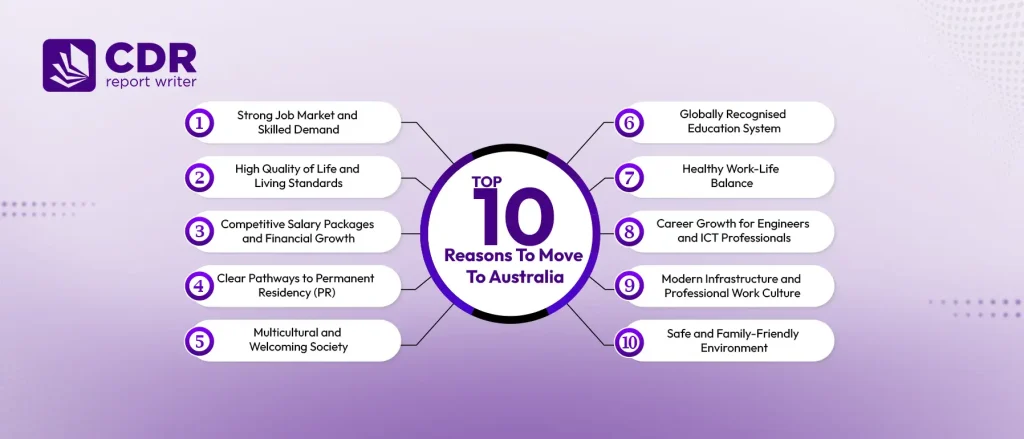
1. Strong Job Market and Skilled Demand
Australia has a stable and skill-based job market with consistent demand for qualified workers. The unemployment rate has recently stayed around 3.5%–4.5%, which shows a strong employment environment compared to many other developed countries.
Key industries such as information technology, engineering, construction, and others often face skill shortages. To manage this, the Australian Government regularly updates the Skilled Occupation List (SOL), which helps skilled migrants understand which jobs are in demand and eligible for migration pathways. This structured demand system makes Australia attractive for long-term career development, especially for migrants with technical or professional qualifications.
2. High Quality of Life and Living Standards
Australia is known for offering a high standard of living with safe cities, clean surroundings, and well-developed public services. It consistently ranks in global quality of life reports due to strong healthcare, education, and overall living conditions.
Major cities such as Sydney, Melbourne, and Brisbane are often listed among the world’s most livable cities. Overall, Australia provides a secure, balanced, and high-quality lifestyle, making it a popular choice for people looking to migrate.
3. Competitive Salary Packages and Financial Growth
Australia offers strong earning potential across multiple industries. The average full-time annual salary is approximately AUD 95,000–100,000, depending on occupation and experience level.
Skilled roles in engineering, IT, and healthcare often earn significantly higher salaries, especially in senior or specialized positions. In addition to wages, employers are required to contribute around 11–12% superannuation, which supports retirement savings and long-term financial security.
4. Clear Pathways to Permanent Residency (PR)
Australia offers transparent and points-based migration pathways for skilled workers through visa subclasses such as 189 (Skilled Independent), 190 (State Nominated), and 491 (Regional Visa). These pathways are designed to help skilled professionals move through a clear immigration process based on eligibility and demand.
The system evaluates applicants on key factors like age, education, work experience, English proficiency, and occupation demand. You can better understand your eligibility using the Australia PR points calculator, which helps estimate your score based on the official points system.
5. Multicultural and Welcoming Society
Australia has a diverse population with people from many cultural backgrounds. New migrants can find migrant communities, cultural events, international food, language diversity, and student or worker support networks. This multicultural environment can make settlement easier for new arrivals.
6. Globally Recognised Education System
Australia has a strong and globally respected education system with more than 40 universities, many ranked among the world’s top institutions, including the University of Melbourne, UNSW Sydney, and the Australian National University. These universities are known for high academic standards, quality research, and a strong international reputation.
The education system is also highly practical and industry-focused, helping students gain real-world skills alongside academic knowledge. With a large number of international students choosing Australia each year, it remains one of the top destinations for globally recognised qualifications and strong career opportunities.
7. Healthy Work-Life Balance
Australia is well known for promoting a healthy work-life balance, where people are encouraged to maintain a good balance between work and personal life. Standard working hours, paid leave benefits, and flexible work options help employees manage their time effectively.
Many workplaces also value leisure, family time, and outdoor activities, which reduces stress and improves overall well-being. This balanced lifestyle makes Australia attractive for professionals seeking both career growth and a better quality of life.
8. Career Growth for Engineers and ICT Professionals
Australia offers strong career growth opportunities for engineers and ICT professionals in sectors such as construction, infrastructure, mining, energy, software development, cybersecurity, cloud computing, networking and data analytics. Skilled professionals with relevant qualifications and experience may find opportunities in both major cities and regional areas, depending on labour demand and industry needs.
Depending on their qualification pathway, engineers may require a CDR report, and ICT applicants without suitable qualifications may need an RPL report. This makes proper document preparation important before starting the skilled migration process.
9. Modern Infrastructure and Professional Work Culture
Australia offers modern infrastructure, organised cities, reliable transport systems, and well-developed business environments. These factors make daily life easier for migrants and support professional growth across different industries.
The professional work culture in Australia also focuses on safety, communication, teamwork and work-life balance. For engineers, ICT professionals and other skilled workers, this creates a strong environment to apply technical knowledge, follow international standards and build long-term career experience in a developed economy.
10. Safe and Family-Friendly Environment
Australia is widely considered a safe and family-friendly country, with secure neighbourhoods, strong healthcare services, and high-quality education systems. It provides a supportive environment where families can live, study, and grow with confidence.
Both cities and regional areas offer parks, recreational spaces, sports facilities, and community activities suitable for children and adults. While the cost of living varies by location, many families choose Australia for its balanced lifestyle, strong public infrastructure, and long-term settlement opportunities
How to Migrate to Australia Through Skilled Migration?
To migrate to Australia through skilled migration, you need to first check if your occupation is on the SOL, complete a skills assessment, meet the required points score, and submit an Expression of Interest (EOI).
Step 1: Check Your Eligibility
Check whether your occupation is on the skilled occupation list and choose the correct ANZSCO code.
Step 2: Choose the Right Visa Pathway
Select a suitable visa option, such as 189, 190, 491, or an employer-sponsored visa.
Step 3: Complete Your Skills Assessment
Apply to the right assessment authority. Engineers may need Engineers Australia, while ICT professionals may need ACS.
Step 4: Prepare and Submit Your EOI
Prepare your documents, check your points, and submit an Expression of Interest through SkillSelect.
Step 5: Apply After Invitation
Once invited, lodge your visa application with the required documents, fees, health checks, and character checks.
Challenges to Consider Before Moving to Australia
Moving to Australia offers many opportunities, but it also comes with certain challenges, including the high cost of living in major cities, competitive job markets, strict visa and PR requirements, and skill assessment processes.
1. High Cost of Living: Major cities like Sydney, Melbourne, Brisbane, and Perth can be expensive. Rent, groceries, transport, childcare, and daily expenses may be high, especially for new migrants without a stable job.
2. Competitive Housing Market: Finding a rental home can take time in popular cities. New migrants may need to prepare enough savings, documents, and temporary accommodation before arriving.
3. Strict Visa Requirements: Australia’s visa system can be complex due to detailed eligibility requirements, documentation processes, and points-based assessments. Applicants must check their occupation eligibility, English requirement, age limit, work experience, and visa conditions before applying.
4. Skills Assessment Process: Many skilled applicants need a positive skills assessment. Engineers may need an Engineers Australia assessment, while ICT professionals may need an ACS assessment. Preparing the wrong documents can delay the process.
5. Job Search Challenges: Having overseas experience does not always guarantee an immediate job in Australia. Some employers may prefer local experience, Australian references, or knowledge of local standards.
6. Changing Migration Rules: Occupation lists, visa requirements, state nomination rules, and skills assessment guidelines can change. Applicants should always check official sources before making a final decision.
Things to Check Before Moving to Australia
Before moving to Australia, you must check your visa eligibility, skills assessment requirements, occupation demand, English language proficiency, cost of living, job opportunities, and healthcare access.
- Occupation Eligibility: Check whether your occupation is listed for skilled migration before planning your application.
- Correct ANZSCO Code: Choose the ANZSCO code that best matches your education, work experience, and daily job duties.
- Visa Pathway: Check which visa suits your profile, such as skilled independent, state-nominated, regional, or employer-sponsored visas.
- Points Score: Review your points based on age, English level, education, work experience, partner points, and nomination options.
- Document Readiness: Prepare your passport, academic certificates, English test result, employment reference letters, payslips, tax records, and work evidence.
- Job Market: Check the demand for your occupation and understand whether employers require Australian experience, licences, or local knowledge.
- Healthcare Access: Check whether you are eligible for Medicare or need private health insurance based on your visa type.
- Settlement Plan: Plan your temporary accommodation, transport, banking, phone connection, school enrolment, and emergency savings before arrival.
Frequently Asked Questions
1. Do Engineers Need a CDR to Move to Australia?
Not all engineers need a CDR to move to Australia. A CDR is usually required when Engineers Australia assesses a non-accredited qualification. Applicants with qualifications accredited under the Washington, Sydney, or Dublin Accord may not need a CDR.
2. Can Moving to Australia Lead to Permanent Residency?
Yes, moving to Australia can lead to permanent residency for eligible applicants. Options include skilled independent, state-nominated, regional, and employer-sponsored visas. Eligibility depends on occupation, points, skills assessment, English ability, experience, and visa conditions.
3. Which City Is Best to Move to in Australia?
The best Australian city depends on your career, budget, lifestyle, and visa goals. Sydney and Melbourne offer broad job markets but usually have higher living costs.
Brisbane, Perth, Adelaide, and Canberra can provide lower costs and strong job prospects. Regional areas may also support state nomination and additional migration points.
4. Do I Need a Job Offer Before Moving to Australia?
No, a job offer is not always required before moving to Australia. Independent and state-nominated skilled visas may allow applications without employer sponsorship.
Employer-sponsored visa categories usually require a valid offer from an Australian employer.