
You may know your ICT projects, tools, and responsibilities well. However, matching them with the right Australian Computer Society (ACS) occupation can still feel confusing. Your job title may say one thing, while your daily tasks show something more specific. In some cases, your qualification may also point to a different assessment pathway.
That is why you need a clear view of the ACS process before moving ahead. It helps you understand your pathway, evidence, and next steps before preparing documents for ACS skill assessment.
In this guide, you will walk through the key ACS Migration Skills Assessment Australia steps, requirements, mistakes, and outcome options.
Key Takeaways
- ACS Skills Assessment reviews your ICT qualification, technical skills, and work experience against your nominated migration occupation.
- Eligibility depends on a clear match between your occupation, education, experience, pathway, and selected ANZSCO code.
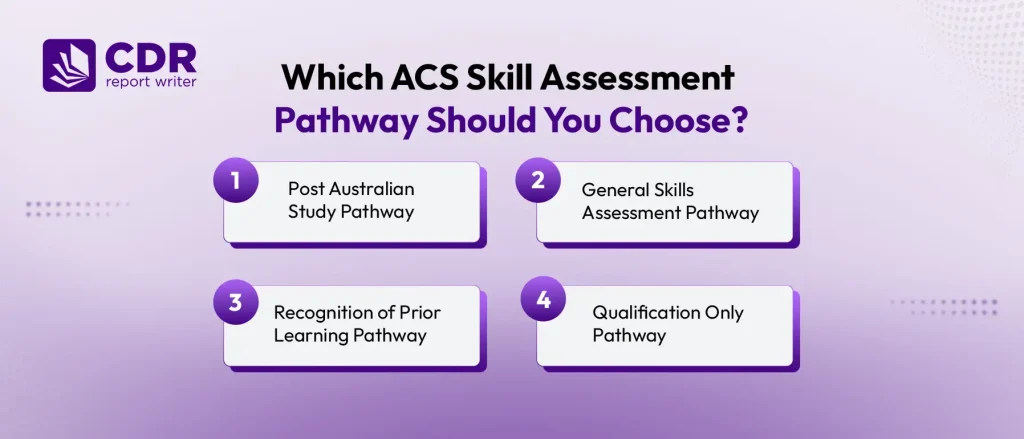
- ACS pathways include Post Australian Study, General Skills, Recognition of Prior Learning, and Qualification Only. Each pathway suits a different applicant background.
- ACS checks your identity, qualification level, ICT content, work experience, and ANZSCO occupation alignment.
- Requirements vary by pathway and may include identity records, academic evidence, employment proof, RPL reports, and Professional Year records.
- ACS RPL guidance helps you review project evidence, ANZSCO alignment, technical details, and your self-prepared RPL report.
- Strong preparation requires the correct pathway, suitable occupation, complete evidence, accurate details, and careful outcome review.
- ACS processing times depend on the pathway, document quality, payment status, and additional information requests.
- Common mistakes include incorrect pathway selection, weak ANZSCO matching, unclear employment proof, missing ICT content, and generic RPL evidence.
What is the ACS Skills Assessment?
ACS Skills Assessment is a migration skills review conducted by the Australian Computer Society to check whether an applicant’s Information and Communication Technology (ICT) qualification, technical skills, and work experience match Australian migration standards. It helps applicants show that their background supports the ICT occupation they want to nominate.
ACS acts as the official assessing authority for many ICT occupations in Australia. When an applicant does not hold a closely related ICT qualification, a Recognition of Prior Learning (RPL) report helps present practical ICT knowledge, project involvement, tools used, and problem-solving experience.
This assessment applies to ICT professionals planning skilled migration to Australia. Software Engineers, Developer Programmers, ICT Business Analysts, Cyber Security Specialists, and other ICT applicants may need it to support their nominated occupation.
What are the Eligibility Criteria for ACS Skill Assessment?
To qualify for ACS skill assessment, an applicant must show that their ICT occupation, education, work experience, and selected pathway connect clearly. The nominated ANZSCO code should also match their real technical tasks, tools, projects, and professional background.
1. Select an ACS-assessed ICT occupation: Choose an ICT occupation that ACS assesses under IT, Data Science, or Cyber Security. The selected role should match the applicant’s actual skills, not only their job title.
2. Choose the right assessment pathway: Select the ACS assessment pathway that fits the applicant’s background. Temporary Graduate, Post Australian Study, General Skills, and RPL apply to different qualification and experience profiles.
3. Provide qualification evidence: Provide academic records that support the selected pathway. Degrees, diplomas, transcripts, or course details should show ICT learning related to the nominated occupation.
4. Show valid work experience: Submit employment records that show job title, work dates, duties, tools used, and ICT responsibilities. The evidence should prove that the applicant performed work related to the chosen ANZSCO code.
5. Align your ANZSCO occupation: Match the ANZSCO code with real work history, technical tasks, projects, and professional responsibilities. A weak occupation match can make the ACS profile unclear.
Which ACS Skill Assessment Pathway Should You Choose?
1. Post Australian Study Pathway
The Post Australian Study Pathway suits applicants who completed an Australian bachelor’s degree or higher with an IT or Data Science major. The qualification should support the nominated occupation and match the selected ANZSCO code.
Eligibility Criteria
Applicants must meet these requirements:
- Complete an Australian bachelor’s degree or higher.
- Study a major in IT or Data Science.
- Match the qualification with the nominated ICT occupation.
- Select an ANZSCO code that fits the degree and career path.
- Complete one year of relevant ICT work experience after the degree.
- Complete the ACS Professional Year if using it instead of work experience.
- Show relevant ICT work experience of at least 20 hours per week.
Application Fee
The application fee for the Post Australian Study Pathway is AUD 1,136. Applicants pay this fee when they start the application.
2. General Skills Assessment Pathway
The General Skills Pathway suits IT, Data Science, and Cyber Security professionals with recognised qualifications and relevant work experience. ACS reviews their study background, ICT content, ANZSCO occupation, and employment history before issuing an outcome.
Eligibility Criteria
i. IT Qualification and Experience Criteria
| Applicant Profile | Occupation is Closely Related | Occupation is Not Closely Related |
| Bachelor’s degree or higher with an IT major | 2 years of relevant IT experience in the last 10 years, or 4 years anytime in the applicant’s work history | 4 years of relevant IT experience anytime in the applicant’s work history |
| Bachelor’s degree or higher with an IT minor | 5 years of relevant IT experience in the last 10 years, or 6 years anytime in the applicant’s work history | 6 years of relevant IT experience anytime in the applicant’s work history |
| Diploma, advanced diploma, or associate degree with an IT major | 5 years of relevant IT experience in the last 10 years, or 6 years anytime in the applicant’s work history | 6 years of relevant IT experience anytime in the applicant’s work history |
ii. Data Science Qualification and Experience Criteria
| AQF-Comparable Qualification | Relevance to Nominated Occupation and ANZSCO Code | Relevant Work Experience Required |
| Bachelor’s degree or higher | Major in Data Science | 2 years in the last 10 years, or 4 years anytime |
| Bachelor’s degree or higher | Major in ICT, Computer Science, Mathematics, Statistics, or Engineering | 4 years anytime |
| Bachelor’s degree or higher | Minor in Data Science | 5 years in the last 10 years, or 6 years anytime |
| Bachelor’s degree or higher | Minor in ICT, Computer Science, Mathematics, Statistics, or Engineering | 6 years anytime |
| Diploma, advanced diploma, or associate degree | Major in Data Science | 5 years in the last 10 years, or 6 years anytime |
| Diploma, advanced diploma, or associate degree | Major in ICT, Computer Science, Mathematics, Statistics, or Engineering | 6 years anytime |
Application Fee
The General Skills Pathway fee is AUD 1,498. Check the latest ACS fee page before applying, as fees may change.
3. Recognition of Prior Learning Pathway
Some ICT professionals build their careers through hands-on work instead of a closely related degree. ACS reviews their practical IT, Data Science, or Cyber Security knowledge through the RPL Pathway, using work history, project reports, and ANZSCO-linked evidence.
Eligibility Criteria
- Have 6 years of work experience in IT, Data Science, or Cyber Security.
- Do not hold a closely related ICT qualification.
- Show recent ICT work, with the latest role active or completed within the last 2 years.
- Provide proof of paid ICT work for at least 20 hours per week.
- Prepare two RPL project reports from real ICT projects.
- Match their work evidence and project reports with the nominated ANZSCO code.
Application Fee
The RPL Pathway fee is AUD 625. Check the latest ACS fee page before applying, as fees may change.
4. Qualification Only Pathway
The Qualification Only Pathway focuses on an Australian qualification instead of work experience. ACS uses this pathway when applicants need a qualification-based outcome for the Temporary Graduate 485 Post-Vocational Education Work stream or Professional Year Program enrolment.
Eligibility Criteria
- Complete an Australian diploma or associate degree from an Australian education provider.
- Hold a major in IT, Data Science, or Cyber Security.
- Choose a nominated occupation that closely matches the qualification and ANZSCO code.
- Use the outcome for the Temporary Graduate 485 Post-Vocational Education Work stream.
- Hold an Australian bachelor’s degree or higher when applying for Professional Year Program enrolment.
- Need ACS to confirm the ICT content of the Australian qualification.
Application Fee
The Qualification Only Pathway fee is AUD 625. Check the latest ACS fee page before applying, as fees may change.
Note: ACS only reviews the qualification for this pathway. The Department of Home Affairs decides whether the applicant meets the Temporary Graduate visa study requirements.
How Does ACS Assess ICT Skills?
The ACS assessment process goes beyond job titles. It checks identity, qualifications, ICT content, work experience, and ANZSCO fit before issuing an outcome for the nominated occupation
Step 1: Verify Applicant Identity
ACS verifies the applicant’s personal details through identity documents. This step connects the application name with qualification records, employment documents, and supporting evidence.
Step 2: Review Qualification Level
The ACS skills assessment compares the applicant’s academic award with the Australian Qualifications Framework. This review confirms whether the degree, diploma, or certificate meets the level required for the selected pathway.
Step 3: Check ICT Course Content
The ACS assessment process checks the subjects, units, or modules studied in the qualification. This review shows whether the course includes enough ICT learning to support the nominated occupation.
Step 4: Review ICT Work Experience
ACS reviews employment records, job duties, work dates, and professional responsibilities. This step confirms whether the applicant performed ICT tasks that match the selected ANZSCO code.
Step 5: Issue the ACS Outcome
The ACS migration skill assessment ends with an assessment outcome letter. The letter states whether the applicant’s ICT background supports the nominated occupation for migration purposes.
What Are the Key Requirements for ACS Skill Assessment?
The ACS skill assessment process uses different evidence for different pathways. Applicants should prepare records that prove identity, ICT study, paid employment, recent professional activity, or RPL-based project experience.
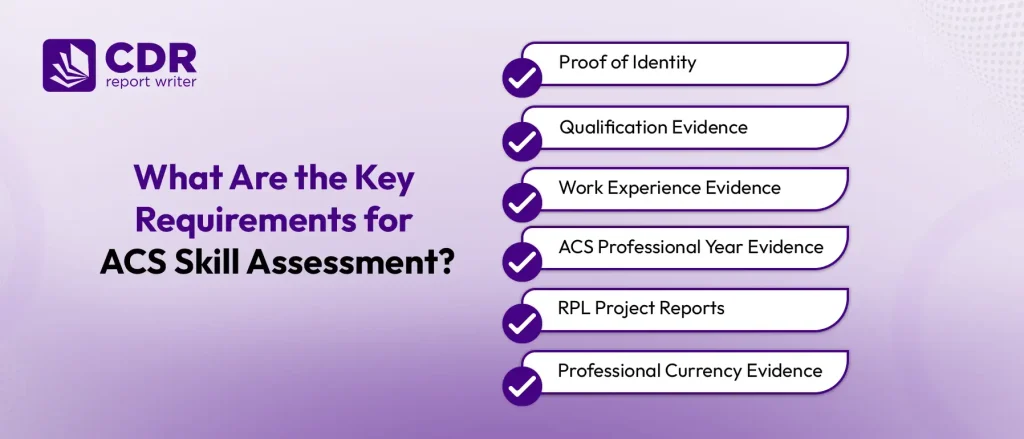
1. Proof of Identity: ACS uses identity records to confirm that the application belongs to the right person. It may include:
- Passport
- National identity card
- Driver’s licence
- Birth certificate
- Name change document, if applicable
2. Qualification Evidence: ACS reviews academic records to understand the applicant’s qualification level, study area, and ICT course content. It may include:
- Degree certificate
- Diploma or advanced diploma certificate
- Academic transcript
- Completion letter
- Course syllabus or subject details
- Vendor certification, only where ACS accepts it
3. Work Experience Evidence: ACS uses employment records to verify paid ICT work, job duties, weekly hours, and relevance to the nominated ANZSCO code. It consists:
- Employment reference letter
- Job title and employment dates
- Weekly working hours
- ICT duties and responsibilities
- Salary or payment proof
- Employer contact details
- Payslips, tax records, or bank statements
- Statutory declaration, if an employer reference is unavailable
4. ACS Professional Year Evidence: Applicants can use a completed Professional Year when the selected pathway accepts it instead of work experience. It includes:
- Professional Year completion certificate
- Program provider details
- Completion date
- Applicant name matching ACS records
5. RPL Project Reports: These reports explain how applicants use ICT knowledge in real projects. They cover the project role, tools, tasks, challenges, and technical solutions.
- Completed ACS RPL form
- Two project reports
- One recent project from the last 2 years
- One project from the last 4 years
- Project role, tools, tasks, and challenges
- Evidence linked to the nominated ANZSCO code
6. Professional Currency Evidence: ACS uses professional currency evidence to check recent ICT activity, current tools, and ongoing professional practice. It may include:
- Current ICT employment evidence
- Recent ICT training
- Professional development records
- Accepted vendor certifications, where relevant
- Recent project involvement
- Evidence linked to the nominated ANZSCO code
How to Prepare for ACS Skill Assessment?
A strong ACS application preparation starts with a clear pathway, correct occupation code, and relevant evidence. When these details align, applicants can prepare their skills assessment request with less confusion.
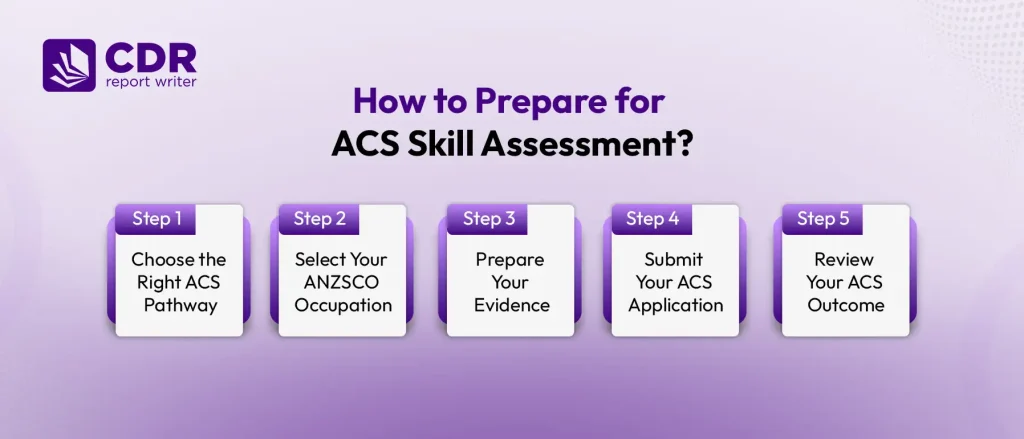
Step 1: Choose the Right ACS Pathway
Match the assessment pathway with the applicant’s study and work background. Post Australian Study, General Skills, Qualification Only, and Recognition of Prior Learning suit different profiles.
Step 2: Select Your ANZSCO Occupation
Choose an ANZSCO occupation that reflects the applicant’s real ICT role. Match the code with daily tasks, tools used, project work, and employment history.
Step 3: Prepare Your Evidence
Collect documents that support the selected pathway. Include identity records, qualification evidence, employment proof, RPL project reports, or Professional Year records where required.
Step 4: Submit Your ACS Application
Complete the ACS online application with accurate personal, qualification, employment, and occupation details. Upload clear documents before paying the application fee.
Step 5: Review Your ACS Outcome
Check the ACS outcome letter once the result arrives. Review the nominated occupation, result status, skill date, and any notes before planning the next migration step.
Note: ACS processing time varies by pathway, document completeness, payment status, and requests for additional information.
What Mistakes Can Affect ACS Skill Assessment?
If you are checking what can affect an ACS skills assessment, look at the pathway choice and ANZSCO match first. Weak employment proof and generic RPL project details can also make the ICT profile unclear.
1. Choosing the Wrong ACS Pathway: The wrong pathway can create confusion from the beginning. Applicants should match their education and work history with the ACS route that fits their actual ICT background.
2. Selecting a Poor ANZSCO Match: A weak ANZSCO match can make the job role look unclear. The selected code should reflect the applicant’s real tasks, tools, projects, and technical experience.
3. Submitting Weak Employment Evidence: Weak employment records can make paid ICT work difficult to verify. Clear references should show job title, work dates, weekly hours, ICT duties, employer details, and payment proof.
4. Missing ICT Content in Qualification Evidence: Incomplete academic records can make the ICT study area unclear. Transcripts, course details, and certificates should show how the qualification supports the nominated occupation.
5. Preparing Generic RPL Project Reports: Generic RPL content can make practical ICT experience look weak. Each project report should explain the applicant’s role, tools used, tasks completed, problems solved, and project results.
Frequently Asked Questions
1. How Long Is an ACS Skills Assessment Outcome Valid?
An ACS Skills Assessment outcome is valid for two years from its issue date. You can use a suitable outcome letter as assessment evidence during that period.
2. Can You Apply for an ACS Skills Assessment With More Than One ANZSCO Code?
Yes, you can select up to three ANZSCO codes in one ACS Migration Skills Assessment application. ACS reviews each nominated ICT occupation separately against your submitted evidence.
3. What Happens if ACS Gives an Unsuitable Outcome?
An unsuitable outcome means ACS found your evidence insufficient for the nominated occupation. Review the stated reason and request an appeal within the allowed timeframe.
Your appeal should address each issue listed in the outcome letter.
4. Does ACS Require an English Language Test for Skills Assessment?
No, ACS does not usually assess English ability during the skills assessment. English test requirements generally apply to visa rules.
Check the requirements for your intended visa subclass separately.
5. Can You Update an ACS Application After Submission?
Submit complete evidence before lodging your ACS Skills Assessment application. ACS may accept additional documents only when it requests more information during the review.