
Planning to migrate to Australia as an ICT professional, but unsure how long the ACS Skills Assessment will take? You’re not alone. Many applicants face uncertainty when planning their migration pathway because ACS processing times can vary depending on the assessment type, application complexity, and supporting documents.
As a result, this uncertainty can affect your visa timeline, Expression of Interest (EOI) submission, document validity, and overall migration planning. Therefore, understanding the ACS Skill Assessment processing time can help you set realistic expectations, avoid unnecessary setbacks, and prepare your application more effectively.
In this guide, you’ll learn about processing time for ACS skills assessment, including standard assessment timelines, priority processing options, and factors that affect processing time.
Key Takeaways
- The ACS skill assessment processing time is the period taken to evaluate your ICT qualifications, work experience, and documents for Australian skilled migration.
- ACS Skill Assessment usually takes 4 to 6 weeks, while simple Migration Skills Assessment (MSA) cases can be completed in as little as 15 days.
- The ACS Skill Assessment processing works by first selecting the correct assessment pathway, then preparing all required documents, and finally submitting the completed application online through the ACS portal.
- The documents required to ensure faster ACS Skill Assessment processing time include employment reference letters, payslips, tax records, identity documents, and any supporting evidence that clearly verifies ICT work experience and skills.
- ACS fees start around AUD 625+, vary by pathway, and depend on the type of assessment selected.
- A positive ACS outcome is valid for 2 years and can be used for skilled migration applications.
What is the ACS Skill Assessment Processing Time?
The ACS Skill Assessment processing time is the period the Australian Computer Society (ACS) takes to review your ICT qualifications, work experience, identity documents, and supporting evidence before issuing an assessment outcome.
An ACS Skills Assessment is a mandatory requirement for many ICT professionals, including those working in IT, Data Science, Cyber Security, Software Development, and related occupations who wish to apply for skilled migration to Australia. The assessment verifies whether your qualifications and employment experience meet Australian standards for your nominated occupation.
How Long Does ACS Take for Skill Assessment?
ACS Skill Assessment processing time is usually around 4 to 6 weeks for complete applications that do not require any additional documents or further clarification. In some cases, the new Migration Skills Assessment (MSA) pathway can deliver faster outcomes, with results issued in 15 days.
Applicants applying for the ACS Migration Skills Assessment are automatically given priority processing if their Australian visa deadline is within 12 weeks from the date of application, ensuring faster handling of urgent cases. However, this timeframe should be considered an estimate rather than a guarantee. The actual processing time can vary depending on application complexity, document quality, and whether ACS requests further information during the assessment.
ACS Skill Assessment Processing Time at a Glance
Here is the quick overview of ACS Skill Assessment processing time: most standard applications take around 4 to 6 weeks to complete, while simple MSA cases can be processed faster, depending on document quality and application accuracy.
| Assessment Type | Processing Time | Key Details |
| Standard Application | 4–6 weeks | For complete applications with no additional document requests |
| Migration Skills Assessment (MSA) | Up to 15 days | Possible for straightforward applications with fully complete and accurate documents |
| Priority Processing | Fast-tracked (varies) | Automatically applied if the visa deadline is within 12 weeks of the application date |
| RPL Applications | Longer than standard | Requires a detailed review of prior learning and work experience |
| Delayed Applications | Beyond standard time | Occurs if ACS requests additional documents or verification |
How ACS Skill Assessment Processing Works?
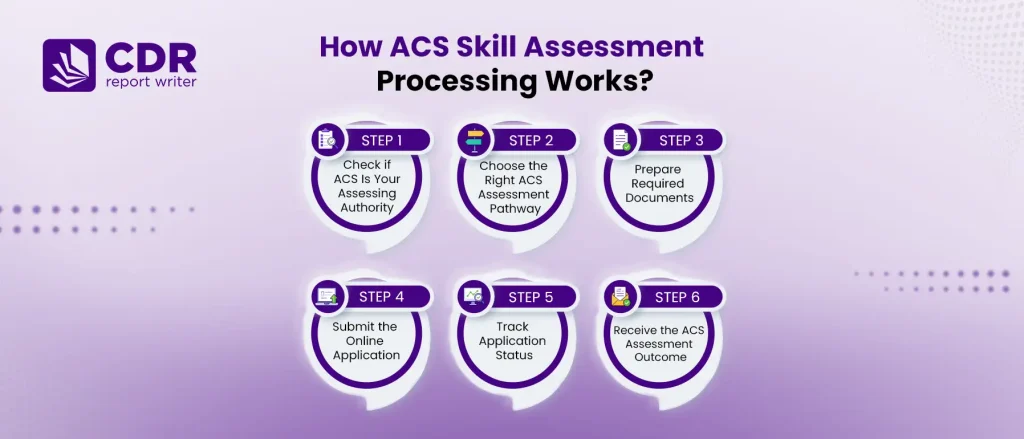
The ACS Skill Assessment process starts by confirming whether ACS is the correct assessing authority, followed by selecting the right assessment pathway. Applicants then prepare the required documents and submit the online application. After submission, they can track the application status and finally receive the ACS assessment outcome.
Step 1: Check if ACS Is Your Assessing Authority
Before starting the application, applicants must confirm that ACS assesses their nominated occupation. ACS assesses selected IT, Data Science, and Cyber Security occupations for skilled migration purposes. The applicant should check the occupation title, ANZSCO code, and occupation description before applying.
Step 2: Choose the Right ACS Assessment Pathway
The next step is selecting the correct assessment pathway. The right pathway depends on the applicant’s qualification, work experience, Australian study history, and whether they have formal ICT qualifications. The main ACS pathways include Qualification Only, Post Australian Study, General Skills, and Recognition of Prior Learning.
| ACS Pathway | Best Suited For | Approximated Processing Time |
| Qualification Only | Applicants who need a qualification assessment only | Usually closer to the standard timeframe if academic evidence is complete |
| Post Australian Study | Applicants with an Australian bachelor’s degree or higher, and required experience or Professional Year evidence | May follow the standard timeframe if qualification and experience documents are clear |
| General Skills | Applicants with Australian or overseas qualifications and relevant ICT work experience | May take longer than qualification-only cases because both education and employment are reviewed |
| Recognition of Prior Learning (RPL) | Applicants who need to prove ICT knowledge through RPL reports and professional experience | May take longer if RPL reports, project details, or employment evidence need closer review |
Step 3: Prepare Required Documents
Applicants must prepare documents based on the selected pathway. Common documents include proof of identity, academic evidence, employment references, payment evidence, and pathway-specific documents.
RPL applicants need extra RPL project reports and professional currency evidence. These documents should clearly show the applicant’s own ICT knowledge, responsibilities, problem-solving ability, and professional experience.
Step 4: Submit the Online Application
The ACS Migration Skills Assessment application is submitted online through the ACS portal. Applicants must enter personal information, qualification details, employment history, and occupation-related details accurately.
The portal may recommend ANZSCO codes based on the applicant’s skills, but the applicant is still responsible for ensuring the information is true, accurate, and complete.
Step 5: Track Application Status
After submission, applicants receive confirmation and can track their ACS application status through the applicant dashboard. The dashboard helps applicants monitor the progress of their assessment and respond if ACS requires any further information.
Step 6: Receive the ACS Assessment Outcome
Once ACS completes the assessment, the applicant receives the outcome letter in PDF format. A suitable ACS outcome can be used as official evidence for the Department of Home Affairs as proof of a successful skills assessment during the skilled migration process in Australia.
The outcome may include details related to the nominated occupation, skill level requirement met date, and suitability result. If the outcome is unsuitable, the applicant may need to review the reason and consider appeal or reapplication options.
What Affects ACS Skill Assessment Processing Time?
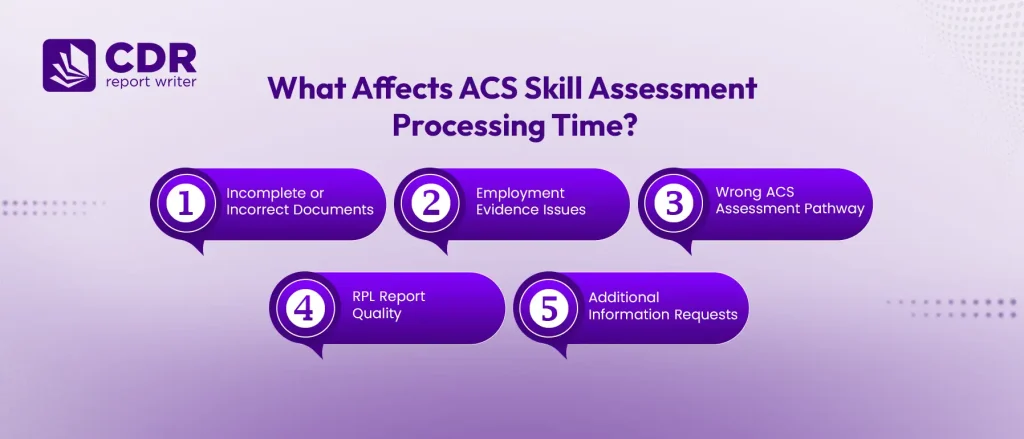
The processing time for ACS skills assessment depends on several important factors, including the completeness and accuracy of your application and the quality of supporting documents. It also depends on whether ACS requires additional information or employment verification during the review process.
Documents to Ensure Faster ACS Skill Assessment Processing Time
The documents required for ACS Skill Assessment processing time include identity documents, academic documents, payslips, tax records, and any other supporting evidence that clearly verifies your skills and work experience.
1. Incomplete or Incorrect Documents
Incomplete documents can slow down the ACS assessment because the assessor may not have enough information to complete the review. Common document issues include missing pages, wrong file format, unclear scans, name mismatch, missing translations, incomplete academic transcripts, and missing completion letters.
Applicants should make sure that every uploaded document is readable, complete, correctly named, and consistent with the details entered in the ACS portal.
2. Employment Evidence Issues
Employment evidence is an important part of the ACS skill assessment for General Skills, Post Australian Study, and RPL applicants. Weak or incomplete employment documents can delay processing or affect the final outcome.
Common employment evidence issues include missing reference letters, incomplete job duties, missing payment evidence, incorrect employment dates, unclear job titles, and duties that do not match the nominated ANZSCO code.
3. Wrong ACS Assessment Pathway
Choosing the wrong ACS pathway can cause processing issues because each pathway has different eligibility requirements and document expectations. For example, an applicant with insufficient ICT qualifications may need the RPL pathway, while an applicant with a relevant qualification and employment history may fit the General Skills pathway.
Applicants should compare their qualifications, employment history, and migration purpose before choosing the pathway.
4. RPL Report Quality
Weak RPL reports often fail because they describe general job duties instead of explaining real ICT problem-solving. Common RPL issues include no clear personal contribution, limited technical explanation, poor connection to the nominated occupation, and lack of evidence showing professional ICT knowledge.
A strong RPL report should show the problem the applicant solved, the system or project involved, the technologies used, the decisions the applicant made, and the outcome achieved.
5. Additional Information Requests
If ACS requires extra documents or clarification during the assessment process, the application is temporarily placed on hold until the applicant responds with the requested information. This pause directly affects the overall processing time, as the assessment cannot continue until all required details are provided.
Need Help With Your ACS Skill Assessment?
Get expert help to review your ACS pathway, ANZSCO code, RPL report and other documents before submission to avoid delays and strengthen your application.
What Are the ACS Skill Assessment Fees and Costs?
The ACS Skill Assessment fees vary depending on the application type and pathway. A Temporary Graduate application usually costs around AUD 625, while General Skills and Post Australian Study applications are higher due to a more detailed evaluation process.
Below are the ACS Skill Assessment Fees by Pathway:
| Assessment Pathway | New Fee (Excl. GST) (AUD) |
| Temporary Graduate | $625 |
| Post Australian Study | $1,136 |
| General Skills | $1,498 |
| Recognition of Prior Learning (RPL) | $625 |
| Appeal Level 1 | $516 |
| Appeal Level 2 | $620 |
Note: These fees are exclusive of GST and may change over time. Applicants should always check the official ACS website before submitting their application.
ACS Skill Assessment Outcome Validity and Reapplication
A positive ACS Skill Assessment outcome is valid for 2 years from the date of issue and can be used as supporting evidence for the Department of Home Affairs or other relevant Australian government authorities during the skilled migration process.
If your ACS outcome expires before you submit your visa application, you will need to submit a new Migration Skills Assessment application through the ACS member portal. A new application usually takes around 4 to 6 weeks for complete submissions. In some cases, under the updated ACS MSA system, eligible applications may be processed faster, with outcomes issued in as little as 15 days for straightforward cases.
Frequently Asked Questions
1. Does ACS Charge Extra for Priority Processing?
No, ACS does not charge an additional fee for priority processing. It provides priority processing as a courtesy for applicants with urgent Australian visa deadlines. This service is not a paid fast-track option. It may apply when the visa deadline is less than 12 weeks from the application date.
2. Can You Submit More Documents After Applying for an ACS Skills Assessment?
No, you should submit complete documents before lodging your ACS Skills Assessment application. ACS generally does not accept additional evidence once the assessment begins. It may accept further documents when it specifically requests more information.
3. What Happens After ACS Completes the Assessment?
After completing the assessment, ACS issues an outcome letter in PDF format. You can use a suitable outcome as evidence for your Australian skilled migration application.
4. Does Early Submission Affect ACS Assessment Processing Time?
No, early submission does not guarantee faster ACS assessment processing. However, applying early gives you more time to correct document issues and respond to ACS requests. It also reduces pressure from approaching visa deadlines.
5. What Is the Fastest ACS Skills Assessment Processing Time?
The fastest ACS Skills Assessment processing time may be around 15 days under the Migration Skills Assessment pathway. However, actual processing times depend on application complexity, document quality, and verification requirements.