
Preparing a Competency Demonstration Report (CDR) can feel confusing when every component serves a different assessment purpose. Many applicants struggle to connect their engineering experience with the required competencies.
Unclear Career Episodes, weak competency mapping, or inconsistent evidence can make the report difficult to assess. These gaps can also hide the applicant’s actual engineering contribution.
In this blog, you will learn what a CDR report includes and what each section should demonstrate. You will also understand how the complete report presents your engineering competency.
Key Takeaways
- A CDR presents personal engineering evidence showing how an applicant meets Engineers Australia’s competency standards.
- Engineers Australia uses the CDR pathway when qualification accreditation cannot confirm competency for the nominated occupation.
- Applicants with non-accredited qualifications, different occupation claims, or Engineering Manager nominations commonly require a CDR.
- A complete CDR includes three Career Episodes, one Summary Statement, and one Continuing Professional Development record.
- Applicants must demonstrate technical knowledge, problem-solving, personal contribution, communication, and professional responsibility through genuine engineering work.
- A CDR proves engineering competency, while supporting documents verify identity, qualifications, employment, and other application details.
- Job descriptions, team achievements, certificates, and copied content cannot replace evidence of personal engineering competency.
- A final review should confirm component completeness, accurate mapping, consistent details, required evidence, and original authorship.
What is a Competency Demonstration Report?
A Competency Demonstration Report (CDR) is a structured assessment document showing how an applicant meets Engineers Australia’s competency standards. It focuses on the applicant’s engineering activities to demonstrate technical knowledge, problem-solving, decision-making, and professional responsibility.
The CDR pathway mainly applies when an engineering qualification is not recognised through an accredited pathway. Applicants then use the CDR to demonstrate their competencies through individual skill assessment. It may also apply to different occupation claims and Engineering Manager applications.
Engineers Australia is authorised by the Department of Home Affairs to assess engineering qualifications, skills, and experience for migration. Under the CDR pathway, EA compares each applicant’s evidence with standards for their nominated engineering occupation.
Why Does Engineers Australia Use the CDR Pathway?
Engineers Australia uses the CDR pathway when your qualification alone cannot confirm the competencies required for your nominated occupation. Through the CDR, you can show exactly how your engineering knowledge, decisions, and responsibilities meet required standards to migrate to Australia as an engineer.
1. Assessment of non-accredited qualifications: The pathway allows applicants to demonstrate competency when their engineering qualification lacks recognised accreditation.
2. Assessment for another occupation: A CDR supports applicants nominating an occupation that differs from their accredited qualification.
3. Review of personal engineering competency: EA examines technical knowledge, problem-solving, decisions, communication, and professional responsibility.
4. Comparison against occupational standards: Your evidence must align with the competency standards for the nominated engineering occupation.
5. Individual evidence-based assessment: The pathway gives applicants from different backgrounds a structured route to demonstrate engineering capability.
Who Needs a Competency Demonstration Report?
You need a CDR when your qualification does not fit an accredited assessment pathway. Engineers Australia may also require a CDR for specific occupation-based applications.
1. Applicants With Non-Accredited Engineering Qualifications
A non-accredited qualification usually places your application under the Engineers Australia CDR pathway. Your engineering CDR must then demonstrate your knowledge, skills, and professional competency.
This pathway does not suggest that your qualification lacks value. It allows EA to assess your capabilities through detailed engineering evidence.
2. Applicants Nominating a Different Engineering Occupation
Your accredited qualification may relate to a different discipline than your nominated engineering occupation. A CDR report can connect your relevant experience with the new occupation.
Career Episodes should show how your engineering activities support that occupational claim. Projects without a clear connection may weaken your competency evidence.
3. Applicants Seeking Assessment as an Engineering Manager
Engineering Manager applicants follow the CDR pathway and provide evidence of relevant skilled employment. Your report should demonstrate engineering leadership within a technical environment.
Strong evidence may include technical direction, engineering decisions, resource control, and risk management. General management duties alone cannot establish engineering management competency.
Also Read: How Much Do Engineers Earn in Australia
What Are the Main Components of a Competency Demonstration Report?
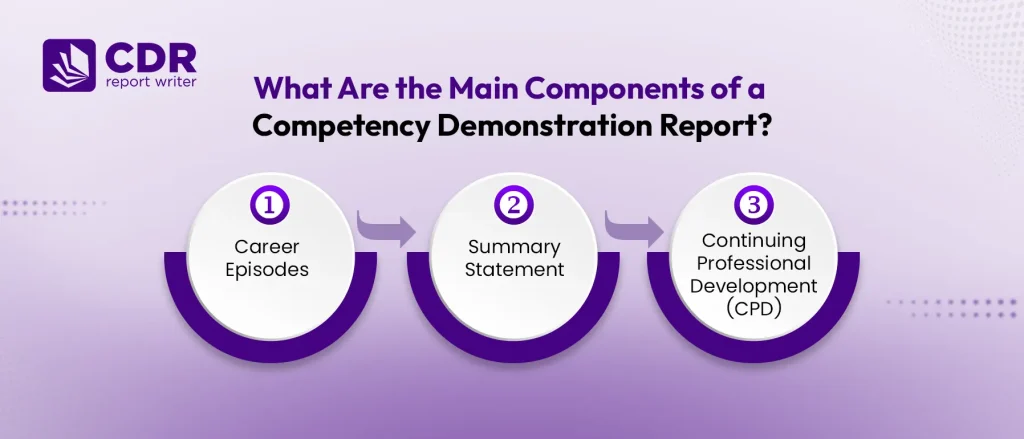
A complete CDR package brings together three Career Episodes, one Summary Statement, and a Continuing Professional Development record. Together, these sections present your engineering experience, competency evidence, and ongoing professional learning.
1. Career Episodes
Your CDR includes Career Episode 1, Career Episode 2, and Career Episode 3. Each episode describes one academic or professional engineering activity in detail.
Engineers Australia accepts between 1,000 and 2,500 words for each Career Episode. The content should focus on your personal engineering work, decisions, problem-solving, and responsibilities.
Number the paragraphs separately within each episode:
- Career Episode 1: 1.1, 1.2, 1.3
- Career Episode 2: 2.1, 2.2, 2.3
- Career Episode 3: 3.1, 3.2, 3.3
2. Summary Statement
The Summary Statement works as a competency map, not a shortened version of your Career Episodes. It connects EA’s competency elements with evidence already explained in those episodes.
For each competency element, identify the exact paragraph where your supporting evidence appears. Use references such as CE1.4, CE2.7, or CE3.5.
The brief explanation beside each reference should identify the relevant skill, decision, or engineering action. Accurate mapping helps the assessor verify your competency without searching through every episode.
3. Continuing Professional Development (CPD)
Your CPD record lists learning activities completed after your engineering qualification. It shows how you maintain and expand your professional knowledge.
Present the activities as a structured written list rather than detailed project narratives. The record may include courses, workshops, seminars, presentations, and technical reading.
| CDR Component | Core Purpose |
| Three Career Episodes | Demonstrate applied engineering knowledge and personal contribution |
| Summary Statement | Map Career Episode evidence to competencyF elements |
| CPD statement | Record continuing professional learning and development |
What Should Applicants Demonstrate Through the CDR?
Your CDR report should document how you meet the Stage 1 competency standards for your nominated occupational category. EA assesses engineering knowledge, practical application, and professional attributes through evidence from your own work.
1. Engineering Knowledge and Technical Application
Explain how you applied engineering principles, calculations, standards, software, or testing methods during specific technical activities. Connect each method with the result or decision it supported.
2. Engineering Problem-Solving and Decision-Making
Describe how you identified a technical problem, evaluated possible solutions, and selected the most suitable approach. Include the constraints, risks, and requirements that influenced your decision.
3. Personal Engineering Contribution
Clearly identify the engineering work you completed within each project. Distinguish your analyses, designs, investigations, improvements, and recommendations from the wider team’s contribution.
4. Engineering Communication and Professional Responsibility
Show how you communicated technical information and coordinated with colleagues, clients, supervisors, or other stakeholders. Explain how you addressed safety, ethics, sustainability, risk, and accountability.
5. Consistent Competency Coverage Across the CDR
Use the three Career Episodes to address every required competency element across your engineering experience. The Summary Statement should link each element to its exact supporting paragraph.
Also Read: Highest Paying Engineering Jobs in Australia
How is a CDR Different From Supporting Documents?
A CDR and supporting documents serve different purposes during the Engineers Australia skills assessment. One demonstrates competency, while the other verifies your application details.
| Comparison Area | Competency Demonstration Report | Supporting Documents |
| Main purpose | Demonstrates how you meet the required engineering competency standards. | Confirms the personal, academic, and employment details in your application. |
| What it includes | Includes three Career Episodes, one Summary Statement, and a CPD record. | Includes identity documents, academic certificates, English results, and employment records. |
| Type of evidence | Presents detailed evidence from your own engineering activities and decisions. | Provides official records that verify your qualifications, employment, and identity. |
| Engineering contribution | Explains the technical work, problem-solving, and decisions you personally completed. | Confirms where you studied or worked but does not explain your engineering contribution. |
| Role in assessment | Helps EA assess your engineering knowledge, application ability, and professional attributes. | Helps EA confirm that your submitted claims match the supporting records. |
| Can it replace the other? | A CDR cannot replace required identity, qualification, or employment documents. | Supporting documents cannot replace the competency evidence within your Career Episodes. |
Note: Engineers Australia reviews both forms of evidence together. Your CDR demonstrates competency, while supporting records confirm the facts behind your application.
What Common Misunderstandings Weaken CDR Reports?
Misunderstanding the CDR’s purpose can weaken otherwise relevant engineering evidence. These common mistakes often prevent EA from seeing your actual competency.
1. Treating the CDR as an employment record: Job titles and project duties provide background only. EA needs evidence of your technical decisions and engineering actions.
2. Considering the CDR the complete application: The CDR forms one part of the migration skills assessment. Your application also requires identity, qualification, English, and employment documents.
3. Focusing on team achievements: A successful project does not automatically prove your individual competency. Clearly identify the calculations, designs, decisions, and solutions you completed.
4. Relying only on supporting documents: Certificates and reference letters verify your qualifications or employment. They cannot replace detailed competency evidence within your Career Episodes.
5. Using work that is not your own: Every Career Episode must reflect your genuine engineering activities and original written content. Copied material can create serious plagiarism concerns.
Also Read: Fast Tract Skill Assessment
Competency Demonstration Report Review Checklist
1. Three complete Career Episodes: Include Career Episode 1, Career Episode 2, and Career Episode 3. Keep each episode between 1,000 and 2,500 words.
2. Relevant engineering activities: Base each episode on academic or professional work that demonstrates your personal engineering involvement.
3. All competency elements covered: Collectively address all 16 Stage 1 competency elements across the three Career Episodes.
4. Clear paragraph numbering: Number each Career Episode separately using references such as CE1.1, CE2.1, and CE3.1.
5. Accurate Summary Statement mapping: Link every competency element to the exact numbered paragraph containing its supporting evidence.
6. Visible personal contribution: Clearly identify your calculations, designs, analyses, decisions, investigations, and technical recommendations.
7. Complete CPD record: Include the professional learning activities that maintained or expanded your engineering knowledge.
8. Matching employment evidence: Provide an employer or supervisor reference when a Career Episode uses workplace experience.
9. Consistent application details: Check that project names, dates, employers, roles, and responsibilities match your supporting records.
10. Original applicant-authored content: Ensure the Career Episodes and Summary Statement reflect your own work and words. EA prohibits copied or third-party-written content.
Need Clear Guidance Before Preparing Your CDR?
Get professional counselling to understand the CDR structure, competency requirements, and evidence expectations. Our review team can guide your planning and improve your self-prepared draft.
Frequently Asked Questions
1. Should Career Episodes Use First-Person Language?
Yes, first-person language clearly separates your engineering contribution from the wider project team. Use “I” to identify your decisions, calculations, actions, and responsibilities.
2. Can Multiple Career Episodes Come From the Same Employer?
Yes, multiple episodes can come from one employer when each covers a distinct engineering activity. Avoid repeating the same project evidence, decisions, or competency claims.
3. Can Applicants Include Calculations, Diagrams, or Tables?
Yes, relevant calculations, diagrams, and tables can strengthen technical explanations. Connect each item with the engineering decision, method, or result it supports.
4. How Should Applicants Handle Confidential Project Information?
Protect confidential details without removing the technical substance of your engineering work. Replace sensitive names, locations, values, or identifiers with clear general descriptions.
5. Can the Same Competency Appear in More Than One Career Episode?
Yes, several episodes may demonstrate the same competency through different engineering activities. The Summary Statement should reference the clearest and strongest supporting evidence.
6. Can Review Support Change Technical Information in a CDR?
No, review support should not create projects, decisions, calculations, or competency evidence. Reviewers can improve clarity, structure, formatting, grammar, and guideline alignment.