Preparing the documents required for Competency Demonstration Report (CDR) assessment can become difficult when every record serves a different purpose. You might get confused between mandatory documents and evidence that applies only to specific circumstances.
Missing transcripts, unclear scans, and inconsistent dates can prevent Engineers Australia from verifying important claims. These gaps may also weaken an otherwise relevant Migration Skills Assessment application.
Use this checklist to organise each essential document before submission. Complete and consistent evidence supports a clear assessment, although it cannot guarantee a positive outcome.
Key Takeaways
- A complete CDR application combines identity, qualification, English, CDR, and circumstance-based supporting documents.
- The CDR package includes three Career Episodes, a Summary Statement, and a Continuing Professional Development record.
- Employees and self-employed applicants provide different evidence for a Relevant Skilled Employment Assessment.
- Clear colour scans should display every name, date, signature, stamp, and qualification detail.
- Blurred files, missing pages, mismatched dates, and incorrect references can make evidence difficult to verify.
- A final checklist helps separate mandatory documents from conditional records before submission.
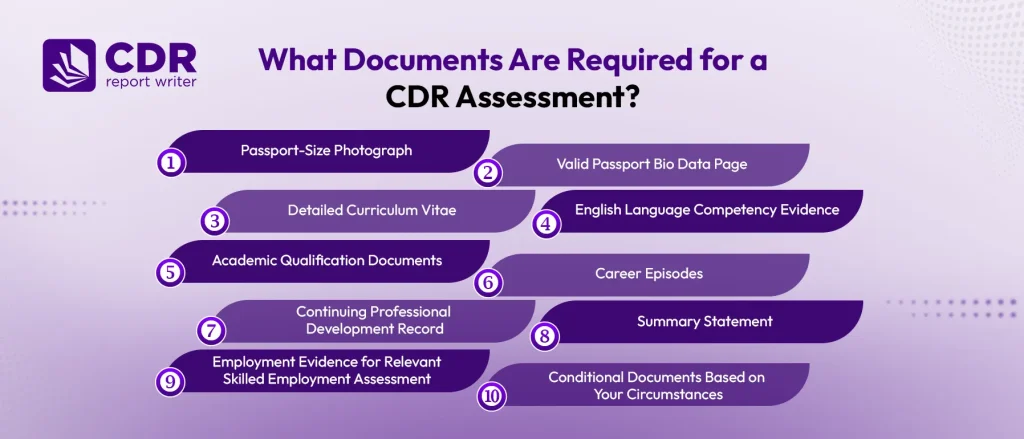
What Documents Are Required for a CDR Assessment?
A CDR assessment requires documents that confirm your identity, qualifications, English competency, and engineering capability. Engineers Australia reviews this evidence against your nominated occupation’s competency standards.
1. Passport-Size Photograph
Provide a recent, high-resolution passport-size photograph in colour that clearly reflects your current appearance. Keep your face centred, eyes open, expression neutral, and background plain white or light grey.
As a practical Australian passport-photo standard, use a photograph measuring 35–40 mm wide and 45–50 mm high. Keep it under six months old and avoid filters, retouching, shadows, glare, red-eye, head tilting, or cropped facial features.
2. Valid Passport Bio Data Page
Your passport bio data page verifies the identity used throughout your EA Migration Skills Assessment application. Provide a clear colour scan from your current passport.
The page must show your photograph, full name, birth date, nationality, passport number, and expiry date. Include legal evidence when another required document shows a different name.
3. Detailed Curriculum Vitae
A detailed CV gives EA a chronological record of your engineering education and professional experience. Include each qualification, employer, position, employment period, and main responsibility.
List every role separately and keep the dates consistent with your references and application form. Describe your actual technical duties instead of copying generic job descriptions.
4. English Language Competency Evidence
EA requires valid English language evidence unless an accepted exemption applies. For tests taken on or after 7 August 2025, applicants must meet these minimum scores:
| English Skill | IELTS Academic or General | TOEFL iBT | PTE Academic |
| Listening | 6 | 16 | 47 |
| Reading | 6 | 16 | 48 |
| Writing | 6 | 19 | 51 |
| Speaking | 6 | 19 | 54 |
EA also accepts Cambridge C1 Advanced, LANGUAGECERT Academic, Michigan English Test, and CELPIP General. Submit a valid score report with the details required for online verification.
5. Academic Qualification Documents
Academic documents allow EA to examine the engineering level and content of your qualification. Submit your final degree certificate or testamur with the complete academic transcript.
The transcript should show every subject, grade, study period, and awarded qualification. Include each qualification supporting your selected pathway and authorised translations for non-English records.
6. Career Episodes
You prepare three accounts for the CDR package: Career Episode 1, Career Episode 2, and Career Episode 3. Each episode presents one genuine academic or professional engineering activity.
Keep each Career Episode between 1,000 and 2,500 words. Explain your personal calculations, technical decisions, problem-solving, and responsibilities rather than general team achievements.
Number the paragraphs separately:
- Career Episode 1: 1.1, 1.2, 1.3
- Career Episode 2: 2.1, 2.2, 2.3
- Career Episode 3: 3.1, 3.2, 3.3
7. Continuing Professional Development Record
A Continuing Professional Development record shows how you maintained and expanded your engineering knowledge after qualification. Present it as a structured list rather than a project narrative.
Record the activity, provider, date, duration, and technical subject where applicable. Suitable entries include courses, workshops, seminars, conferences, standards, journals, presentations, and structured private study.
EA does not prescribe a fixed word count for this CDR document. It also does not require every learning activity to produce a certificate.
8. Summary Statement
The Summary Statement maps EA’s competency elements to evidence already presented within your three Career Episodes. Use the template for your nominated occupational category.
Link each element to exact paragraph references, such as CE1.4, CE2.7, or CE3.5. Briefly identify the technical action or decision demonstrated at each location.
Do not introduce new projects, responsibilities, or competency claims. Every reference must lead to evidence already explained within a Career Episode.
9. Employment Evidence for Relevant Skilled Employment Assessment
The employment evidence you submit depends on whether you worked as an employee or operated independently. Employees need employer-issued and independent records, while self-employed applicants need client, business, tax, and transaction evidence.
10. Conditional Documents Based on Your Circumstances
Conditional documents resolve specific differences or verification requirements within an application. Include only the records that apply to your circumstances.
- Different legal names: Provide a marriage certificate, deed poll, gazette notice, or official name-change record.
- Non-English documents: Upload the original document with an authorised English translation showing the translator’s details.
- Professional registration: Include a registration or licence when it supports your qualification or professional status.
- Appointed representative: Provide the required authorisation when a migration agent manages your application.
- Further verification: Supply the exact identity, qualification, employment, or competency evidence requested by EA.
Also Read: Key Engineering Occupations MLTSSL For CDR
Which Documents Support a Relevant Skilled Employment Assessment?
A Relevant Skilled Employment Assessment requires evidence for every period of engineering work you claim. Employees provide employer references and official records, while self-employed applicants provide client, invoice, tax, and business evidence.
1. Employment Evidence for Employees
Employees must provide primary and secondary documents for each claimed employment period. One evidence category cannot replace the other.
i. Primary Employment Documents
Your employer issues the reference on official company letterhead, and an authorised representative signs it to verify your role and employment period.
The letter should confirm:
- your job title
- full-time or part-time status
- hours worked
- pay rate
- commencement date
- completion date
- main engineering duties
- issuing officer’s position
- official email address
- official telephone number
- issue date
- company stamp, when applicable
ii. Secondary Employment Documents
Government departments or recognised official bodies issue the secondary records that verify your employment. These documents should cover the entire period claimed in your assessment.
Relevant records include:
- income tax statements
- tax return acknowledgements
- social security statements
- superannuation records
- retirement contribution reports
- provident fund statements
- work permits
- residence permits
- government-issued employment contracts
Note: Personal bank statements and payslips do not qualify as secondary evidence for employee claims. A CV, Career Episode, personal statement, or informal email also cannot verify employment independently. Recognised official records provide the required verification for each claimed period.
2. Employment Evidence for Self-Employed Applicants
Self-employed applicants must verify both the business operation and the engineering services delivered. Connect every claimed period with clients, invoices, and official business records.
i. Primary Documents for Self-Employment
Client or contracting organisations issue letters on official letterhead to confirm your engineering services, dates, hours, and payment arrangements. Supporting records then connect each client with the work completed across the full claimed business period.
You must also submit:
- invoices covering the claimed period
- details of engineering services delivered
- an organisational chart, when applicable
- staff numbers and occupations, when applicable
ii. Secondary Documents for Self-Employment
Official business records should confirm that your business operated throughout the claimed period. They should also align with your client and invoice evidence.
Relevant documents include:
- business registration certificates
- business tax reports
- business bank statements
- payroll tax records
- employee wage records
- personal income tax returns
- social security contributions
- retirement contribution reports
- business financial statements
- practice or compliance certificates
Note: Each document should match the employment dates, role, employer or client, and payment details stated in your application. Records should cover the full period claimed.
Also Read: Top Reasons to Move to Australia in 2026
How Should You Upload Documents to Engineers Australia?
Upload clear, complete files that show every name, date, signature, stamp, and qualification detail. EA uses these details to verify your evidence accurately.
1. Scan Original Documents in High-Resolution Colour
Create clear colour scans from original or accepted certified documents. Preserve every signature, stamp, seal, border, and security feature.
Rescan files containing shadows, glare, cropped edges, or blurred text. Do not upload a page that remains difficult to read.
2. Keep Complete Records Together
Combine all pages belonging to one transcript, certificate, or official record. Keep the pages in their original order.
Separate unrelated identity, qualification, employment, and CDR evidence. Use clear filenames that identify each document accurately.
3. Match Details Across Every Document
Compare all repeated information before submission. Correct any unexplained differences across your records.
Check these details:
- legal name
- qualification title
- institution
- study dates
- employer
- job title
- employment dates
- project dates
- nominated occupation
Use official evidence to explain legitimate differences. Never expect the assessor to interpret conflicting information.
4. Upload Original Documents With Translations
Upload the original-language record with its authorised English translation. Do not submit the translation by itself.
Ensure the translation includes the translator’s registered identification, name, and contact details. Translate every visible stamp, note, signature, and endorsement.
Upload each document once under the correct portal category. Remove duplicate versions before lodging the application.
Exclude unrelated certificates, awards, photographs, and work records. Every file should support a specific MSA requirement.
Also Read: How Much do Engineers Earn in Australia?
Which Document Errors Can Affect a CDR Assessment?
Errors in the documents required for CDR assessment can make your evidence difficult to verify. Finding them early keeps your application clear and complete.
1. Incomplete transcripts: Include every page showing subjects, grades, and study periods.
2. Unreadable scans: Replace files with cropped, blurred, dark, or reflective pages.
3. Expired English evidence: Confirm validity before lodging your assessment.
4. Unexplained name differences: Connect different names through recognised legal records.
5. Unauthorised translations: Use a translator who meets EA’s requirements.
6. Inconsistent dates: Match study, project, and employment periods across every document.
7. Generic employer references: Include specific engineering duties and verifiable contact details.
8. Incomplete employment coverage: Support the entire period claimed for assessment.
9. Incorrect evidence category: Apply employee and self-employment records to the correct claim.
10. Missing Career Episode references: Number every paragraph before completing the Summary Statement.
11. Incorrect competency mapping: Link each competency element to relevant Career Episode evidence.
12. Copied competency content: Submit only your own engineering activities and applicant-authored explanations.
Need Guidance Reviewing Your CDR Documents?
Get editing, proofreading, formatting, and guideline-alignment feedback while retaining full authorship of your CDR documents.
Frequently Asked Questions
1. Can Certified Copies Replace Original Documents in a CDR Application?
Yes, Engineers Australia accepts original documents or certified copies for a CDR application. Each uploaded copy must remain clear, complete, and readable.
2. Can You Change Your CDR Documents After Submission?
No, you cannot modify your application after submitting it through the Engineers Australia portal. Review every file carefully before completing the submission.
3. Can Engineers Australia Request Original Documents?
Yes, Engineers Australia can request original documents when an uploaded file appears unclear or contains inconsistent information. Keep your original records available throughout the assessment.
4. What Happens When Engineers Australia Finds Missing Information?
Engineers Australia usually gives you one 30-day opportunity to address identified gaps. Provide the requested information within that period to keep the assessment moving.
5. Can Someone Else Prepare Your Career Episodes or Summary Statement?
No, you must prepare your Career Episodes and Summary Statement in your own words. Engineers Australia prohibits third-party authorship, copied content, and misleading documents.