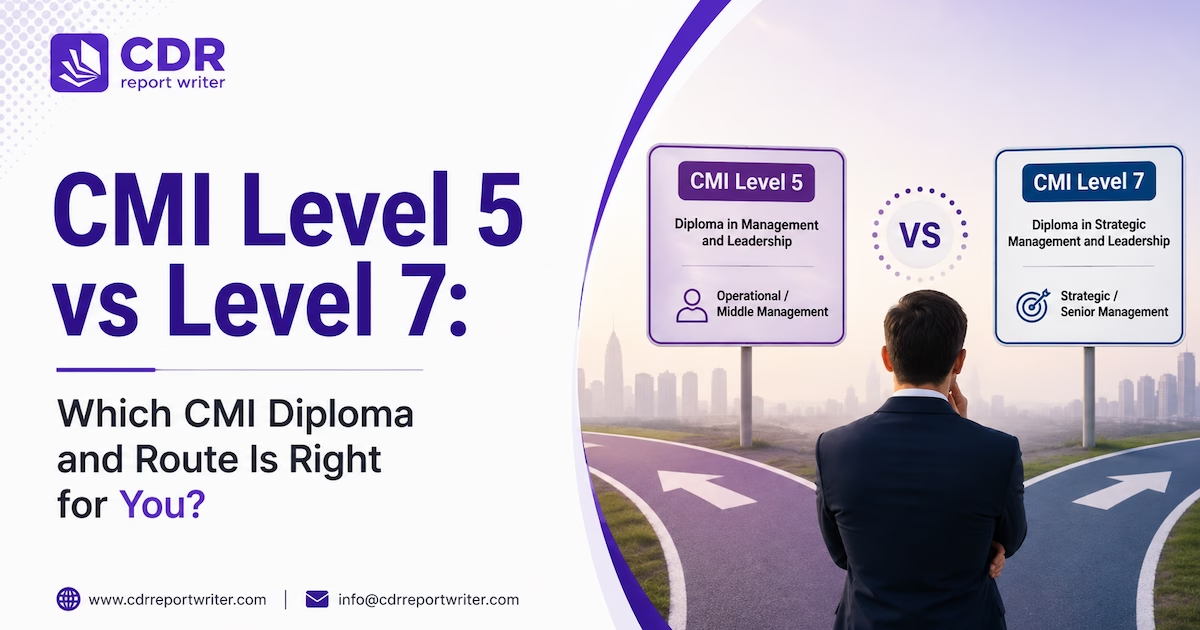
CMI Level 5 and CMI Level 7 are both Chartered Management Institute (CMI) leadership and management qualifications, but they are built for different career stages. Level 5 is mainly for middle and operational managers. Level 7 is for senior managers, directors, and strategic leaders.
The choice matters because it affects more than course enrolment. It changes the level of written work, the type of workplace evidence you need, the way employers may read the qualification, and how the qualification can support a future Chartered Manager (CMgr) route.
This guide compares the two levels in practical language: target audience, equivalency, duration, cost, Chartered Manager relevance, and what changes when you actually start writing assignments and reports.
Key Takeaways
- CMI Level 5 is usually the better fit for practising middle managers and operational leaders.
- CMI Level 7 is usually the better fit for senior managers, directors, and leaders shaping organisational strategy.
- Level 5 is broadly comparable to foundation degree or HND level; Level 7 is positioned at postgraduate level, but equivalency should be verified for any specific employer or university use.
- Both levels can support a route toward Chartered Manager status, but the qualification alone does not automatically award CMgr.
- The biggest practical difference is the evidence depth: Level 5 is more operational; Level 7 expects strategic analysis and organisation-wide impact.
Quick Answer: What’s the Difference Between CMI Level 5 and Level 7?
CMI Level 5 is designed for middle and operational managers who lead teams, projects, resources, and service delivery. CMI Level 7 is designed for senior managers and strategic leaders who influence wider organisational direction. Level 5 is broadly comparable to an intermediate undergraduate level such as a foundation degree or HND. Level 7 is positioned at postgraduate level, often compared with a Master’s, PGCert, or PGDip. The right choice depends on your current responsibility, not only your years of experience.
A useful rule is this: choose Level 5 if your evidence is mainly about managing people, operations, projects, and change inside a department or function. Choose Level 7 if your evidence is about strategy, cross-functional leadership, risk, organisational design, policy, growth, or senior decision-making.
CMI Level 5 vs Level 7 at a Glance
The table below gives a quick decision view. It is a practical comparison, not a substitute for checking the current CMI qualification page or your provider’s entry requirements.
| Dimension | CMI Level 5 | CMI Level 7 |
| Common qualification name | Diploma in Management and Leadership / Leadership and Management | Diploma in Strategic Management and Leadership Practice |
| Best fit | Middle managers, department heads, operational leaders, project or resource managers | Senior managers, directors, executives, regional or specialist leaders |
| Core focus | Team leadership, operational planning, managing change, resources, projects, stakeholders, and finance | Strategic leadership, organisational strategy, partnerships, innovation, risk, EDI, and senior-level development |
| Official CMI audience | Practising middle managers and leaders at operations, division, departmental, or specialist level | Individuals developing strategic management and leadership practice for senior, regional, specialist, director, or CEO roles |
| Typical diploma size | CMI Level 5 Diploma: 37 credits, 370 Total Qualification Time on CMI’s current Level 5 page | CMI Level 7 Diploma: 370 Total Qualification Time on CMI’s current Level 7 page |
| Broad equivalency | Intermediate undergraduate / foundation degree / HND-level comparison | Postgraduate / Master’s-level comparison, but not an automatic academic credit-transfer guarantee |
| Chartered Manager link | Can support a CMgr route when paired with suitable management experience and assessment | Can support a CMgr route where the applicant also has senior management experience and impact |
Costs and entry requirements vary by provider, delivery mode, funding route, and qualification size. Always confirm live details before enrolling.
Not Sure Which CMI Level Fits Your Chartered Manager Route?
Choosing the wrong level can make the written work harder to evidence. A quick route check helps you match your experience to the right qualification and CMgr plan.
Who Is CMI Level 5 For?
CMI describes its Management and Leadership Level 5 qualifications as designed for practising middle managers and leaders at operations, division, departmental, or specialist level.
That means Level 5 is usually suitable when you manage people, projects, processes, service delivery, budgets, or resources, but you are not yet mainly responsible for organisation-wide strategy. It is often a strong fit for team leaders moving into management, department managers, project managers, operations managers, and specialists who manage work through others.
Typical Level 5 evidence may include:
- leading a team through performance, workload, or service-quality issues
- planning and delivering an operational change
- managing stakeholder relationships across a department or project
- using financial or resource information to improve delivery
- creating operational plans that support wider organisational goals
The mistake is choosing Level 5 only because it sounds easier. It is still a professional management qualification. The better question is whether your current work gives you enough real examples of middle-management practice to write strong assignments.
Who Is CMI Level 7 For?
CMI describes Strategic Management and Leadership Practice Level 7 as designed for people developing strategic management and leadership practice in senior, regional, specialist, director, or CEO-level roles.
Level 7 is normally the better fit when your role involves strategic choices rather than only operational delivery. You may be setting departmental direction, shaping organisational policy, managing complex risk, leading cross-functional change, developing partnerships, or reporting to senior leadership or a board.
Typical Level 7 evidence may include:
- developing or influencing organisational strategy
- leading change across more than one function or business area
- building partnerships, commercial plans, or strategic proposals
- using data, risk analysis, and governance to support senior decisions
- reflecting on your own development as a strategic leader
The risk is enrolling too early. If your current role does not give you access to strategic decisions or senior-level evidence, Level 7 assignments can become abstract and weak. Strong Level 7 writing needs credible strategic context.
Is CMI Level 5 or Level 7 Equivalent to a Degree?
Equivalency language should be handled carefully. CMI levels are positioned within a qualification-level framework, but that does not mean every employer or university will treat them as identical to a degree, HND, Master’s, PGCert, or PGDip for every purpose.
CMI’s Qualifications Explained page gives the official level context: Levels 4 and 5 are for mid-managers, while Levels 6 and 7 are for senior managers translating organisational strategy into performance.
In practical terms:
- CMI Level 5 is commonly compared with foundation degree or HND-level study. It is not the same as saying you hold a full honours degree.
- CMI Level 7 is commonly positioned at postgraduate level and often described as comparable to a Master’s-level qualification. It is not an automatic guarantee of Master’s degree equivalence for every admissions, visa, salary, or HR framework.
If you need the qualification for a specific employer requirement, university progression route, professional body, or promotion band, check directly with that institution before relying on broad equivalency language.
How Long Does CMI Level 5 or Level 7 Take?
The time needed depends on the qualification size, provider model, assessment schedule, and your pace. CMI explains that an Award is typically one to three months, a Certificate three to six months, and a Diploma six to twelve months, while noting that timings vary by delivery options.
For a Level 5 or Level 7 Diploma, many learners should plan around several months of structured study and assessment work. Level 7 may take longer in practice because the evidence is more strategic, the analysis is deeper, and many candidates are balancing the programme with senior responsibilities.
A better planning question is not only “how many months?” It is whether you can consistently collect the right workplace evidence while studying. A candidate with strong access to relevant projects may progress faster than a candidate who has to search for suitable examples late in the programme.
How Much Do CMI Level 5 and Level 7 Cost?
CMI Level 5 and Level 7 costs vary significantly. Provider pricing can change according to qualification size, delivery format, tutor support, assessment support, membership arrangements, employer funding, and whether the programme is self-study, online, blended, or in person.
Because pricing is provider-specific, this article should not present one universal cost figure. Ask the provider what is included: registration, assessment, resubmission fees, tutor feedback, membership, learning materials, and certificate charges.
Which Level Do You Need for Chartered Manager (CMgr) Status?
A CMI qualification can support a route toward Chartered Manager (CMgr) status, but the qualification alone does not automatically award CMgr. Chartered Manager status is a separate professional recognition route with its own assessment requirements.
If you are still clarifying the meaning of CMgr, read our guide on what is a Chartered Manager (CMgr) before choosing a level. It explains the relationship between CMI qualifications, membership grades, and Chartered Manager status.
CMI’s routes to Chartered Manager status include qualification-linked and assessment routes. Level 5 may suit managers building toward CMgr over time. Level 7 may suit experienced leaders who already have strategic impact to evidence.
Level 6 also appears in this conversation because it is linked with degree-apprenticeship pathways. Do not confuse Level 6 with Level 7 simply because both can sit near senior-leadership development. The route, funding, assessment pattern, and evidence expectations can differ.
Need help connecting your CMI qualification to CMgr status?
A qualification is only part of the route. Your application still needs evidence of management impact, judgement, outcomes, and professional development.
What Is Actually Different When You Are Writing the Assignments?
The biggest practical difference between CMI Level 5 and Level 7 is not just the title of the qualification. It is the level of evidence and analysis expected in the written work.
Level 5 assignments are usually more operational. You may be asked to show how you manage teams, projects, change, stakeholders, resources, finance, or performance inside a real organisational context. The evidence can often come from your own team, department, project, or service area.
Level 7 assignments are usually more strategic. You may need to discuss organisational strategy, leadership theory, complex change, partnerships, strategic risk, innovation, equality and inclusion, or your own development as a strategic leader. The evidence must show wider business thinking, not only competent day-to-day management.
In report-writing terms, the difference often looks like this:
- Level 5: “What operational problem did I manage, and how did my actions improve delivery?”
- Level 7: “What strategic issue did I analyse, what options did I evaluate, and how did my recommendation affect organisational direction?”
This is also why generic sample assignments can be risky. A Level 5 example may not be deep enough for Level 7. A Level 7 example may feel impressive but be unsuitable for a candidate whose role is mainly operational. Your evidence has to fit your actual responsibility level.
Need Help With Your CMI Level 5 or Level 7 Assignments?
We help candidates structure their own real workplace evidence clearly, without turning examples into copied or generic assignment answers.
Can You Skip CMI Level 5 and Go Straight to Level 7?
Many learners can go directly to CMI Level 7 if their role, experience, and provider entry requirements fit. CMI levels are not always a compulsory ladder where every candidate must complete Level 5 before Level 7.
The key issue is readiness. If you already work at senior or strategic level, Level 7 may be appropriate even without a previous CMI Level 5. If your experience is mainly operational, Level 5 may be a better foundation and may lead to stronger written evidence.
Before enrolling directly on Level 7, ask the provider:
- What management experience do you expect before entry?
- Do I need previous academic study or professional qualifications?
- Will my current role give me enough strategic evidence for the assessments?
- How is assessment handled, and what support is included?
- Can this qualification support my planned Chartered Manager route?
Self-Assessment: Which CMI Level Fits You?
Use this checklist as general decision support, not official CMI or provider eligibility advice.
- Choose CMI Level 5 if you manage teams, projects, resources, processes, or operational change, but you do not yet set organisation-wide strategy.
- Choose CMI Level 7 if you influence strategy, lead senior-level change, manage cross-functional priorities, or report into executive or board-level decision-making.
- Choose Level 5 if your strongest examples are about delivery, performance, resource planning, and team leadership.
- Choose Level 7 if your strongest examples are about strategic analysis, organisational direction, risk, governance, innovation, and senior leadership impact.
- Verify equivalency directly if the qualification is needed for university progression, salary banding, visa use, or a specific employer requirement.
- If your goal is Chartered Manager status, think about both the qualification and the evidence you will later use for CMgr assessment.
Ready to Plan Your CMI Qualification and Chartered Manager Route?
A focused route plan can help you choose the right level, prepare stronger evidence, and avoid writing assignments that do not match your role.
Frequently Asked Questions
1. What Is the Difference Between CMI Level 5 and Level 7?
CMI Level 5 is mainly for middle and operational managers. CMI Level 7 is for senior managers and strategic leaders. Level 5 focuses on managing teams, resources, projects, and operational change. Level 7 focuses on strategy, senior leadership, risk, innovation, and organisation-wide impact.
2. What Is CMI Level 5 Equivalent To?
CMI Level 5 is commonly compared with foundation degree or HND-level study. Treat this as a broad level comparison, not an automatic guarantee that every employer or university will treat it exactly like a specific academic award.
3. What Is CMI Level 7 Equivalent To?
CMI Level 7 is positioned at postgraduate level and is often compared with Master’s-level study, PGCert, or PGDip level. For any formal use, check how the receiving employer, university, or professional body recognises it.
4. Is CMI Level 7 Equivalent to a Degree or a Master’s?
CMI Level 7 is above undergraduate degree level and is usually described as Master’s-level or postgraduate-level. It is not the same as holding a full Master’s degree unless a specific institution or framework treats it that way for your purpose.
5. How Long Does CMI Level 5 or Level 7 Take to Complete?
Timings vary by provider and qualification size. CMI says diplomas typically take six to twelve months, but some Level 7 routes may take longer depending on workload, study mode, and assessment pace.
6. Which CMI Level Do I Need for Chartered Manager Status?
There is no single universal answer. Level 5 can support a route for developing and middle managers, while Level 7 can suit senior leaders with strategic impact. Chartered Manager status still requires the relevant CMI route and assessment.
7. Can I Go Straight to CMI Level 7 Without Doing Level 5 First?
Often, yes, if your experience and the provider’s entry requirements fit. Level 7 is not always dependent on completing Level 5 first, but you should confirm this with the provider before enrolling.
8. Is CMI Level 5 or Level 7 Worth It?
It can be worth it when the level matches your current role and career aim. Level 5 is usually stronger for building operational management capability. Level 7 is stronger for senior leadership and strategic management progression.