
Preparing a Competency Demonstration Report (CDR) for an Electronics Engineer can feel challenging. Your projects may involve circuit design, embedded systems, signal processing, automation, testing, or electronic equipment development.
Your report should connect each electronics project to your own engineering work. It should explain how you selected components, tested circuits, analysed faults, used software tools, and improved system performance.
In this blog, you will learn how to prepare Career Episodes, Summary Statement, Continuing Professional Development (CPD), and supporting documents. It also explains the Australian and New Zealand Standard Classification of Occupations code (ANZSCO) 233411.
Key Takeaways
- An Electronics Engineer CDR report should align project evidence with ANZSCO 233411 through circuit design, testing, fault analysis, and system improvement.
- Applicants usually need the CDR pathway when their qualification, nominated occupation, or engineering background does not fit a direct accredited route.
- A complete CDR submission includes Career Episodes, Summary Statement, CPD record, and supporting documents with consistent project details.
- Strong Electronics Engineer CDR writing explains personal project roles, technical decisions, and competency links without relying on broad summaries.
- Common CDR mistakes include repeated project focus, weak personal contribution, poor Summary Statement mapping, and missing electronics-specific evidence.
Overview of Electronics Engineer Role for CDR Report
A CDR report for Electronics Engineer presents how your electronics background matches ANZSCO 233411 and Engineers Australia (EA) competency expectations. It connects your technical experience with the occupation you nominate for assessment.
The report presents work across circuit design, embedded systems, signal processing, automation, testing, and electronic equipment development. It shows your personal engineering input through design choices, fault analysis, validation work, and performance improvements.
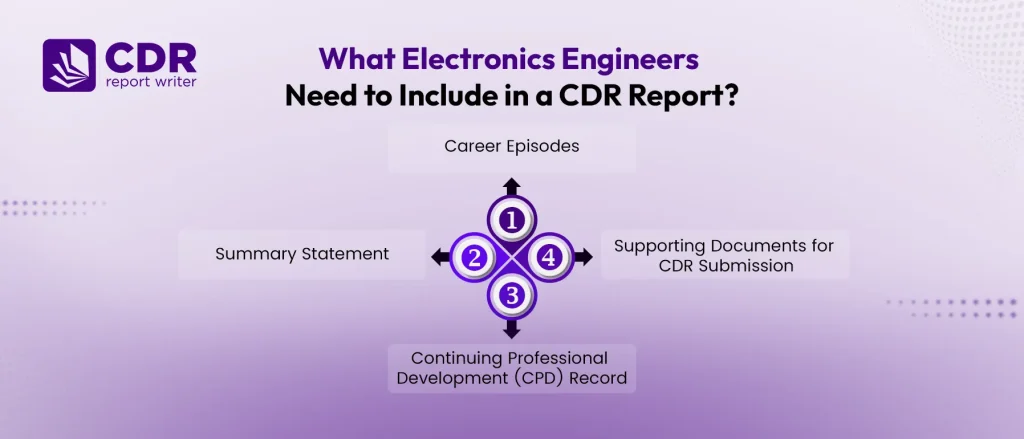
For Electronics Engineers, the CDR usually includes Career Episodes, Summary Statement, CPD record, and supporting documents. These sections present your technical role, project evidence, problem-solving ability, and competency mapping in one structured submission.
Who Needs a CDR Report for Electronics Engineering?
Electronics Engineers need a CDR report when their skills assessment requires project-based competency evidence. This often applies to non-accredited qualifications, provisional accreditation, a different nominated occupation, or mixed education and work history.
1. Non-Accredited Engineering Qualification
A non-accredited qualification often requires project-based evidence. Your CDR shows how your electronics projects meet the required competency areas.
2. Provisionally Accredited Australian Qualification
A provisionally accredited Australian program may still need extra competency evidence. Your project details help Engineers Australia review your practical engineering capability beyond the course title.
3. Different Nominated Occupation
Your assessment may need a CDR when your nominated occupation differs from your accredited qualification title. For Electronics Engineer, your evidence should connect your projects with ANZSCO 233411.
4. Mixed Qualifications or Related Experience
Some applicants have education, training, or work history across more than one technical area. Your Career Episodes and Summary Statement can show consistent electronics engineering knowledge across those details.
Also Read: Engineers’ Salary in Australia 2026
What Electronics Engineers Need to Include in a CDR Report?
1. Career Episodes
Career Episodes present three separate electronics engineering projects from your study, training, or work experience. Each episode shows different project situations, including the following core areas:
| Core Area | What to Include |
| Project details | Start with the project title, organisation, location, duration, your position, and your direct role. |
| Technical background | Explain the project purpose, system requirements, technical limits, equipment setup, and main engineering problem. |
| Engineering activities | Describe the design, testing, analysis, troubleshooting, validation, documentation, or coordination work you completed. |
| Personal contribution | Highlight the engineering decisions you made and the technical tasks you handled independently. |
| Project results | Present the final outcome, performance improvement, fault reduction, testing result, or engineering learning. |
i. Career Episode 1: Engineering Project Background
Career Episode 1 presents one required electronics engineering project in your CDR report. It may focus on circuit design, printed circuit board layout, prototype testing, or product improvement. This episode should show how you selected components, checked circuit behaviour, reviewed test results, corrected design issues, and improved electronic performance.
ii. Career Episode 2: Personal Engineering Activities
Career Episode 2 gives your CDR report a stronger system-focused example through microcontrollers, sensors, control panels, or automation logic. This episode shows how you connected hardware, software, input-output signals, calibration steps, troubleshooting, and final system testing.
iii. Career Episode 3: Technical Problems, Decisions and Results
Career Episode 3 adds a broader technical example through communication modules, signal processing, power circuits, equipment upgrades, or reliability improvement. This episode explains how you analysed faults, tested performance, modified systems, verified results, and improved the final operation.
2. Summary Statement
The Summary Statement connects your Career Episode paragraphs with Engineers Australia’s competency elements. It helps assessors follow where your project evidence appears and how each episode supports the required engineering competencies.
i. Knowledge and Skill Base
Knowledge and Skill Base highlights the technical knowledge behind your electronics work. It can cover circuit theory, digital electronics, signal behaviour, embedded control, engineering calculations, standards, and analysis used in your Career Episodes.
ii. Engineering Application Ability
Engineering Application Ability focuses on how you used that knowledge during project work. It can include component selection, circuit simulation, prototype testing, fault diagnosis, validation checks, system integration, and performance improvement.
iii. Professional and Personal Attributes
Professional and Personal Attributes show how you handled responsibility within the project environment. It can include technical reporting, team coordination, safety awareness, ethical decisions, document control, and communication with supervisors or technicians.
3. Continuing Professional Development (CPD) Record
The CPD record shows how you maintain your technical knowledge after formal education. For Electronics Engineers, it can reflect updates in circuit design, embedded systems, automation tools, testing methods, safety practices, and electronic technologies.
Each CPD entry usually records the activity title, provider, date, duration, and outcome. These details help present your professional growth in a clear and organised way.
i. Formal Learning Activities
Formal activities include courses, seminars, workshops, conferences, and technical programs. Electronics Engineers may include sessions on printed circuit board design, microcontrollers, communication systems, power electronics, testing equipment, or engineering standards.
ii. Self-Directed Learning
Self-directed activities cover independent study that improves your technical understanding. This may include reading product manuals, reviewing datasheets, studying software documentation, watching engineering webinars, or exploring new testing procedures.
iii. Workplace Learning and Technical Training
Workplace-based activities come from your project environment or employer-led sessions. These may include equipment demonstrations, safety briefings, software updates, quality procedures, testing workflows, or project review meetings.
4. Supporting Documents for CDR Submission
Supporting documents for electrical engineers verify the details you present in your CDR report. They help connect your education, work history, project evidence, and identity records with your Career Episodes, Summary Statement, and CPD record.
i. Academic documents: Degree certificate, academic transcripts, and any relevant course completion records.
ii. Identification records: Passport, national identity document, or other accepted identity proof.
iii. Resume or curriculum vitae: Updated work history, education details, technical skills, and project experience.
iv. Employment evidence: Appointment letters, reference letters, payslips, experience letters, or employment contracts.
v. English language evidence: English test results, if required for your assessment pathway.
vi. Project evidence: Circuit drawings, testing records, technical reports, design files, screenshots, calculations, or equipment documentation.
vii. CPD evidence: Training certificates, seminar records, workshop details, webinar records, or professional learning logs.
Need Help with Your Electronics Engineer CDR?
Get expert CDR support before submission.
What Makes a Strong CDR Report for Electronics Engineers?
A strong CDR report for Electronics Engineers explains your role in each project. It connects your design choices, testing work, fault analysis, and project evidence with Engineers Australia’s competency standards.
1. Clear Project Context: Your Career Episodes should explain the project goal, system type, technical requirement, and problem before you describe your work.
2. Specific Technical Contribution: Your content should show your own engineering actions, such as selecting components, testing circuits, analysing faults, reviewing designs, or checking system performance.
3. Evidence-based Competency Mapping: Your Summary Statement should connect each competency element with exact Career Episode paragraph numbers. This helps assessors find the evidence quickly.
4. Professional Language and Structure: Clear English, numbered paragraphs, and a logical order help assessors follow your project story, technical role, and supporting records.
Common Mistakes in Electronics Engineer CDR Reports
Mistakes in an Electronics Engineer CDR report often come from weak project evidence, unclear technical contribution, or poor competency mapping. These issues weaken your alignment with ANZSCO 233411 and reduce the clarity of your submission.
1. Writing project summaries instead of Electronics Engineer Career Episodes: Applicants often describe the whole project but leave out their own engineering role. Your Career Episodes should show your design choices, testing work, fault analysis, and technical decisions.
2. Repeating similar electronics projects in all three episodes: Using three similar projects limits your competency evidence. A stronger CDR shows varied experience across circuit design, embedded systems, automation, signal processing, or equipment testing.
3. Missing personal engineering contribution in project work: Team-based wording makes your role unclear. Explain what you designed, checked, modified, tested, analysed, or improved during the project.
4. Using weak Summary Statement paragraph mapping: Wrong paragraph links make your competency evidence hard to trace. Each Summary Statement entry should point to the exact Career Episode paragraph that supports the claim.
5. Leaving out electronics-specific technical evidence: Broad engineering descriptions do not show your Electronics Engineer background clearly. Add components, circuits, tools, test methods, fault findings, results, and system performance details.
6. Submitting inconsistent CDR supporting documents: Mismatched dates, job titles, project names, or employer details create confusion. Your resume, employment records, academic documents, and CDR content should present the same information.
Frequently Asked Questions
1. Can Electronics Engineers Use Academic Projects in a CDR Report?
Yes, academic projects can support an Electronics Engineer CDR when they show genuine engineering work. Include design decisions, testing steps, analysis, tools, and your personal contribution.
2. Can Embedded Systems Projects Be Used for an Electronics Engineer CDR?
Yes, embedded systems projects work well when they involve hardware and software integration. Strong examples include microcontroller programming, sensor interfacing, control logic, calibration, signal testing, and system validation.
3. Should an Electronics Engineer CDR Focus More on Hardware or Software?
An Electronics Engineer CDR can include both hardware and software work. Show how your actions supported circuit design, testing, automation, communication, accuracy, or system performance.
4. Can Telecom or Communication System Projects Support ANZSCO 233411?
Yes, communication system projects can support ANZSCO 233411 when they demonstrate electronics engineering knowledge. Relevant work includes signal analysis, circuit testing, transmission equipment, communication modules, and network hardware.
5. How Much Technical Detail Should Electronics Engineers Add to Career Episodes?
Include enough technical detail to show your engineering decisions and problem-solving process. Add tools, components, calculations, test methods, design changes, fault findings, and measurable results.
6. Can Team Projects Be Used in an Electronics Engineer CDR?
Yes, team projects can be used, but each Career Episode should focus on your individual work. Explain what you designed, tested, analysed, modified, checked, or documented.
7. Is It Safe to Copy Electronics Engineer CDR Samples?
No, copying CDR samples can create originality and evidence concerns. Use samples only to understand structure, not to copy projects, technical explanations, or competency statements.
8. Can Old Electronics Engineering Projects Be Used in a CDR Report?
Yes, older projects can be used when you can explain the technical work accurately. Include project dates, your role, engineering actions, tools, testing methods, and clear outcomes.