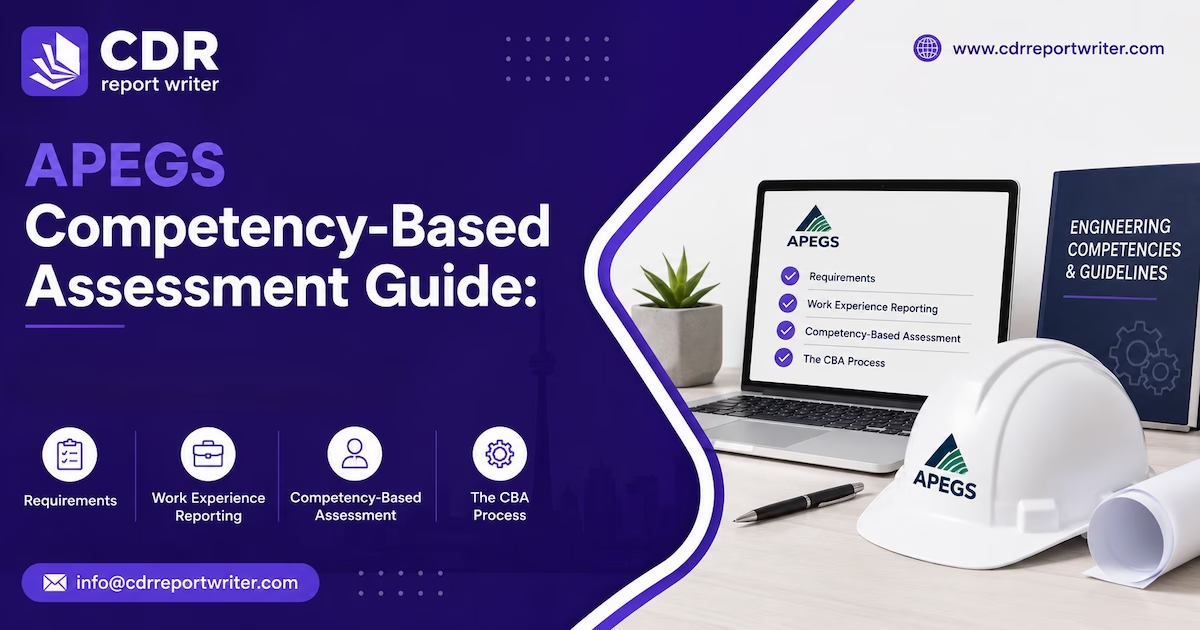
An APEGS work experience record succeeds when an assessor can trace a clear line from project context to your decisions, results and validator confirmation. Four years of employment alone is not enough; the CBA must demonstrate professional engineering or geoscience competence in a structured, verifiable form.
The Association of Professional Engineers and Geoscientists of Saskatchewan (APEGS) uses an online competency-based assessment, or CBA, for this purpose. Applicants record their employment history, select evidence for the required competencies, rate their own examples, and ask qualified validators to confirm work they know firsthand.
This guide follows the complete journey: eligibility, experience requirements, preparation, portal entry, validation, assessment, results and possible resubmission. It covers both engineering and geoscience while keeping their different competency frameworks separate.
Key highlights
- APEGS requires at least 48 months of validated engineering or geoscience experience, including at least 6 months within the 2 years immediately before submission.
- Engineering candidates address 34 competencies across 7 categories; geoscience candidates address 29 competencies across 4 categories.
- A minimum of 4 validators is required, including at least 2 Canadian-licensed professional engineers or geoscientists, or accepted equivalents.
- Every competency example must show the professional context, direct alignment, specific personal involvement and evidence that the assigned validator knows firsthand.
- The signed CBA Declaration Form is mandatory, and passing CBA completes only the work-experience assessment; all other registration requirements still apply.
Quick Answer: What Is the APEGS Competency-Based Assessment?
The APEGS competency-based assessment is the online process used to decide whether an applicant’s work experience demonstrates the competence needed for professional practice in Saskatchewan. The candidate completes an employment history, writes a specific example for every applicable competency, assigns a self-rating, and selects validators who can independently confirm the work.
Validation is not the final decision. APEGS assessors review the examples, ratings and validator feedback. The assessment uses a confidence-based process: strong, professionally validated evidence may receive a more limited review, while a lower-confidence file receives more rigorous assessment and may involve volunteer technical assessors.
Where Does CBA Fit in the APEGS Licensing Process?
CBA is one gate in the P.Eng. or P.Geo. pathway, not the licence itself. Most first-time applicants must first become registered as an engineer-in-training or geoscientist-in-training. Academic requirements are handled separately from the work-experience assessment.
| Academic and member-in-training stage | Whether the academic requirement is met and the applicant may proceed through the applicable route. |
| APEGS competency assessment | Whether at least four years of validated work and the competency evidence meet the professional-experience requirement. |
| Other registration requirements | Applicable NPPE, English-language competence, references and good-character requirements. |
| Professional-member application | The final application for P.Eng. or P.Geo. after all applicable prerequisites are complete. |
The full professional-member pathway also includes the applicable examination, language, reference and character requirements. Applicants already licensed elsewhere in Canada may follow an inter-association mobility route instead.
Starting your APEGS CBA? Organise the evidence before you fill the fields
A structured review can expose gaps between employment dates, competency examples, ratings and validator coverage while the record is still editable.
Who Is Eligible to Report Work Experience?
Access to the Competency Assessment System is currently available to three principal applicant groups:
- An APEGS engineer-in-training or geoscientist-in-training.
- A member-in-training applicant who has received written permission to report work experience before registration, including certain academic-review cases.
- A licensee applicant whom APEGS has authorized to submit work experience after the required academic and identification material has been accepted.
Creating an account does not establish eligibility by itself. APEGS reviews eligibility before approving access. Anyone following an unusual academic-review, licensee, mobility or reinstatement route should use the instructions issued for that file rather than assuming the standard sequence applies.
APEGS Work Experience Requirements at a Glance
Before professional licensure, APEGS requires four years of engineering or geoscience experience to be assessed by the Experience Review Committee. In the CBA system, that means at least 48 months from the employment history must be validated.
- Minimum validated experience: 48 months.
- Recency: at least 6 months of experience within the 2 years immediately before submission.
- Validator coverage: the combined validation must cover the required experience periods, not only the projects used for the strongest examples.
- Minimum validator count: 4, with at least 2 Canadian-licensed P.Eng./P.Geo. professionals or accepted equivalents.
- Evidence quality: each competency needs a specific example and a self-rating supported by the work described.
An employment period can be validated through a competency validator, professional reference validator or employment history validator, depending on what that person is being asked to confirm. Applicants may need more than four people when no set of four can cover the full 48 months.
Engineering CBA vs Geoscience CBA
Engineering and geoscience use the same online platform, but they do not use the same competency framework. Mixing the counts or interpretation statements can send an otherwise careful submission in the wrong direction.
| Framework | 34 competencies across 7 categories | 29 competencies across 4 categories |
| Professional context | Examples must demonstrate engineering practice and the applicable interpretation statements. | Examples must demonstrate geoscience practice and the applicable interpretation statements. |
| Canadian context | Selected Canadian Environment Competencies must show Canadian or equivalent understanding. | Seven competencies require explicit Canadian work-environment knowledge; a fixed year of Canadian experience is no longer required. |
| Portal route | Select the APEGS engineering framework applicable to the file. | Use the APEGS geoscience framework and current geoscience guidance. |
Work experience in Canada is not automatically required for either profession, but specific competencies must demonstrate Canadian or equivalent context. Applicants relying on overseas work should explain the relevant standards, regulatory environment, public-interest duties, safety practices or professional controls rather than merely stating that the experience was equivalent.
What Do You Need Before Starting the APEGS CBA?
1. A Consistent Employment History
Prepare employer names, positions, dates, locations, responsibilities and reporting relationships in chronological order. Explain gaps or overlaps. The employment record should agree with the resume, project dates, example dates and the periods each validator can confirm.
2. A Project and Evidence Inventory
List real projects and the decisions you made: calculations, interpretations, standards, risks, constraints, stakeholders, alternatives and outcomes. Then map those facts to competencies. This reduces repetition and prevents a general duty statement from being reused as evidence.
3. A Defensible Self-Assessment
Each example includes Situation, Action and Outcome fields plus a self-assessed competence level. Rate the evidence that exists; do not choose a preferred level first and stretch the narrative to fit it. The Action field should make your own judgement and contribution visible.
4. A Validator Coverage Plan
Match every example to someone with firsthand knowledge. Also check that all 48 required months can be confirmed. A validator who knows your reputation but did not observe the work cannot reliably verify a competency example.
5. Current Supporting Documents
The working file should contain the current CBA Declaration Form and Competency Assessment Guide. For a standard CBA submission, the signed declaration is mandatory. A thesis abstract or Licensee Scope of Practice form belongs in the file only when the applicant’s route requires it. Older third-party copies and forms saved from another applicant may no longer match the active requirements.
Also Read: APEGS competency report review support
The APEGS CBA Process Step by Step
Step 1: Confirm Eligibility and Apply the Correct Framework
Confirm eligibility first, then apply the current profession-specific framework and interpretation statements. Any case-specific instructions issued for an academic review, licensee, mobility or reinstatement file take precedence over the standard sequence.
Step 2: Create or Access the Competency Assessment Account
Open the Competency Assessment System, choose Applicants, and create an account using your APEGS registration or application number as the user ID. Select the Association of Professional Engineers and Geoscientists of Saskatchewan as the jurisdiction. Allow up to five business days for manual approval during business hours.
Step 3: Enter Employment History
Build the chronological record before polishing individual examples. Link positions and projects to the correct periods, and check which person can validate each period. The system does not currently display educational information while you enter the CBA record, so do not treat that as a missing-document signal.
Step 4: Complete the Competency Self-Assessment
Choose the strongest specific example for each competency. Identify the employer, position, validator and dates; write a concise Situation, a detailed Action and a clear Outcome; then assign an honest self-rating. The same project can support more than one competency, but each example must address the distinct competency rather than repeat the same paragraph.
Step 5: Assign Validators
Select validators according to direct knowledge, professional qualification and coverage. A competency validator confirms assigned examples. A professional reference validator gives broader feedback and may confirm professional responsibility. An employment history validator confirms a period when no competency or professional reference validation covers it.
Step 6: Upload the Declaration and Release the File for Validation
Upload the signed current CBA Declaration Form, check the entire record, and only then release it. Once the file is released for validation, the competency content and validator assignments are locked and cannot be changed.
Step 7: Validators Respond Independently
Validators receive their own email link, review the relevant history and examples, give independent ratings and answer general feedback questions. The applicant may confirm that the email arrived, but must not access the validator link or assist with the response. If a validator needs help, that person should contact APEGS.
Step 8: Submit for APEGS Quality Review and Assessment
After required validations are complete, the file moves to APEGS. Professional staff check whether it is complete and assessable. Depending on confidence and technical needs, volunteer assessors and the Experience Review Committee may also be involved.
What Makes a Competency Example Assessable?
Every competency example must clear three threshold tests. An example that does not clearly meet them can receive a rating of zero:
- Was the work performed in an engineering or geoscience context?
- Does the example actually address the named competency?
- Does it contain enough specific detail to demonstrate engineering or geoscience work under the governing definitions?
An assessable example must also show an appropriate level of personal involvement. The assessor should be able to separate your decisions and actions from the team’s work, understand the outcome, compare the evidence with your rating, and see that the assigned validator could confirm it firsthand.
This article intentionally stops at the threshold. Detailed writing technique, the full 34-element engineering framework and strong-versus-weak examples belong in separate cluster guides so this process article does not repeat them.
What Happens After Submission?
The file first goes through a completeness and assessability review. If grammar problems or missing information prevent a reliable assessment, the submission may be reopened and every competency may need to be rewritten and revalidated. A whole-file review is therefore more valuable than correcting isolated sentences.
During assessment, an assessor rates each competency. A zero causes the category to fail automatically. A category also fails if its average falls below the required level. Depending on the reason, an applicant may be asked for more information, told to gain new professional-level experience, or required to demonstrate Canadian equivalence with different evidence.
When evidence is insufficient, the applicant normally receives competency-specific feedback and an opportunity to resubmit. The same validation and assessment cycle then applies again. A separate reassessment route is available when an applicant believes a rating was unfair, but that request is limited and its result is final.
The current service target is an assessment result within 90 days for a complete submission. Completeness includes full employment history, an example and self-assessment for every competency, approved validations covering at least four years, and the required professional references. Treat the 90-day period as service guidance, not a guaranteed decision date.
Common APEGS CBA Mistakes
- Starting in the portal before confirming eligibility and the correct profession-specific framework.
- Treating position duties or a project overview as evidence of personal competence.
- Writing mainly in ‘we’ language so the assessor cannot identify the applicant’s contribution.
- Choosing a self-rating that the scope, complexity, risk or independence in the example does not support.
- Leaving inconsistencies between employment dates, project dates, positions and validator knowledge.
- Choosing validators for seniority or convenience rather than firsthand knowledge.
- Failing to cover all 48 months or assuming four validators will always be enough.
- Using an outdated declaration or a competency guide copied from a third-party host.
- Copying sample wording, exaggerating outcomes or exposing confidential client information.
- Helping a validator complete an independent response or accessing the validator link.
- Treating account approval or the 90-day target as a guaranteed deadline.
APEGS CBA Preparation Checklist
- Correct engineering or geoscience framework confirmed.
- Eligibility and any case-specific instructions confirmed.
- At least 48 months of valid work identified, including the recent-experience condition.
- Employment history complete, chronological and consistent with the resume.
- A genuine project evidence bank mapped to every competency.
- Situation, Action and Outcome entries support honest self-ratings.
- At least four suitable validators planned, including the required licensed professionals or equivalents.
- Validator coverage spans the full required experience period.
- Current CBA Declaration Form and applicable supporting documents ready.
- Confidential information generalized without removing essential evidence.
- Full record checked before release because examples and assignments become locked.
When Can Professional Review Support Help?
Review support is useful when the experience is genuine but the record is difficult to assess: projects overlap, employment dates conflict, examples map poorly to competencies, ratings appear unsupported, or the proposed validators cannot cover the claimed work cleanly.
Ethical support can help organize evidence, identify gaps, improve clarity and test consistency before validation. It should never invent a project, calculate a false result, create a validator, impersonate the applicant, access a validator response or promise an APEGS outcome. The applicant must understand, approve and stand behind every statement submitted.
Submit your own draft for mapping, clarity, chronology, rating and validator-readiness feedback. Final decisions remain with APEGS.
Frequently Asked Questions
1. What is the APEGS competency-based assessment?
It is APEGS’s online process for assessing whether an applicant’s engineering or geoscience work experience demonstrates the competencies required for professional practice. The record combines employment history, examples, self-ratings and independent validation.
2. Who can access the APEGS Competency Assessment System?
APEGS engineers-in-training and geoscientists-in-training can use it, as can certain member-in-training or licensee applicants who have received permission. APEGS reviews eligibility before approving the account.
3. How many years of work experience does APEGS require?
APEGS requires at least four years, or 48 months, of validated engineering or geoscience experience. At least six months must fall within the two years immediately before submission.
4. Are APEGS engineering and geoscience competencies the same?
No. Engineering uses 34 competencies across seven categories. Geoscience uses 29 competencies across four categories, including seven that explicitly assess Canadian work-environment knowledge.
5. What is an APEGS validator?
A validator is a person who independently confirms work experience that they know firsthand. Different validator types may confirm competency examples, provide professional-reference feedback, or verify employment periods.
6. How many validators does APEGS require?
At least four validators are required, including at least two Canadian-licensed professional engineers or geoscientists, or accepted equivalents. More may be necessary to validate the full 48 months.
7. What is the CBA Declaration Form?
The CBA Declaration Form is the signed statement that must be uploaded before the submission can be assessed. Use the current declaration issued for APEGS work experience reporting rather than a previously saved or third-party copy.
8. How long does APEGS competency assessment take?
Allow up to five business days for manual account approval. A complete, validated submission has a current assessment target of 90 days, although actual timing can vary.
9. What happens if a competency does not meet the requirements?
APEGS may provide feedback and reopen the competency for resubmission. A zero-rated example must be rewritten, revalidated and resubmitted; evidence below professional level may require new experience rather than a rewrite of the same example.
10. Can overseas engineering or geoscience experience be used?
Yes, non-Canadian work can contribute when it is valid professional experience and suitable validators can confirm it. The applicant must still demonstrate Canadian or equivalent context for the designated competencies.
11. Where is the official APEGS competency assessment login?
Open the Competency Assessment applicant login, choose Applicants, and select APEGS as the jurisdiction. This system is separate from the APEGS Central self-serve portal.