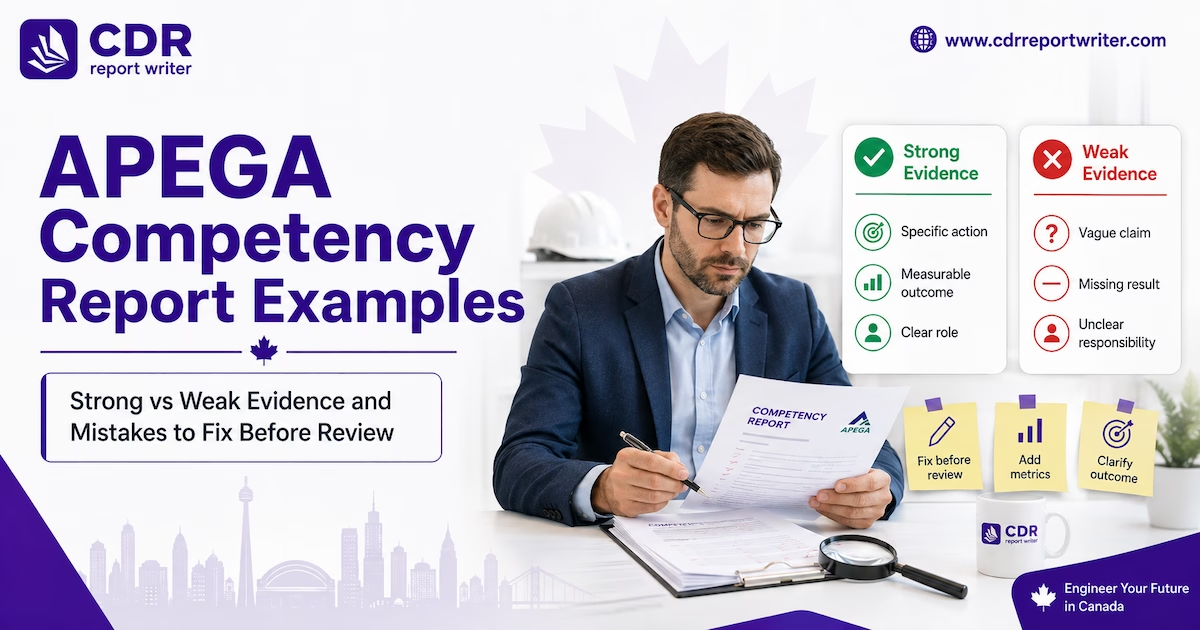
People searching for APEGA competency report examples usually need more than a polished paragraph to copy. They need a reliable way to decide whether their own work evidence is specific, relevant, personal, reasoned, and verifiable. A strong response makes the applicant’s engineering or professional judgement visible; a weak response often describes duties, team activity, or project success without proving the selected competency.
This evidence clinic compares short weak and stronger fragments, then explains what changed. Every fragment is original, fictional or composite, intentionally incomplete, and unsuitable for submission. It teaches diagnostic principles across technical and non-technical competencies without presenting a downloadable APEGA competency report sample or implying access to accepted applications.
APEGA assesses genuine experience and context, not writing polish in isolation. Current engineering descriptors ask for first-person contributions in 2-3 paragraphs with a maximum of 1,800 characters, and copied indicators are not accepted. Your final examples must match your Work Record Validator List (WRVL), self-assessment, Canadian-equivalent requirements, and a validator’s direct knowledge. Editorial review can clarify evidence, but it cannot create competence or guarantee the BOE’s decision.
Key highlights
- Diagnose evidence substance before polishing grammar or shortening sentences.
- A stronger example passes six tests: alignment, specificity, ownership, judgement, outcome, and consistency.
- Use ‘I’ for your Actions and reserve ‘we’ for necessary team context.
- Name the real method, criterion, risk, trade-off, communication need, or professional obligation behind the decision.
- An Outcome may be technical, safety, quality, cost, schedule, stakeholder, conflict-resolution, or learning evidence; it need not always be numerical.
- A well-written story can still be weak if it proves a different competency or cannot support the score and validator assignment.
- Online samples may belong to APEGS, EGBC, PEO, or an outdated process; never treat them as APEGA submission text.
Quick Answer: What Makes an APEGA Competency Example Strong?
A strong APEGA competency example uses one relevant event, gives enough context to understand the problem, identifies what the applicant personally decided and did, explains the judgement behind those Actions, states a concrete Outcome, and remains consistent with the claimed score, WRVL, and validator’s direct knowledge. A weak example relies on duties, ‘we,’ or unsupported success claims.
Six-word check: Specific. Personal. Relevant. Reasoned. Measurable. Verifiable.
Read These Examples as Diagnostics, Not Templates
Another applicant’s complete answer cannot prove your competence. You may study the Situation-Actions-Outcome structure and ask diagnostic questions, but the project facts, analysis, decisions, communications, constraints, validator, and Outcome must come from your own experience. The complete APEGA Competency-Based Assessment guide explains where this evidence fits in the current process.
Search results commonly mix APEGA with APEGS, EGBC, PEO, community posts, old PDFs, and generic shared-platform advice. Those regulators may use related concepts, but their counts, terminology, thresholds, forms, and current instructions are not interchangeable. An APEGS example is not an APEGA authority.
Project and employer names, sensitive figures, or proprietary details may be anonymized carefully, but the professional substance must remain accurate enough to assess and validate. Never replace a confidential value with an invented number or remove so much context that the decision becomes misleading.
Editorial boundary: Never submit a fictional, borrowed, or reconstructed example as your own work.
The Six Tests Every APEGA Competency Example Should Pass
| Alignment | Actions directly prove the selected competency | A good story proving something else | Which Action maps to the descriptor? |
| Specificity | Bounded problem, role, constraint, and period | Career summary or recurring duty | What exact event occurred? |
| Ownership | Applicant’s own decisions and contribution | ‘We,’ passive voice, or team output | What did I do personally? |
| Judgement | Criteria, calculation, risk, trade-off, or principle | Task list without a reason | Why did I choose this Action? |
| Outcome | Relevant and traceable consequence | ‘Project completed successfully’ | What changed and how was it checked? |
| Consistency | Score, WRVL, dates, role, and validator align | Inflated or unsupported claim | Can the validator support this? |
Apply these tests to substance before editing style. The appropriate evidence changes by competency: a technical example may need calculations or verification, while communication evidence needs an audience, message, response, and consequence. More technical detail is not automatically stronger when it does not answer the descriptor.
Also Read: How to Write APEGA Competency Examples Using Situation, Actions and Outcome
Strong vs Weak Situation Evidence
Weak Situation Pattern
Fictional weak fragment: ‘Our company was responsible for several municipal upgrades, and I worked with the design team.’
This gives broad employer context but no defined event, constraint, personal responsibility, decision point, or competency link. The assessor cannot tell which experience will be evaluated.
Stronger Situation Pattern
Fictional stronger fragment: ‘During detailed design of a municipal pump-station upgrade, the selected duty point conflicted with the existing electrical capacity and approved capital limit. I was responsible for comparing feasible equipment options.’
This is stronger because it bounds the event, states two relevant constraints, identifies personal responsibility, and creates a decision that the Actions can explain. It remains a fragment; an applicant must replace every fact with genuine evidence.
Strong vs Weak Action Evidence
Weak Action Pattern
Fictional weak fragment: ‘We reviewed the design and followed all applicable standards.’
Collective ownership hides the applicant’s contribution. The standards, review method, issue, reasoning, and decision are absent.
Stronger Action Pattern
Fictional stronger fragment: ‘I checked two equipment options against the governing design criteria, recalculated operating points under peak and minimum demand, documented the overload risk, and recommended the option that met capacity and safety constraints.’
The stronger direction uses first-person verbs, a logical sequence, real decision criteria, technical analysis, and a recommendation. A final response should name only the details that prove the competency; excessive calculation history can obscure the judgement.
Strong vs Weak Outcome Evidence
Weak Outcome Pattern
Fictional weak fragment: ‘The client was happy and the project was successful.’
This is subjective, unmeasured, disconnected from the applicant’s Actions, and difficult for a validator to substantiate.
Stronger Outcome Pattern
Fictional stronger fragment: ‘The approved option remained within the available electrical capacity and was accepted at design review; I recorded the assumptions and acceptance criteria for commissioning verification.’
This closes the evidence loop with a traceable technical result, an acceptance point, and follow-through. A valid Outcome may also be a resolved conflict, changed procedure, documented risk, stakeholder decision, or learning result when it is specific and relevant.
Eight APEGA Strong-vs-Weak Evidence Comparisons
The pairs below are original fictional/composite teaching fragments. They are deliberately short and cannot be used as CBAT responses. For each pair, replace the entire scenario with your real event, Action, reasoning, Outcome, WRVL position, and validator.
Example 1 – Regulations, Codes and Standards
Competency aim: Show how a specific external requirement affected technical work.
Fictional weak fragment: ‘I followed all required codes.’
Fictional stronger fragment: ‘I identified the clearance requirement governing the equipment layout, checked the proposed arrangement against it, and revised the access zone before design review.’
Why it is stronger: It connects a genuine requirement to a check, design change, and review point. Name the actual code and clause used in your work.
Example 2 – Application of Theory or Technical Analysis
Competency aim: Show engineering reasoning, not software operation.
Fictional weak fragment: ‘I used modelling software to complete the calculations.’
Fictional stronger fragment: ‘I defined the governing load cases and assumptions, compared model behaviour with a hand-calculated limiting case, and used the verified result to select the design option.’
Why it is stronger: It reveals inputs, independent checking, judgement, and the decision supported by the analysis.
Example 3 – Quality Assurance or Results Verification
Competency aim: Show how correctness or quality was assessed independently.
Fictional weak fragment: ‘I checked the drawings for quality.’
Fictional stronger fragment: ‘I applied the approved review checklist, traced interface dimensions to the design basis, identified a conflicting elevation, and verified closure after the drawing was revised.’
Why it is stronger: It names the review method, defect, corrective action, and closure evidence rather than claiming a generic check.
Example 4 – Written or Oral Communication
Competency aim: Show audience-aware communication that changed understanding or action.
Fictional weak fragment: ‘I attended meetings and helped prepare reports.’
Fictional stronger fragment: ‘I converted the design risk into a non-technical comparison for the owner’s review, answered questions about operational impact, and documented the option selected after the meeting.’
Why it is stronger: It identifies audience, message, response, and consequence. Attendance or document length alone proves little.
Example 5 – Project Management, Budget or Schedule
Competency aim: Show a control decision, trade-off, or response to change.
Fictional weak fragment: ‘I managed the project on time and under budget.’
Fictional stronger fragment: ‘I forecast the schedule impact of late vendor data, resequenced two review packages, and escalated the residual commissioning risk with a recovery recommendation.’
Why it is stronger: It distinguishes the applicant’s planning and escalation from a broad claim about the whole project.
Example 6 – Team Effectiveness or Conflict Resolution
Competency aim: Show a real interpersonal barrier and professional intervention.
Fictional weak fragment: ‘I worked well with the multidisciplinary team.’
Fictional stronger fragment: ‘I met separately with two discipline leads to clarify the disputed interface, facilitated an agreed responsibility matrix, and confirmed the resolution at the joint design review.’
Why it is stronger: It demonstrates listening, facilitation, role clarity, and a result without requiring formal authority.
Example 7 – Professional Accountability or Public Interest
Competency aim: Show an applied obligation, limitation, conflict, or public-risk decision.
Fictional weak fragment: ‘I always acted ethically and put safety first.’
Fictional stronger fragment: ‘I recognized that the requested approval exceeded my verified design scope, documented the limitation, and obtained review from the qualified discipline engineer before release.’
Why it is stronger: It turns an ethics claim into a specific limitation, accountable Action, and controlled Outcome.
Example 8 – Canadian Work Environment or Equivalent Experience
Competency aim: Show the functional equivalence relevant to the designated competency.
Fictional weak fragment: ‘My overseas work was similar to Canada and used equivalent codes.’
Fictional stronger fragment: ‘I applied the local pressure-equipment inspection requirement to the repair decision, then mapped its design-control and public-safety purpose to the applicable Canadian requirement.’
Why it is stronger: It explains the actual overseas practice and a reasoned Canadian relationship. It must name only standards truly used or compared.
For current descriptor wording and the eight engineering competencies carrying Canadian-equivalent requirements, use APEGA’s 22 engineering competencies rather than a sample from another regulator. As of August 12, 2026, the designated competencies are 1.1, 1.6, 1.9, 2.1, 2.2, 2.3, 5.1, and 6.2.
Turn weak applicant-owned fragments into verifiable evidence
Writing support can help isolate the right event, preserve accurate first-person ownership, and connect genuine reasoning and Outcomes to the selected competency.
A Good Story Can Still Be the Wrong Competency Example
One project can contain technical, communication, management, safety, quality, and sustainability evidence. The response becomes weak when the heading changes but the Actions continue to prove the same ability. Map competency to descriptor, event, personal Action, result, and validator before drafting.
| Technical analysis | Defined cases, checked assumptions, compared equipment options | Verified option met design constraints |
| Communication | Explained operating risk to a mixed technical/non-technical audience | Stakeholders selected an informed option |
| Project management | Forecast delay, resequenced reviews, escalated residual risk | Controlled schedule impact and decision |
Changing only the competency title or inserting indicator terms does not remap the evidence. Each version must use different relevant Actions and may require a different validator who directly knows that aspect of the work.
Does the Example Support the Claimed Competency Score?
Polished prose is not evidence of a higher proficiency level. Compare the actual independence, complexity, responsibility, judgement, and breadth shown in the example with APEGA’s current category-specific scoring guidance. Do not use a universal score-to-verb formula or inflate authority to make a rating appear plausible.
| Independence | Claims sole authority; WRVL shows junior/support role | Describe actual supervision and responsibility |
| Complexity | High rating supported by a routine task | Choose a representative event or reassess rating |
| Outcome | Result cannot be traced to Actions | Add verification or narrow the claim |
| Validator knowledge | Validator did not observe or review the work | Reconsider example or assignment |
| Timeline | Project dates conflict with work history | Reconcile chronology before submission |
Only APEGA determines the assessment result. A reviewer can identify an evidence-score mismatch but cannot assign, guarantee, or pre-approve a score.
Can One Project Be Used for Multiple APEGA Competencies?
Yes, when the project genuinely contains different evidence for each selected competency. Reusing the setting can be efficient; recycling the same narrative with minor keyword substitutions is not. Across all 22 responses, check breadth, duplicated wording, conflicting retellings, and whether the same validator directly knows every reused aspect.
15 Common APEGA Competency Report Mistakes and How to Fix Them
- Job duties instead of one event – narrow the response to a specific problem, decision, or conflict.
- Overusing ‘we’ – retain team context but identify your own Actions accurately.
- Repeating an indicator as a claim – add observable work evidence that proves it.
- Choosing a story that proves another competency – remap the event or select a better one.
- Listing tools without engineering reasoning – explain inputs, criteria, checks, and decisions.
- Naming a code without applying it – show which real requirement affected the work and how.
- Claiming leadership without an intervention – identify the coordination, escalation, or resolution.
- Using a vague Outcome – state what changed and how it was checked, accepted, or learned from.
- Inflating ownership or authority – represent supervision, review, and approval honestly.
- Choosing an unsupported self-rating – align it with demonstrated complexity and independence.
- Ignoring WRVL consistency – reconcile role, employer, dates, and chronology.
- Assigning a validator without direct knowledge – map every example to someone able to support it.
- Assuming foreign work automatically proves Canadian equivalency – explain the relevant functional relationship.
- Copying online sample or template language – keep the structural lesson and replace all substance with real experience.
- Editing style before fixing missing evidence – repair alignment, ownership, judgement, and Outcome first.
Review the evidence before validator assignment
An evidence-focused review can flag repeated narratives, unsupported scores, WRVL conflicts, missing Canadian-equivalent reasoning, and validator-knowledge gaps while revisions remain practical.
APEGA Example Self-Review Matrix
Copy this matrix into a private planning sheet; it is a quality-control tool, not a submission template. Mark red for missing facts, amber for unclear explanation, and green only when the evidence is relevant, accurate, and verifiable.
| Does the event address the selected competency? | |||
| Is my role distinct from the team’s? | |||
| Did I explain what I decided or did? | |||
| Did I explain why I took those Actions? | |||
| Are details specific but concise? | |||
| Is the Outcome concrete and connected? | |||
| Does evidence fit the claimed score? | |||
| Does it agree with WRVL chronology? | |||
| Can the validator confirm it directly? | |||
| Is every material claim accurate and mine? |
Resolve red evidence gaps before wordsmithing. If a decision, result, or validator does not exist, no amount of editing can responsibly manufacture it.
When an APEGA Competency Report Review May Help
Review may help when competency mapping is uncertain, the same weak pattern appears repeatedly, the score exceeds the evidence, Canadian-equivalent reasoning feels inserted after the fact, WRVL details conflict with examples, or validator assignment is approaching.
An ethical review evaluates clarity, structure, relevance, consistency, and gaps using the applicant’s own evidence. It must not invent experience, fabricate results, impersonate a validator, obtain confidential forms, turn these fragments into submitted answers, promise approval, or claim access to assessor deliberations.
Before finalizing, compare the complete record with APEGA’s current engineering work-experience guidance because WRVL, CBAT, references, validators, form sequence, and process deadlines can change.
Final Pre-Review Checklist
- Each example answers the chosen competency, not merely the project topic.
- Situation is short and specific; Actions contain most of the evidence.
- First-person ownership is accurate and team contributions are not erased.
- Reasoning, constraints, methods, and decisions are visible.
- Outcome is concrete and linked to the Actions.
- The score is proportionate to demonstrated responsibility and complexity.
- WRVL details, dates, roles, projects, and examples agree.
- The assigned validator has direct knowledge of the work.
- Canadian-equivalent evidence is explicit where required.
- No wording, fact, decision, result, or validator response has been copied or invented.
- Current APEGA pages have been checked for process changes.
Use these APEGA competency report examples as diagnostic contrasts, then return to your own project records. Select the correct competency, draft with Situation, Actions, and Outcome, confirm the score and WRVL alignment, and check validator readiness before submission. Stronger writing begins with stronger genuine evidence.
Frequently Asked Questions
1. Does APEGA provide a full competency report sample?
APEGA publishes current competencies, indicators, process guidance, and scoring information, but applicants should not treat a third-party completed report as official or reusable evidence. Check APEGA’s live pages for current official resources.
2. Can I copy an APEGA competency example from the internet?
No. The submitted work, Actions, reasoning, Outcome, WRVL position, and validator must be your own and factually consistent. Copying also risks using another regulator’s or an outdated framework.
3. Should I write ‘I’ or ‘we’ in my examples?
Use ‘I’ to identify your Actions, decisions, and accountability. Use ‘we’ only where necessary to explain team context, then separate your personal contribution.
4. Is a technical example always stronger than a non-technical example?
No. The strongest evidence directly demonstrates the selected competency. Communication, conflict resolution, accountability, and public-interest evidence require different professional behaviours.
5. How much detail should an APEGA competency example contain?
Include enough context, Action, reasoning, and Outcome to demonstrate the competency within the current limit. As of August 12, 2026, APEGA’s live engineering descriptors specify 2-3 paragraphs and a maximum of 1,800 characters.
6. Can I use the same project more than once?
Yes, if each response proves a distinct competency using different relevant Actions and Outcomes and avoids copy-paste repetition or contradictory retellings.
7. What if my strongest experience was outside Canada?
Use genuine international work when relevant and verifiable. For designated competencies, explain the applicable Canadian-equivalent practice using the real code, safety, quality, accountability, communication, or public-impact context.
8. Can a reviewer tell me what score to claim?
A reviewer may identify evidence-score inconsistencies, but the applicant attests to the experience, validators score independently, and APEGA makes the assessment decision.