
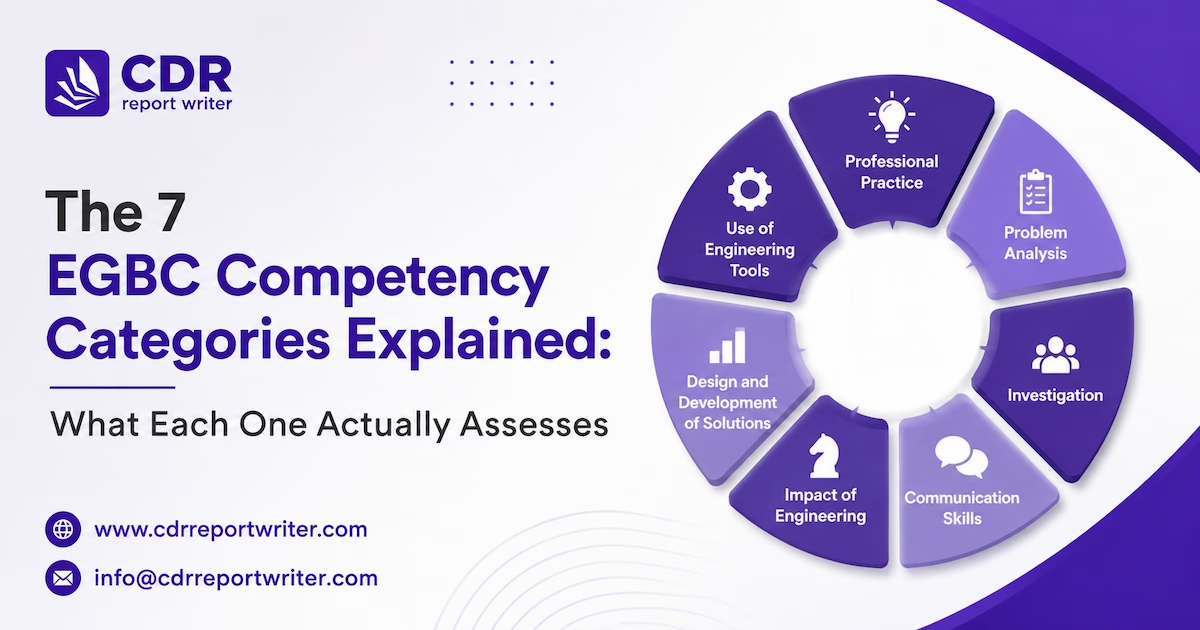
EGBC groups the 34 key competencies in its engineering competency-based assessment into 7 categories: Technical Competence (10 competencies), Communication (3), Project and Financial Management (5), Team Effectiveness (2), Professional Accountability (6), Social, Economic, Environmental and Sustainability (5), and Personal Continuing Professional Development (3). Every competency needs its own workplace example, and each category has a minimum average rating.
This article explains what each category actually assesses, how many examples it requires, which minimum rating applies, and where applicants usually underestimate the work. It is the next step after understanding what an EGBC competency report is, because the category structure controls how you plan the whole submission.
Key highlights
- Every one of the 34 competencies needs its own genuine workplace example.
- Ratings are averaged within each category, and each category has its own minimum average.
- Five categories require 3.0; Project and Financial Management and Social, Economic, Environmental and Sustainability require 2.0.
- Technical Competence carries 10 examples; Team Effectiveness carries only 2.
- Category 1 and Category 7 use different rating descriptor logic from Categories 2 to 6.
- 8 of the 34 competencies are also Canadian environment competencies with individual minimums.
- P.Geo. applicants use a different geoscience framework: 4 categories and 29 competencies.
Also Read: What an EGBC competency report is.
Quick Answer: What Are the 7 EGBC Competency Categories?
The 7 EGBC competency categories are Technical Competence, Communication, Project and Financial Management, Team Effectiveness, Professional Accountability, Social, Economic, Environmental and Sustainability, and Personal Continuing Professional Development. Together they contain 34 engineering competencies. Five categories require a minimum average rating of 3.0, while Project and Financial Management and Social, Economic, Environmental and Sustainability require 2.0.
The 7 Categories at a Glance
The current EGBC competency list sets out the 34 key competencies, and the April 2024 engineering applicant guide explains the minimum category ratings. The share column below is simple planning arithmetic from those counts, not a separate EGBC rule.
| # | Competency category | Competencies | Minimum rating | Share of examples |
| 1 | Technical Competence | 10 | 3.0 | 29% |
| 2 | Communication | 3 | 3.0 | 9% |
| 3 | Project and Financial Management | 5 | 2.0 | 15% |
| 4 | Team Effectiveness | 2 | 3.0 | 6% |
| 5 | Professional Accountability (Ethics & Professionalism) | 6 | 3.0 | 18% |
| 6 | Social, Economic, Environmental and Sustainability | 5 | 2.0 | 15% |
| 7 | Personal Continuing Professional Development | 3 | 3.0 | 9% |
| Total | 34 | 100% |
Two points make this table useful. Technical Competence is nearly a third of the writing effort. The two categories with a 2.0 minimum are also the two that many applicants worry about most, because junior or specialised engineers may not have had full budget authority or broad sustainability influence.
Use the table before you choose examples, not after. If most of your strongest stories come from one project, you may still be short in a category that needs a different kind of evidence. A technically strong bridge, plant, building-services or software project will not automatically cover communication, professional accountability, CPD and sustainability unless your role in that project actually touched those areas.
The share column also shows why a neat-looking draft can still be unbalanced. Ten technical examples can make the report feel complete, but those examples do not compensate for a thin Team Effectiveness example or a missing CPD gap analysis. EGBC assesses each category against its own minimum, so planning by category is safer than planning by project alone.
Not sure which categories your experience actually covers?
A category review can help you see whether your projects are doing enough work across technical, communication, management, ethics, sustainability and CPD evidence.
Why Is the Minimum Rating Not the Same for Every Category?
The minimum rating is not the same because EGBC treats different categories as different kinds of professional evidence. Each competency is rated on the 0-5 scale, those ratings are averaged within the category, and the category average must meet that category’s minimum.
Project and Financial Management and Social, Economic, Environmental and Sustainability are set at 2.0. That does not make them optional. It recognises that an applicant ready for registration may have had limited independent budget control, project authority, or sustainability influence, especially in earlier or specialised roles.
A 2.0 minimum is still not permission to write thin examples. Every competency still needs real evidence. The clearest warning is competency 6.2: it sits inside a category with a 2.0 average, but it is also a Canadian environment competency with its own individual 2.0 minimum.
A useful way to think about the lower minimum is this: EGBC is not asking every applicant to prove they have independently controlled a full project budget or personally led an organisation’s sustainability strategy. It is still asking them to show professional awareness, appropriate participation, and enough judgement to understand how engineering work is managed and how it affects people, money and the environment.
How Is Each Category Actually Rated?
The Competency Rating Scale Summary is easy to skim past, but it shows a detail many applicants miss: Category 1, Categories 2 to 6, and Category 7 are described with different rating language.
| Rating descriptors used | Applies to | Language used |
| Engineering-task descriptors | Category 1 – Technical | Scope and complexity of assigned engineering tasks, design work and supervision of staff |
| General activity descriptors | Categories 2 to 6 | Scope and complexity of activities, reliance on standard procedures and support for senior engineers |
| CPD descriptors | Category 7 | Professional development completed, gap analysis and strength of the development plan |
The level-0 contrast makes the split clear. For Categories 1 to 6, level 0 means little or no exposure to the competency. For Category 7, level 0 means no continuing professional development completed, no gap analysis and no development plan.
| Level | Direct supervision required | Responsibility and risk | Complexity of your own work |
| 1 | Significant | Minimal | Minimal |
| 2 | Considerable | Some | Some |
| 3 | Some | Considerable | Moderate |
| 4 | Minimal | Significant | Considerable |
| 5 | Autonomous | Total | Significant |
This calibration explains why a level 3 is not a claim of senior mastery. At level 3, the applicant may still need some supervision, but should carry considerable responsibility and risk on work of moderate complexity. EGBC’s applicant guide also says applicants are not expected to be working at level 4 or 5.
This article does not try to turn the rating scale into a formula. The better use is diagnostic. If your example describes work that was routine, closely directed and low risk, it may sit closer to level 2. If it shows you making a reasoned decision, managing consequences and working with only some supervision, it is closer to the level 3 expectation used by most categories.
Category 1 – Technical Competence (10 Competencies, Minimum 3.0)
Technical Competence assesses the core of engineering practice: applying engineering knowledge, recognising constraints, managing technical risk, checking work, protecting safety and translating design intent into usable outputs.
- 1.1 Knowledge of regulations, codes, standards and safety
- 1.2 Knowledge of materials or operations, project and design constraints, and inter-disciplinary impacts
- 1.3 Analysing technical risks and offering mitigations
- 1.4 Applying engineering knowledge to design solutions
- 1.5 Understanding solution techniques and independently verifying results
- 1.6 Safety awareness
- 1.7 Understanding systems as well as their components
- 1.8 Exposure to all stages of the project life cycle
- 1.9 Quality control, independent design checks and peer review
- 1.10 Transferring design intent to drawings, sketches and design documents
This is the largest category by a wide margin. It is also the only category where discipline-specific indicators are available in addition to generic indicators. Applicants should treat it as a planning category, not just a writing category: ten examples means ten separate chances for the assessor to test whether the work is truly engineering work.
Do not make every technical example sound like the same design task. Technical Competence covers regulations, risk, design, verification, lifecycle exposure, quality control and documentation. If all ten examples describe only calculations, the category may look repetitive even if the calculations were real. A stronger set shows breadth across the technical life of engineering work.
Competencies 1.1, 1.6 and 1.9 are also Canadian environment competencies. Each carries a 3.0 minimum in its own right, so weak codes, safety or quality-control evidence can create a revision problem even if the broader technical average looks acceptable.
Ten technical examples to write? Get them reviewed before you submit.
Technical Competence is nearly a third of the report, so vague technical responsibility, missing calculations, weak design checks or unclear project constraints can affect the whole assessment.
Category 2 – Communication (3 Competencies, Minimum 3.0)
Communication assesses whether you can explain engineering information clearly in the modes professionals actually use: speaking, writing and reading technical material.
- 2.1 Oral communication
- 2.2 Writing
- 2.3 Reading and comprehension
This category is small but risky. It has only three examples, a 3.0 minimum, and all three competencies are Canadian environment competencies assessed in English or French. A weak example has little room to be balanced by other communication evidence.
Good evidence may involve explaining technical information to non-technical stakeholders, presenting options to a client or team, writing technical reports, responding to comments, or interpreting specifications and engineering documents accurately.
The key is to show communication as an engineering action, not a personality trait. A sentence saying you communicated with the client is weak. A stronger explanation shows what information was difficult, who needed to understand it, how you adapted the message, and what decision or outcome the communication supported.
Category 3 – Project and Financial Management (5 Competencies, Minimum 2.0)
Project and Financial Management assesses whether you understand how engineering work is planned, resourced, costed, adjusted and improved. It does not require you to have been the project manager for an entire project.
- 3.1 Awareness of project management principles
- 3.2 Increasing responsibility for project planning and implementation
- 3.3 Managing expectations in light of available resources
- 3.4 Understanding the financial aspects of the work
- 3.5 Asking for and responding to feedback
The 2.0 minimum and the wording of 3.1 matter. This category can be evidenced through participation in managed engineering work: tracking a schedule, helping estimate effort, flagging a resource constraint, explaining a cost implication, or acting on feedback from a supervisor or reviewer.
Competency 3.5 surprises many applicants because feedback sits here rather than under Team Effectiveness or CPD. The point is practical project improvement: how you receive, use and respond to feedback in the delivery of engineering work.
Applicants without formal cost authority can still use evidence from cost awareness. For example, they may have compared design options for material quantity, explained how a change affected schedule, supported procurement decisions, tracked hours against a work package, or escalated a scope change before it became a budget problem.
Category 4 – Team Effectiveness (2 Competencies, Minimum 3.0)
Team Effectiveness assesses whether you work constructively with others and handle disagreement professionally. It is the smallest category, but it still requires a 3.0 average.
- 4.1 Working respectfully with other disciplines and people
- 4.2 Working to resolve differences
The risk is mathematical and practical. With only two examples averaged against a 3.0 minimum, there is no third example to rescue a weak one. A generic statement that you worked well with a team is rarely enough.
Competency 4.2 usually needs an actual difference to resolve. That may be a disagreement over design direction, priorities, interpretation of a requirement, field conditions or stakeholder expectations. The example should show how you moved the issue toward a professional outcome.
This category also rewards specificity. Name the parties by role, explain the difference without blaming anyone, and show the professional behaviour you used: listening, clarifying constraints, documenting the issue, bringing evidence into the discussion, or escalating appropriately when agreement was not possible at your level.
Category 5 – Professional Accountability, Ethics and Professionalism (6 Competencies, Minimum 3.0)
Professional Accountability assesses whether you understand the obligations that come with engineering practice: ethics, scope of practice, conflict of interest, accountability, use of the seal and honest self-awareness.
- 5.1 Working with integrity, ethically and within professional standards
- 5.2 Awareness of your scope of practice and limitations
- 5.3 Understanding how conflict of interest affects your practice
- 5.4 Awareness of professional accountability
- 5.5 Appropriate use of the stamp and seal
- 5.6 Understanding your strengths and weaknesses as they apply to your position
Competency 5.1 is also a Canadian environment competency at 3.0 and connects directly to the professional conduct expectations applicants associate with the EGBC Code of Ethics. Keep the example specific: an ethics example should show a decision, not only a statement that you follow rules.
Competency 5.5 is often difficult for applicants without Canadian practice experience because stamp and seal responsibility is tied to a regulated Canadian practice environment. If your exposure is indirect, the example must still show what you understood about sealing, accountability and limits of authority.
Professional Accountability examples should avoid broad moral claims. Assessors need to see how the obligation affected your conduct. A strong ethics, scope or conflict-of-interest example usually includes a pressure point: a client request, a design uncertainty, a limit in your own competence, a reviewer comment, or a situation where public safety and convenience pulled in different directions.
Category 6 – Social, Economic, Environmental and Sustainability (5 Competencies, Minimum 2.0)
This category assesses whether you understand the effect of engineering work beyond the technical deliverable: public impact, adverse effects, the regulatory system and sustainability in practice.
- 6.1 Safeguards to protect the public and methods of mitigating adverse impacts
- 6.2 The relationship between the engineering activity and the public
- 6.3 The role of regulatory bodies in the practice of engineering
- 6.4 Awareness of sustainability clauses in practice guidelines relevant to your area
- 6.5 Considering how sustainability principles could be applied and promoted in your work
The 2.0 minimum is important because some applicants over-worry about not having led environmental or sustainability strategy. EGBC’s wording around 6.5 recognises that your position of influence matters. A junior engineer can still show awareness and appropriate application within their real role.
Competency 6.2 is the only Canadian environment competency with a 2.0 minimum. It still carries an individual minimum, so do not bury it in a broad sustainability paragraph that never explains the connection between engineering activity and the public.
This category is not only for environmental engineers. A structural, mechanical, electrical, civil, software or process engineer can still show how engineering work affects users, maintainers, neighbours, regulators, cost, access, safety, energy use, resilience or long-term operation. The evidence should fit your real role, but it should not pretend the work existed in a technical vacuum.
Category 7 – Personal Continuing Professional Development (3 Competencies, Minimum 3.0)
Personal Continuing Professional Development assesses whether you actively manage your growth as a professional. Unlike the other categories, it is not mainly evidenced through project delivery.
- 7.1 Completion of professional development activities
- 7.2 Awareness of gaps in knowledge and areas requiring further development
- 7.3 A professional development plan addressing those gaps and maintaining currency
The rating scale treats CPD differently because the evidence is different. A level 3 in Category 7 means sufficient development activity, an adequate gap analysis and an adequate development plan. Applicants who need a refresher on the concept can also review continuing professional development explained.
The three competencies form a chain: do the development, identify what is still missing, and plan how to close the gap. A section that only lists courses or webinars may cover 7.1 but leave 7.2 and 7.3 thin.
Category 7 is also where applicants can sound either too vague or too polished. A generic statement about lifelong learning is not enough. A credible CPD example names the learning activity, explains why it mattered to the applicant’s practice, identifies a realistic gap, and connects the next development step to future engineering responsibility.
CPD examples are assessed differently. Make sure yours are written for the right question.
A CPD review can check whether your evidence shows development activity, gap analysis and a forward plan instead of trying to force project examples into Category 7.
What Is the Difference Between a Competency and an Indicator?
A competency is what you must demonstrate. An indicator is a suggested example of the kind of action, skill or behaviour that could demonstrate that competency.
Applicants often make two opposite mistakes. They either try to address every indicator, which makes the example crowded, or they assume they can only use the listed indicators, which blocks good evidence from real work. EGBC’s applicant guide explains that indicators are guidance, not a compulsory checklist.
Generic indicators apply across engineering disciplines. Discipline-specific indicators are available within Technical Competence for several practice areas. Professional engineering applicants should also avoid selecting the Professional Licensee indicator, which is intended for professional licensee engineering applicants.
The best use of indicators is selection, not copying. Read the indicators to understand the kind of evidence EGBC expects, then write from your own work. If your example is truthful, specific and clearly mapped to the competency, it does not need to repeat the indicator wording mechanically.
Which Categories Contain the Canadian Environment Competencies?
Eight of the 34 engineering competencies also count as Canadian environment competencies. They are drawn from four categories, not added as a separate category. The Canadian environment guide is especially important for applicants using non-Canadian experience.
| Category | Competency | Minimum competency rating |
| 1. Technical | 1.1 Regulations, Codes and Standards | 3.0 |
| 1. Technical | 1.6 Safety Awareness | 3.0 |
| 1. Technical | 1.9 Peer Review and Quality Control | 3.0 |
| 2. Communication | 2.1 Oral Communication (English/French) | 3.0 |
| 2. Communication | 2.2 Writing (English/French) | 3.0 |
| 2. Communication | 2.3 Reading and Comprehension (English/French) | 3.0 |
| 5. Professional Accountability | 5.1 Code of Ethics | 3.0 |
| 6. Social, Economic, Environmental and Sustainability | 6.2 Engineering and the Public | 2.0 |
These eight carry individual minimums. If one is assessed below its required rating, the applicant can be asked to revise that example regardless of the overall category average. Communication is especially exposed because all three communication competencies are Canadian environment competencies.
Do P.Geo. Applicants Use the Same 7 Categories?
No. The seven-category, 34-competency framework described here is the engineering framework. The shared platform’s framework overview separates engineering from geoscience: geoscience uses 4 categories and 29 competencies.
The geoscience categories are Professional Competencies, Competencies in Scientific Method, Competencies in Area of Geoscience, and Complementary Competencies. This matters because both engineering and geoscience applicants use the same online platform, so engineering guidance can easily circulate into the wrong applicant path.
A P.Geo. applicant working from a 34-competency engineering checklist is using the wrong framework. Geoscience applicants should confirm their own current requirements through EGBC and the Competency Assessment System before drafting examples.
Where Should You Focus Your Effort?
Use the category structure as a planning tool, not a shortcut. Every competency still needs a genuine example from your own work, but some categories deserve earlier attention because they carry more volume or less room for error.
- Most volume: Technical Competence, with 10 examples and discipline-specific indicators.
- Least room for error: Team Effectiveness, with only 2 examples averaged against a 3.0 minimum.
- Highest hidden risk: Communication, because all 3 examples are Canadian environment competencies.
- Most commonly under-evidenced: Category 7 CPD, because it needs development activity, gap analysis and a plan.
- Most commonly over-worried about: Project and Financial Management and Sustainability, because both have a 2.0 minimum.
Get a category-by-category review of your competency examples.
Before you assign examples to validators, check whether each category has the right evidence depth, rating logic and Canadian environment coverage.
Frequently Asked Questions
1. What are the 7 EGBC competency categories?
The 7 categories are Technical Competence, Communication, Project and Financial Management, Team Effectiveness, Professional Accountability, Social, Economic, Environmental and Sustainability, and Personal Continuing Professional Development.
2. How many competencies are in each EGBC category?
Technical has 10, Communication has 3, Project and Financial Management has 5, Team Effectiveness has 2, Professional Accountability has 6, Social/Economic/Environmental and Sustainability has 5, and CPD has 3.
3. What is the minimum rating for each EGBC competency category?
Technical, Communication, Team Effectiveness, Professional Accountability and CPD require 3.0. Project and Financial Management and Social/Economic/Environmental and Sustainability require 2.0.
4. Which EGBC competency category has the most competencies?
Technical Competence has the most competencies, with 10 of the 34 required engineering examples.
5. What are EGBC competency indicators?
Indicators are suggested actions, behaviours or evidence types that may demonstrate a competency. They guide your example choice but are not a compulsory checklist.
6. What is the difference between a competency and an indicator?
A competency is the required capability you must demonstrate. An indicator is a suggested way that capability might show up in work experience.
7. Are the EGBC competency categories the same as APEGA’s or PEO’s?
The broad category names come from a shared competency-based assessment framework used across Canadian regulators, but minimum ratings and regulator-specific rules can differ. BC applicants should follow EGBC requirements.
8. Do P.Geo. applicants use the same 7 categories?
No. The 7-category, 34-competency structure is the engineering framework. Geoscience applicants use a different 4-category, 29-competency framework.
9. Which competencies are the Canadian environment competencies?
They are 1.1, 1.6, 1.9, 2.1, 2.2, 2.3, 5.1 and 6.2. Each has an individual minimum rating.