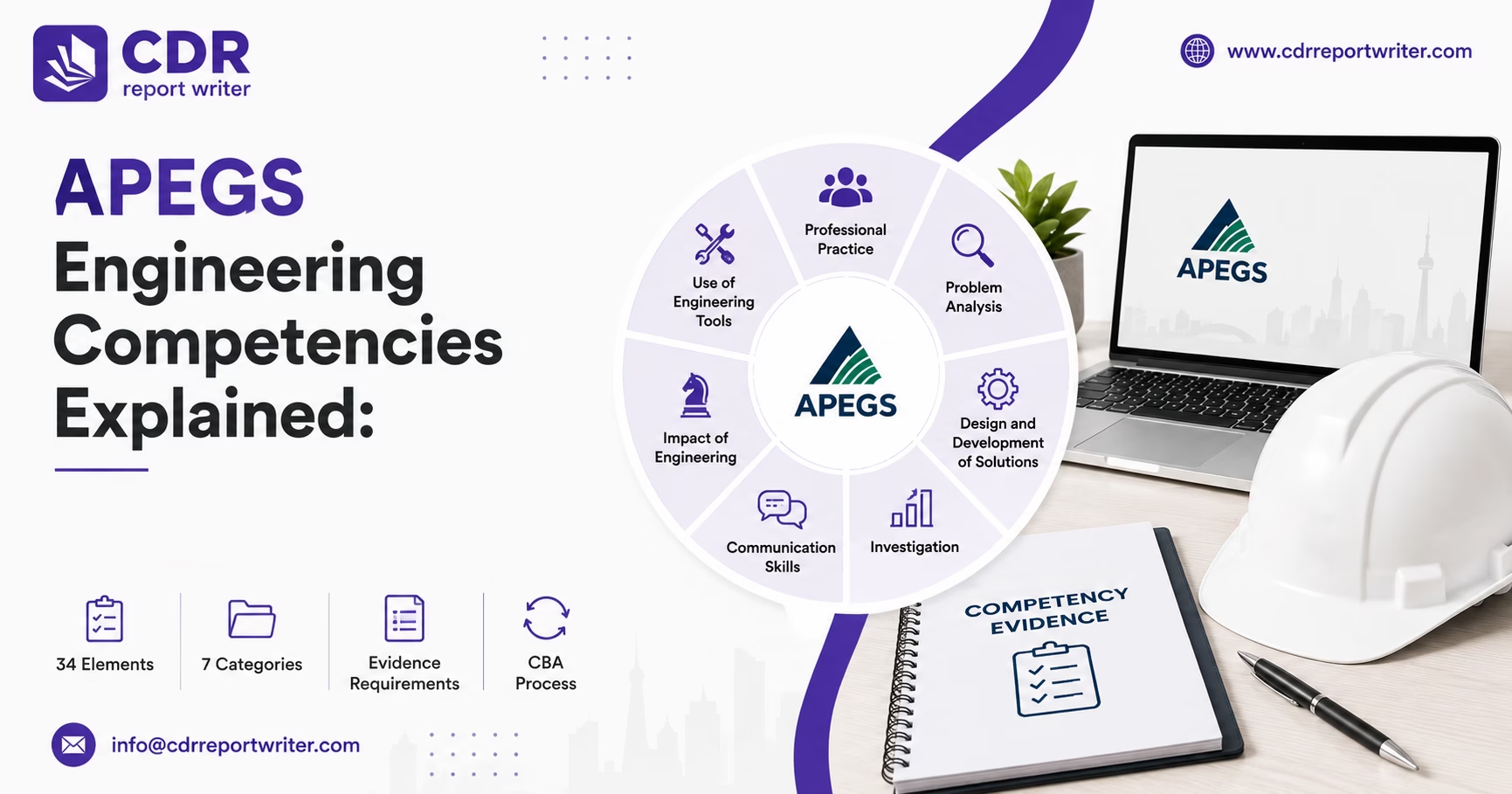
APEGS assesses engineering applicants against 34 competency elements grouped into seven categories: Technical Competence, Communication, Project and Financial Management, Team Effectiveness, Professional Accountability, Social, Economic, Environmental and Sustainability, and Personal Continuing Professional Development. Each category has a required minimum competence level, while every element must be supported by a specific engineering example that can be evaluated and validated.
The framework examines professional readiness from different angles. One design project might contain evidence for application of theory, risk mitigation, written communication and project management, but those competencies are not interchangeable. Each one requires the applicant to isolate a different decision, action or outcome and connect it to the relevant APEGS requirement.
This guide explains all 34 engineering elements, the minimum level for each category, the difference between competencies, indicators and APEGS interpretation statements, and the evidence each element is intended to establish. It applies to the engineering framework only; APEGS assesses geoscience through a separate structure of 29 competencies across four categories.
Key highlights
- APEGS assesses 34 engineering competencies across seven categories; Technical Competence contains the largest group with 10 elements.
- The current minimum overall category levels are 3, 3, 2, 3, 3, 2 and 3 for Categories 1 through 7 respectively.
- A competency states the capability being assessed, an indicator suggests observable behaviour, and an APEGS interpretation statement clarifies the evidence expected for that element.
- A zero on any individual competency causes its category to fail, and each Canadian Environment Competency must independently meet the applicable category level.
- Evidence should come from specific engineering work, show the applicant’s own actions and judgement, and be assigned to a validator with firsthand knowledge.
Quick Answer: What Are the 34 APEGS Engineering Competencies?
The APEGS engineering competency framework contains 34 competencies organised into seven categories. The categories and current minimum overall levels are:
| 1. Technical Competence | 10 | 3 |
| 2. Communication | 3 | 3 |
| 3. Project and Financial Management | 5 | 2 |
| 4. Team Effectiveness | 2 | 3 |
| 5. Professional Accountability | 6 | 3 |
| 6. Social, Economic, Environmental and Sustainability | 5 | 2 |
| 7. Personal Continuing Professional Development | 3 | 3 |
The minimum is a category average, not permission to leave an element unproven. A zero on one competency makes that category fail. Canadian Environment Competencies carry an additional condition: each marked element must meet the minimum level for its category, regardless of the overall average.
Map the framework before you start filling 34 fields.
A category-by-category review can identify missing evidence, repeated projects, unsupported ratings and validator gaps while the submission is still editable.
In This Guide
- How to read competencies, indicators, interpretation statements and ratings
- Category 1: Technical Competence
- Category 2: Communication
- Category 3: Project and Financial Management
- Category 4: Team Effectiveness
- Category 5: Professional Accountability
- Category 6: Social, Economic, Environmental and Sustainability
- Category 7: Personal Continuing Professional Development
- Canadian-context evidence and the 34-competency evidence map
- Common mapping mistakes and FAQs
How to Read the APEGS Competency Framework
The framework uses several related terms, but they do different jobs. Keeping them separate prevents applicants from turning an indicator list into a generic paragraph or treating a self-rating as proof of competence.
| Competency | The skill or knowledge that must be demonstrated at the required level. |
| Indicator | An observable action, skill or behaviour that may demonstrate the competency; it is guidance, not a checklist or a heading to copy. |
| APEGS interpretation statement | The APEGS-specific clarification that identifies what the example should address and what common approaches are insufficient. |
| Competency rating | A 0-5 judgement based on the evidence. The applicant self-rates, the validator rates independently, and the assessor determines the assessed result. |
| Category minimum | The minimum average level required across a category, subject to the zero-rating and Canadian-environment rules. |
Indicators are examples of observable actions or behaviours that may demonstrate achievement. They help applicants recognise relevant work, but the final example must answer the competency and the APEGS interpretation statement using genuine project facts.
Ratings reflect more than the topic of the example. Scope, complexity, responsibility, risk and the amount of supervision shape the level demonstrated. Detailed scoring strategy belongs in a dedicated rating-scale guide; for mapping purposes, first locate the strongest verifiable evidence and then test whether its level is defensible.
Category 1: Technical Competence (10 Competencies, Minimum Level 3)
Technical Competence is the largest category and the clearest test of engineering practice. Participation in a project is not enough. The evidence must reveal the engineering principles, constraints, analysis, verification, risk and documentation behind the applicant’s decisions.
1.1 Regulations, Codes and Standards
Evidence direction: Identify a relevant Canadian regulation, code or standard, cite the applicable requirement, and explain how it changed a calculation, design decision, review or engineering outcome.
Avoid: stating that the project followed a code without showing its technical effect.
1.2 Project and Design Constraints
Evidence direction: Define a technical constraint such as capacity, geometry, material behaviour, operability, constructability or an interface, then show how engineering principles were used to manage it.
Avoid: describing schedule or budget pressure without a technical design consequence.
1.3 Risk Identification and Mitigation
Evidence direction: Show a specific technical risk, the analysis used to understand it, the mitigation selected and how the response reduced or controlled the risk.
Avoid: using a generic project risk register with no engineering judgement.
1.4 Application of Theory
Evidence direction: Name the engineering theory, equation, model or governing principle and trace how it was applied to a problem of suitable complexity.
Avoid: broad phrases such as ‘I applied structural principles’ without the actual theory or decision.
1.5 Solution Techniques
Evidence direction: Identify the analysis or design technique, assumptions and tools, explain why the method fit the problem, and show an independent check of the result.
Avoid: treating software output as evidence without engineering interpretation or verification.
1.6 Safety Awareness
Evidence direction: Connect a specific safety requirement or hazard to an engineering problem and show how it influenced the design, analysis, safeguard or technical control.
Avoid: routine OHS training, toolbox talks or PPE compliance with no application of engineering principles.
1.7 Systems and Their Components
Evidence direction: Describe an engineering system, its major components, interfaces and dependencies, then explain how component behaviour affected system performance.
Avoid: listing equipment or subsystems without analysing their interactions.
1.8 Project and Process Lifecycle
Evidence direction: Use an engineering project that demonstrates meaningful exposure from initiation or feasibility through design, implementation, monitoring and closeout.
Avoid: a project-management story limited to one or two isolated stages.
1.9 Peer Review and Quality Control
Evidence direction: Address both peer review and QA/QC: the review performed or received, the applicable procedure or standard, the applicant’s role and the effect on engineering quality.
Avoid: describing only a final check, document approval or general quality policy.
1.10 Engineering Documentation
Evidence direction: Show personal involvement in turning design intent into controlled drawings, specifications, calculations or technical descriptions and moving them through review and approval.
Avoid: claiming authorship of a team deliverable without identifying the applicant’s own technical contribution.
Category 2: Communication (3 Competencies, Minimum Level 3)
Communication evidence must still be engineering evidence. The assessor needs to understand the technical content, the audience, the applicant’s contribution and what the communication enabled or changed.
2.1 Oral Communication in English or French
Evidence direction: Choose a specific technical briefing, design review, client discussion or presentation. Explain the audience, purpose, content prepared, questions handled and resulting decision.
Avoid: saying that regular meetings or presentations were attended.
2.2 Writing in English or French
Evidence direction: Identify a particular engineering document and show how technical information, assumptions, conclusions and recommendations were made accurate and useful for its readers.
Avoid: listing reports, emails or specifications without explaining authorship or impact.
2.3 Reading and Comprehension
Evidence direction: Show how a key engineering document was interpreted and applied to a decision, review, calculation, design or risk response.
Avoid: merely noting that contracts, drawings or standards were read.
Category 3: Project and Financial Management (5 Competencies, Minimum Level 2)
This category tests whether engineering work is managed within scope, resources, responsibility, feedback and financial constraints. The minimum category level is 2, but each example still needs a specific professional context.
3.1 Project Management Principles
Evidence direction: Demonstrate how scope, planning, execution, monitoring, change control or closeout principles were applied to an engineering project and why they mattered.
Avoid: reciting project-management terminology without linking it to a real decision.
3.2 Level of Responsibility
Evidence direction: Show progression in engineering responsibility across time, including how supervision, decision authority, complexity or accountability changed.
Avoid: a static list of current duties.
3.3 Expectations Versus Resources
Evidence direction: Define the technical expectations and available people, time, information, equipment or budget, then explain the trade-off and management response.
Avoid: claiming that resources were limited without showing what was balanced or decided.
3.4 Financial and Budgets
Evidence direction: Use estimating, budgeting, forecasting, cost monitoring, option comparison or financial control to demonstrate understanding of the wider financial consequences of engineering work.
Avoid: a simple material quantity multiplied by unit price.
3.5 Response to Feedback
Evidence direction: Describe technical feedback received, how its merit was evaluated, what was changed or defended, and how the response improved the work.
Avoid: an example about giving feedback to somebody else.
Category 4: Team Effectiveness (2 Competencies, Minimum Level 3)
Team Effectiveness is not a personality test. Both competencies should be grounded in engineering work and show observable actions that improved collaboration or resolved a difference.
4.1 Work Respectfully With Other Disciplines and People
Evidence direction: Use a multidisciplinary engineering situation and show how information, constraints and responsibilities were coordinated respectfully across roles.
Avoid: general claims such as ‘I am a team player.’
4.2 Resolve Differences
Evidence direction: Describe a genuine engineering disagreement, the interests or technical positions involved, the steps taken to resolve it and the resulting project or team outcome.
Avoid: a generic conflict-management technique with no real engineering issue.
Category 5: Professional Accountability (6 Competencies, Minimum Level 3)
Professional Accountability examines judgement, ethical responsibility, limits of competence and the obligations attached to professional engineering. Awareness alone is weak evidence; the example should show how the obligation affected conduct or a decision.
5.1 Code of Ethics
Evidence direction: Connect an engineering situation to a specific ethical principle and explain the options considered, the choice made and why it protected professional obligations or the public interest.
Avoid: summarising the code without an ethical choice.
5.2 Awareness of Limitations
Evidence direction: Identify a genuine boundary in knowledge, authority or experience and show the responsible steps taken, such as seeking review, specialist advice or additional information.
Avoid: presenting an ordinary delegation as a professional limitation.
5.3 Conflict of Interest
Evidence direction: Explain an actual or potential conflict, how it could influence engineering judgement, and the disclosure, recusal or control used to manage it. If a hypothetical situation is used under the current interpretation, label it clearly and never present it as lived experience.
Avoid: confusing interpersonal disagreement with conflict of interest.
5.4 Professional Liability
Evidence direction: Distinguish professional accountability from legal liability and connect both to an engineering decision, error-control process, contractual duty or consequence.
Avoid: a definition-only response with no practice context.
5.5 Use of Stamp and Seal
Evidence direction: Show when professional authentication applies, the controls surrounding it and why correct use protects document integrity and public reliance. Applicants must not imply that they personally stamped work without authority.
Avoid: memorising stamping rules without applying them to a real engineering context.
5.6 Strengths and Weaknesses
Evidence direction: Identify a personal or interpersonal strength and a soft-skill limitation, then show how each affects engineering work and how the limitation is managed.
Avoid: using a technical knowledge gap that belongs in Category 7.
Category 6: Social, Economic, Environmental and Sustainability (5 Competencies, Minimum Level 2)
Category 6 expands the lens beyond the immediate technical deliverable. Evidence should connect engineering decisions to public safeguards, regulatory purpose, environmental sustainable development and the applicant’s ability to influence better outcomes.
6.1 Public Impacts and Safeguards
Evidence direction: Identify how engineering work could affect the public, the safeguards required and the mitigation used to control adverse impacts.
Avoid: a general statement that safety is important.
6.2 Engineering and the Public
Evidence direction: Explain how a specific engineering activity served, affected or created obligations to the public and how that relationship influenced the work.
Avoid: describing only the client benefit or commercial outcome.
6.3 Role of Regulatory Bodies
Evidence direction: Show why a regulator exists, what public-interest function it performs and how its requirements affected the applicant’s engineering work.
Avoid: listing agencies, permits or approvals without explaining their role.
6.4 Sustainability and Practice Guidelines
Evidence direction: Identify a relevant environmental sustainability clause or practice guideline and show how engineering principles were applied to meet it.
Avoid: using ‘sustainability’ to mean keeping a business or schedule viable.
6.5 Promotion of Sustainability
Evidence direction: Demonstrate how engineering knowledge or the applicant’s position of influence was used to advance environmental sustainable development in a project.
Avoid: repeating compliance evidence from 6.4 without showing advocacy or influence.
Category 7: Personal Continuing Professional Development (3 Competencies, Minimum Level 3)
The three CPD competencies form a sequence: completed development, current technical gaps and a future plan. Treating all three as lists of courses removes the distinction the framework is designed to assess.
7.1 Professional Development Activities
Evidence direction: Show completed engineering-related development and explain how it maintained or strengthened the application of engineering principles.
Avoid: a course list with no connection to competence or practice.
7.2 Identify Training Needs
Evidence direction: Identify current or future gaps in engineering knowledge, explain why they matter to the area of practice and define what needs to improve.
Avoid: repeating past training already covered in 7.1.
7.3 Professional Development Plan
Evidence direction: Build a structured plan tied to the gaps in 7.2, including suitable activities, sequence, timing and the intended competence outcome.
Avoid: an unprioritised wish list of courses or memberships.
Which APEGS Engineering Competencies Need Canadian-Context Evidence?
Canadian work experience is not automatically required. Certain engineering elements are designated as Canadian Environment Competencies (CECs) and appear with a maple-leaf marker in the online system. Each CEC must demonstrate a Canadian or equivalent-to-Canadian work environment and must meet the applicable category level independently.
For experience gained outside Canada, equivalence must be demonstrated rather than asserted. The example should identify the relevant legal, code, safety, regulatory, public-interest or professional-practice context and explain how it compares with Canadian expectations. A blanket sentence such as ‘the overseas standard was equivalent’ does not reveal the knowledge being assessed.
CEC markings and online prompts can change, so the active Competency Assessment System controls the final selection. The evidence map should include a Canadian/equivalent-context column and flag every maple-leaf competency for a separate check before validation.
How to Build a 34-Competency Evidence Map Before Writing
Begin with projects and decisions, not keyword-shaped sentences. A simple matrix makes overlaps visible and separates a true evidence gap from a writing problem.
| 1.x / 2.x etc. | Specific real project and date | Decision, analysis or behaviour to prove | Technical or professional result | Code, regulator, safety or practice context | Firsthand witness | Missing fact, level or experience |
- Inventory real projects, positions, decisions, calculations, reviews, documents, stakeholders and outcomes.
- Map each fact to the competency it proves most directly; do not begin by drafting 34 separate stories.
- Choose the strongest verifiable situation for each competency and record the applicant’s distinct personal action.
- Reuse a project only when the new entry demonstrates a genuinely different competency and does not repeat the same paragraph.
- Check dates and assign a validator who had firsthand knowledge of that work at the time.
- Flag weak or missing evidence honestly. Some gaps require additional professional experience, not more persuasive wording.
Need a second set of eyes on the 34-competency map?
Professional review can test category coverage, evidence strength, chronology, ratings and validator readiness. It should never invent a project, technical decision, outcome or validator.
Common APEGS Competency-Mapping Mistakes
- Treating indicators as a checklist and copying their wording into the example.
- Reusing one generic project paragraph across several competencies without changing the evidence question.
- Describing project success while hiding the applicant’s engineering judgement inside ‘we’ language.
- Confusing routine safety participation with engineering safety analysis or design safeguards.
- Treating basic cost arithmetic as evidence of financial management.
- Listing codes, regulators, sustainability principles or CPD activities without showing application and effect.
- Mixing personal strengths and soft-skill weaknesses in Category 5 with technical development gaps in Category 7.
- Applying the 34-element engineering framework to a geoscience submission.
- Choosing a high self-rating before testing scope, complexity, responsibility, risk and supervision.
- Forcing a weak example into a field when the evidence map shows that new experience is needed.
Frequently Asked Questions
1. How many engineering competencies does APEGS assess?
APEGS assesses 34 engineering competencies across seven categories in the engineering competency-based assessment framework.
2. What are the seven APEGS engineering competency categories?
They are Technical Competence; Communication; Project and Financial Management; Team Effectiveness; Professional Accountability; Social, Economic, Environmental and Sustainability; and Personal Continuing Professional Development.
3. Which APEGS category contains the most competencies?
Technical Competence contains 10 competencies, making it the largest category. Professional Accountability has six; Project and Financial Management and Category 6 have five each.
4. What is the minimum level for each APEGS engineering category?
The current minimum overall levels for Categories 1 through 7 are 3, 3, 2, 3, 3, 2 and 3 respectively. A zero on any individual competency still causes the category to fail.
5. Do applicants have to address every indicator?
No. Indicators are guidance showing behaviours that may demonstrate a competency. The example must prove the competency and satisfy the APEGS interpretation statement; it does not need to copy or mechanically address every generic indicator.
6. Can one project demonstrate multiple APEGS competencies?
Yes. One project may support several competencies when each entry uses distinct facts and proves a different capability. Repeating the same narrative without changing the evidence focus weakens the mapping.
7. Can overseas experience demonstrate APEGS engineering competencies?
Yes. Genuine overseas engineering work can be used when it is verifiable and suitable validators can confirm it. For Canadian Environment Competencies, the example must demonstrate Canadian or equivalent-to-Canadian context.
8. What is an APEGS Canadian Environment Competency?
A Canadian Environment Competency is a maple-leaf-marked engineering element that must show competence in a Canadian or equivalent work environment. It must independently meet the minimum level for its category.
9. Are APEGS engineering and geoscience competencies the same?
No. Engineering uses 34 competencies across seven categories. Geoscience uses 29 competencies across four categories and should be planned against its own interpretation statements.
10. What happens if one APEGS competency is rated zero?
A zero causes the entire category to fail. The required resubmission depends on the assessed results, including which competencies fall below the category requirement.