
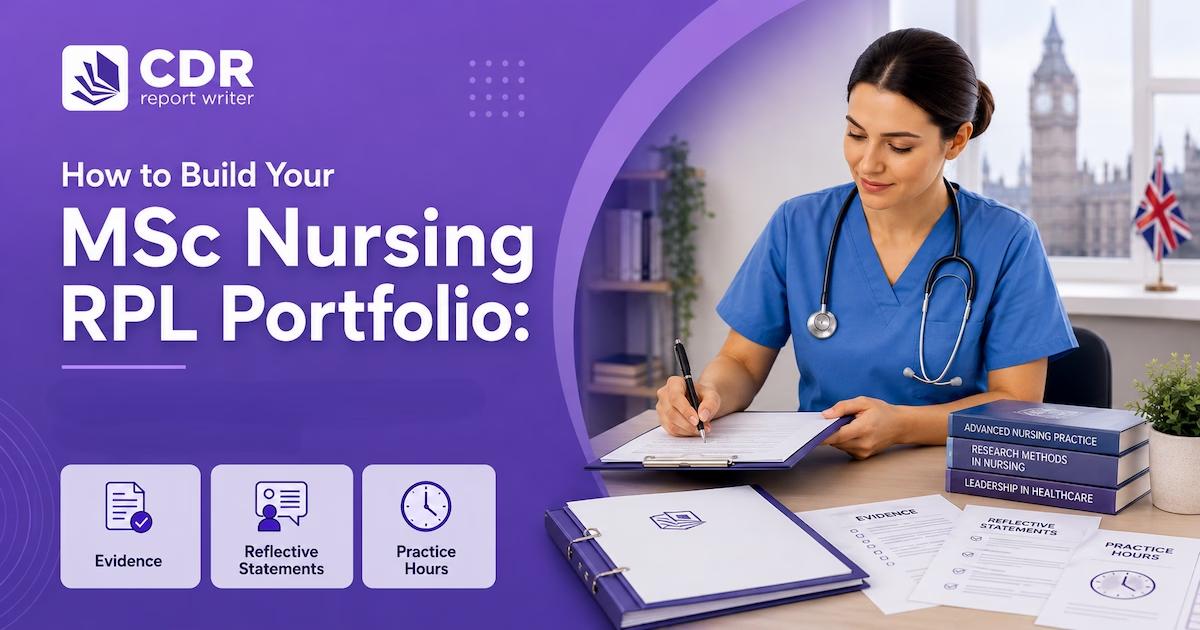
An MSc Nursing RPL portfolio is a structured evidence file. It is not a personal statement and it is not a general story about why you want to become a nurse. Every document, practice-hours record, and reflective account must support a specific learning outcome, platform, or university requirement.
Most weak portfolios fail because the evidence is not organised. The applicant has real care experience, but the hours are not verified. The reflection describes a situation, but does not explain learning. A platform is left blank. Patient or workplace information is included when it should have been anonymised.
This guide explains the portfolio-building process in a practical order: gather documents, map evidence to platforms, verify practice hours, write reflective accounts, close evidence gaps, anonymise everything, and check the full submission before the deadline.
Key highlights
- Build the RPL portfolio around evidence mapping, not around a general narrative.
- Use the seven NMC platforms as the organising framework when your university template is built around them.
- Practice hours must be verified by someone who genuinely knows your clinical or care practice.
- Reflective accounts need learning, analysis, and application, not only a description of duties.
- Remove all identifiable patient, service user, colleague, and workplace-sensitive details before submission.
Quick Answer: How Do You Build an MSc Nursing RPL Portfolio?
To build an MSc Nursing RPL portfolio, gather certified academic documents, collect verified practice-hours evidence, map each item to your university learning outcomes, write structured reflective accounts, anonymise patient and workplace information, and check every form before submission. Many MSc Nursing RPL templates are organised around the NMC platforms of proficiency, so the portfolio must show how your prior study and care experience already cover required theory and practice learning.
Want help structuring your RPL portfolio evidence?
If your evidence is genuine but scattered across transcripts, job descriptions, references, hours logs, and reflective notes, a structured review can help you organise it before writing.
Before You Start: What Documents Do You Need to Gather?
Start by collecting evidence before writing. Writing first usually creates repetition and gaps because you are trying to remember evidence rather than map it.
- Personal and professional details: full name, contact details, course applied for, previous qualifications, and any professional registration details if relevant.
- Academic documents: degree certificate, official transcript, module outlines, course handbook, assessment details, and learning outcomes from previous study.
- Employment evidence: current and previous job descriptions, role profiles, employer letters, reference letters, and evidence of care-related duties.
- Practice evidence: verified hours log, dates of employment or volunteering, settings worked in, supervisor details, and signed confirmation from the correct person.
- Reflection evidence: notes from real situations, training records, CPD certificates, feedback, and examples of learning that link to nursing proficiencies.
The previous course handbook matters. It proves what your prior degree actually covered. A transcript gives module names and marks; a handbook or module descriptor gives the learning outcomes that make academic mapping possible.
Also Read: RPCL vs RPEL: The Two Types of Prior Learning for MSc Nursing RPL Assessment
How Does Your Evidence Map to the NMC’s Platforms of Proficiency?
The NMC standards are grouped under seven platforms. These platforms describe the knowledge, skills, and attributes registered nurses must demonstrate. Many MSc Nursing RPL portfolios use these platforms, or university learning outcomes based on them, as the mapping structure.
| Platform | Focus |
| Platform One | Being an accountable professional |
| Platform Two | Promoting health and preventing ill health |
| Platform Three | Assessing needs and planning care |
| Platform Four | Providing and evaluating care |
| Platform Five | Leading and managing nursing care and working in teams |
| Platform Six | Improving safety and quality of care |
| Platform Seven | Coordinating care |
A single strong piece of evidence can support more than one platform. For example, a verified care episode involving communication, escalation, teamworking, and risk awareness can support more than one proficiency. Do not create seven weak pieces of evidence when one strong piece clearly supports several areas.
Your university template controls the final layout. If it presents the standards differently, follow that template, but keep the same mapping logic: evidence item, relevant outcome, your role, learning shown, and proof attached.
Not sure your evidence covers all seven platforms?
A mapping review can help you spot blank platforms, repeated evidence, and weak links before the portfolio reaches university assessment.
How to Build the Academic (Theory) Evidence Section
The academic section proves prior theory learning. It normally relies on transcripts, module descriptors, degree certificates, and previous academic work rather than workplace references.
Use lateral thinking, but stay evidence-based. A research methods module can support evidence-based practice. A psychology module can support communication, development, mental health awareness, or behaviour-related learning. A public health module can support health promotion. The module title alone is not enough; the learning outcome must fit the platform or university criterion.
If a gap exists, identify it. A blank or vague entry is weaker than a clear note showing the gap and the evidence you are using to close it. Universities assess whether the prior learning is enough, so the portfolio should make gaps visible and manageable rather than hidden.
How to Build the Practice-Hours Evidence Section
Practice-hours requirements differ by university. For example, one current MSc Nursing route sets 500 hours of healthcare-related experience and 500 hours of theory mapping. Greenwich uses a different figure, asking for a minimum of 700 practice hours for its RP(E)L process. UWL has published a 1,000-hour RPL entry requirement through UCAS.
These are verified examples, not one universal rule. The fixed rule for your application is the hour requirement in your own university RPL instructions.
Practice hours must be signed by an appropriate verifier. For nursing RPL, that is normally a registered healthcare professional, manager, supervisor, or equivalent person who genuinely knows your role and practice. If your hours come from more than one setting, each setting needs its own evidence rather than one broad statement covering everything.
- Record dates, total hours, role title, workplace or placement setting, and main duties.
- Attach job descriptions or role profiles where available.
- Use signed verification for each role or organisation.
- Keep the hours log consistent with reference letters and employment dates.
- Do not include unverified hours as if they are confirmed practice evidence.
Also Read: What Is RPL for MSc Nursing in the UK? Meaning, Eligibility and How It Works
How to Write Reflective Accounts for Your RPL Portfolio
Reflective accounts turn experience into assessed learning. A strong account explains what happened, what you personally did, what you learned, how the learning connects to a platform, and how it will affect future nursing practice.
Choosing a Reflective Model
Use the reflective model your university asks for. If the template names Rolfe, Gibbs, Driscoll, or another model, follow that model. If the university does not name one, choose a clear structure and use it consistently.
Rolfe can work well for concise RPL writing because it asks three direct questions: what, so what, and now what. Gibbs gives a fuller cycle with description, feelings, evaluation, analysis, conclusion, and action plan. Driscoll also keeps the reflection focused on what happened, why it matters, and what comes next.
What Makes a Reflective Account Strong vs Weak
Strong reflection is specific, honest, and linked to evidence. It names your role without naming the patient. It explains why a decision mattered. It connects practice to learning, and it uses relevant literature or policy where the university expects academic support.
Weak reflection is only descriptive. It says what the team did but not what you did. It repeats generic nursing values without showing a real situation. It copies another example. It ends without explaining what changed in your understanding or future practice.
- Use first person where the university allows it, because the assessor needs to see your personal learning.
- Keep the event anonymised and focused on learning, not drama.
- Link each account to the platform or learning outcome it supports.
- Use references where the template requires academic support.
- End with clear future application: what you will do differently or continue doing in nursing practice.
Get feedback on your reflective accounts before you submit
If your reflections describe events but do not yet show learning, a review can help strengthen structure, mapping, and clarity while keeping the writing based on your own real experience.
How to Organise the Portfolio File Before Submission
A strong portfolio is easy to navigate. Build an index before the final write-up, then give each evidence item a simple reference code. For example, academic transcript can become A1, degree certificate A2, job description P1, practice-hours verification P2, and reflective account R1. Use the same code in the mapping table, file name, and reflective account so the reviewer can move through the portfolio without searching.
Keep one evidence item in one place and refer back to it when it supports more than one platform. Do not upload the same certificate or job description several times with different names. Repetition makes the portfolio look less controlled and increases the risk that a reviewer misses the strongest evidence.
Before submission, open every file from the reviewer point of view. Check that documents are readable, page order is correct, signatures are visible, file names match the index, and scanned documents are not cropped. This simple check prevents avoidable delays caused by unclear evidence rather than weak experience.
What If You Don’t Have Enough Evidence Yet?
Not having enough evidence is a problem to solve, not a reason to invent experience. First, identify the exact gap. Is it theory learning, practice hours, a missing platform, weak reflection, no verifier, or an out-of-date document?
For theory or CPD gaps, official learning resources can help you build genuine evidence before submission. BCU guidance points applicants toward resources such as e-Learning for Healthcare and free Royal College of Nursing training where relevant. Use these only when the learning matches the platform or outcome you need to evidence.
Relevant short learning can include health inequalities, safeguarding, statutory and mandatory training, dementia, end of life care, leadership, genomics, physical activity and health, or other topics connected to the missing outcome. Keep certificates, notes, completion dates, and a short reflection explaining what was learned.
For practice-hours gaps, training certificates do not replace real practice hours. You need verified hours from an appropriate healthcare, care, or clinical setting. If you are short, speak to the university before submitting a weak or inflated claim.
Confidentiality and Anonymisation: What You Must Never Include
Your portfolio must protect people privacy. The NMC Code requires nurses, midwives, and nursing associates to respect privacy and confidentiality. That professional expectation applies to reflective writing, even before you are registered.
Do not include patient names, dates of birth, addresses, NHS numbers, hospital numbers, staff names, exact ward identifiers, or details that could identify a person when combined. Avoid screenshots of records, handover sheets, rota details, incident forms, and workplace documents unless the university specifically allows an anonymised version.
Confidentiality is also a data-protection issue. The core rule is simple: protect personal information and do not disclose patient or service-user details unless there is a lawful and necessary reason. An RPL portfolio does not need identifiable personal data to prove learning.
Final Checks Before You Submit
- Every required university form is complete.
- Every platform or learning outcome has evidence or a clear explanation of the gap.
- Practice hours are verified by the correct person for each setting.
- Academic evidence includes transcripts, certificates, and module information where needed.
- Reflective accounts are written in your own words and mapped to outcomes.
- Patient, colleague, and workplace-sensitive details are removed.
- File names are clear and match the portfolio index.
- The final version is submitted through the correct university channel before the deadline.
Do the final check against the university checklist, not against a generic article. The purpose of this guide is to help you understand the process; the university template is the submission rule.
Common Mistakes That Weaken an RPL Portfolio
- Leaving one platform or proficiency blank because the evidence is hard to find.
- Submitting practice hours without role-specific verification.
- Using the same generic reflection for several outcomes without adapting the learning point.
- Writing duties instead of reflection.
- Including identifiable patient or workplace information.
- Assuming BCU, Greenwich, UWL, or another university hour figure applies to every course.
- Using copied portfolio answers or free online samples instead of genuine personal evidence.
Should You Build This Portfolio Yourself, or Get Help?
You can build the portfolio yourself if you understand the university template, have verified practice hours, can access academic documents, and can write reflective accounts clearly in your own voice.
A second opinion is useful when the evidence is real but not well organised. It is also useful when reflections stay descriptive, mapping feels uncertain, or the deadline is close and you need to find gaps quickly.
Genuine support means structure, mapping, clarity, and review of your own evidence. It does not mean invented practice hours, false references, copied reflective accounts, or guaranteed university credit. The portfolio must represent your own learning and experience.
Ready to finish your MSc Nursing RPL portfolio?
We can help you review your evidence, organise portfolio sections, and improve reflective clarity while keeping the claim based on your own genuine study and practice experience.
Frequently Asked Questions
1. How do I write a reflective account for an MSc Nursing RPL portfolio?
Choose a real practice situation, remove all identifying details, explain your personal role, describe what you learned, link the learning to a platform or outcome, and end with how the learning will shape future nursing practice.
2. What reflective model should I use for RPL – Gibbs, Driscoll, or Rolfe?
Use the model named in your university template. If no model is named, choose one clear structure and use it consistently. Rolfe is concise, Gibbs is more detailed, and Driscoll keeps the reflection focused on what happened, why it matters, and what comes next.
3. What happens if I don’t have enough evidence for my RPL portfolio?
Identify the exact gap first. Theory gaps can be supported with relevant CPD or academic evidence. Practice-hours gaps need real verified practice hours. Speak to the university before submitting weak, incomplete, or inflated evidence.
4. Can I use the same piece of evidence for more than one NMC platform?
Yes. A strong evidence item can support more than one platform when the learning is clearly mapped. The key is to explain the different learning points instead of repeating the same sentence under several headings.
5. How do I keep patient information confidential in my RPL portfolio?
Remove names, dates of birth, addresses, NHS numbers, hospital numbers, ward details, staff names, and any combination of details that could identify a person. Use anonymised descriptions focused on your learning.
6. Who can verify my practice hours for an RPL claim?
Practice hours should be verified by a person who knows your work in that setting, such as a registered healthcare professional, manager, supervisor, or approved workplace verifier. Follow the exact requirement in your university template.
7. What are the 7 NMC platforms of proficiency?
The seven platforms are: being an accountable professional; promoting health and preventing ill health; assessing needs and planning care; providing and evaluating care; leading and managing nursing care and working in teams; improving safety and quality of care; and coordinating care.