Understanding UK-SPEC is not the same as being able to write evidence that proves it. Most CEng applicants are not turned down because they lack engineering experience. They are turned down, or referred, because their written evidence reads like a CV, a job description, or a general project summary rather than proof of personal competence.
The STAR method gives you a simple, repeatable structure for converting real engineering work into competence statements that an assessor can actually verify. It forces you to isolate what you personally did and what changed as a result, rather than describing a project in general terms.
This guide explains the STAR structure, the first-person writing rule assessors expect, worked examples for UK-SPEC Competences A to E, and the mistakes that weaken otherwise strong applications.
Key Takeaways
- The STAR method (Situation, Task, Action, Result) turns real project experience into assessor-ready CEng evidence.
- Competence statements must be written in the first person: “I,” not “we” or “the team.”
- Each STAR statement should map clearly to one or more UK-SPEC competences (A-E).
- One well-written project example can often prove two or three competences at once, if the mapping is made explicit.
- The biggest writing mistake is describing outcomes without explaining the personal decision that produced them.
What is the STAR Method for CEng?
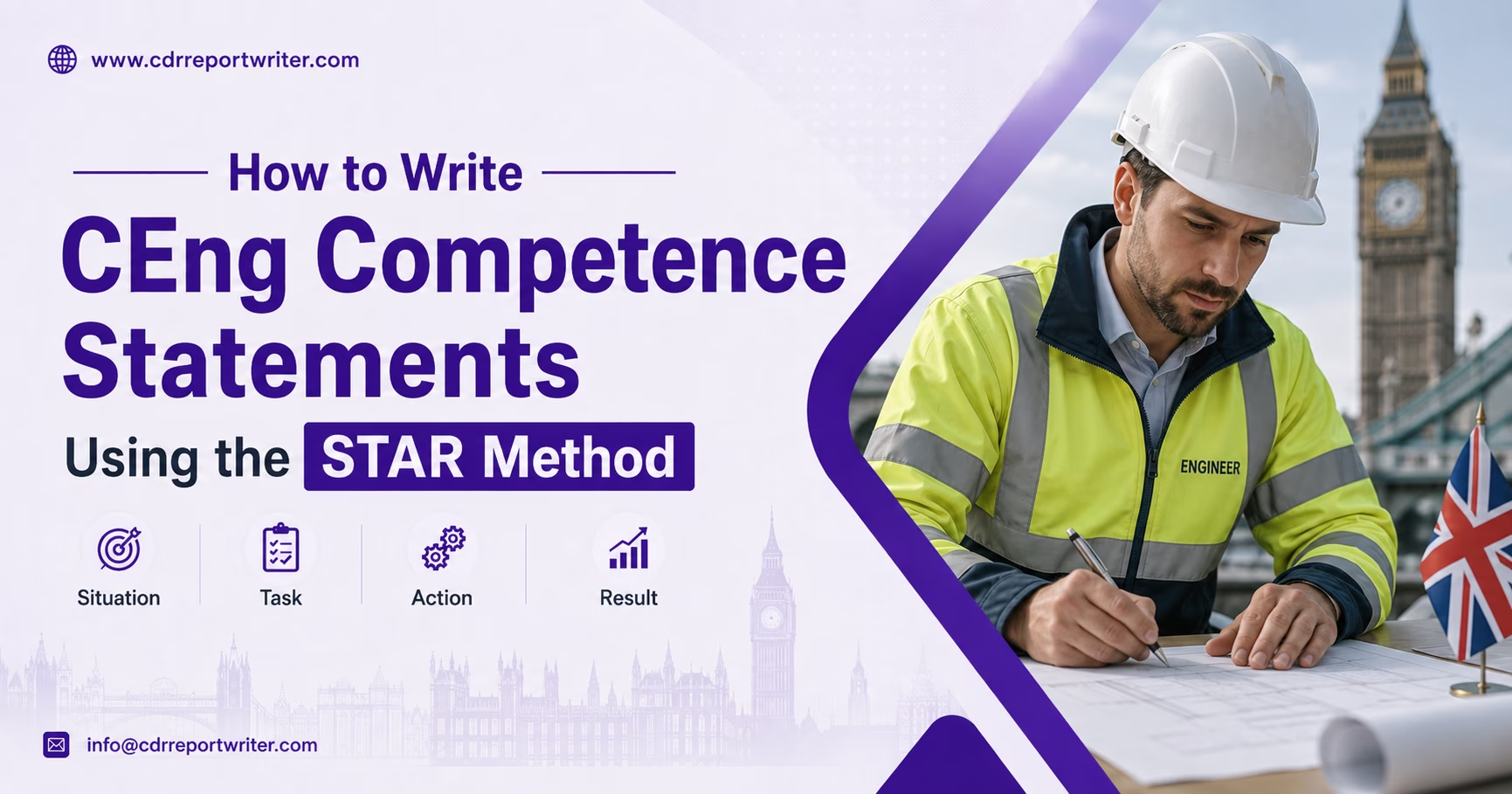
The STAR method is a four-part structure for writing CEng competence statements: Situation (the engineering context), Task (your personal responsibility), Action (what you specifically did, in the first person), and Result (the outcome, ideally with a measurable or verifiable detail). Applied to a CEng application, STAR turns a general project description into focused evidence that maps directly to UK-SPEC Competences A to E, because it forces you to separate context from personal decision-making and to state a concrete result an assessor or supporter can verify.
Why Does the STAR Method Work for CEng Applications?
UK-SPEC assessors and Professional Review interviewers are trained to look for specific, personal evidence, not general statements of responsibility. STAR naturally produces that: the Action section surfaces your decisions, and the Result section surfaces a verifiable outcome, which is exactly what Competences A to E are assessed against.
STAR also keeps statements short and scannable. Assessors read many applications, and a tightly structured statement is easier to credit than a long narrative that buries the personal contribution in project history.
STAR statements are also easier to defend at interview. Because each one is built on a single, real incident, you can answer follow-up questions about it in detail, rather than trying to recall a generalised account of how the team worked.
Four Parts of a CEng STAR Statement
Situation: Set the Engineering Context
State the project, system, or task briefly, along with your job role and where it sits within the wider project. Keep this to one to three sentences. Company history, client background, and details unrelated to the engineering problem do not belong here.
Task: State Your Personal Responsibility
Explain what you specifically were responsible for, not what your team or department was responsible for. Include the technical or managerial challenge you were tasked with resolving.
Action: Describe What You Personally Did
This is the section that carries the most weight, and the one applicants get wrong most often. Use “I,” never “we”: “I assessed,” “I decided,” “I led,” “I calculated.” Describe the specific technical or leadership decisions you made and why you made them. Mention the tools, standards, calculations, or judgement you applied.
Result: State the Outcome
Describe what changed: cost saved, risk reduced, safety improved, schedule met, quality improved, or client satisfaction achieved. Use a measurable or verifiable detail wherever possible, such as a percentage, a cost figure, a time saving, or a compliance outcome. Add a short reflection or learning point where relevant, particularly for Competence E.
Want Your STAR Statements Checked Before You Submit?
A focused review can confirm your Situation, Task, Action, and Result sections read as personal, verifiable evidence before you send your application.
Mapping STAR Statements to UK-SPEC Competences A-E
A STAR statement is only useful for a CEng application if its Action and Result sections can be checked against the five UK-SPEC competence areas. The table below shows how one project example maps across multiple competences.
| STAR Element | Example Content | Competence It Can Prove |
|---|---|---|
| Situation | A pump system was underperforming against its design specification on a client project | Context only, not evidence |
| Task | I was responsible for identifying the root cause and proposing a fix within budget | C: Responsibility |
| Action | I used fluid dynamics modelling and applied ISO standards to identify the cause, then designed a modified impeller specification | A: Knowledge; B: Problem-solving |
| Action (continued) | I presented my findings to the client’s technical director to gain design sign-off | D: Communication |
| Result | The redesign restored performance to specification, reduced material waste by 15%, and met environmental compliance standards | B: Problem-solving; E: Professional commitment |
One well-written STAR statement can support two or three competences at once, but only if you make the mapping explicit. Do not assume an assessor will infer which competence an example proves; state it. If the competence meaning itself is unclear, review our UK-SPEC CEng competencies guide before writing the STAR paragraph.
Not Sure Which Competence Your Example Proves?
If you have real project experience but cannot decide which UK-SPEC competence it supports, an evidence mapping review can clarify it before you write the final statement.
First-Person Writing Rules for CEng Statements
Always write “I,” not “we,” “the team,” or “the department.” Even when work was genuinely collaborative, isolate and state your specific contribution. Avoid passive voice such as “a decision was made” in favour of active, personal voice such as “I decided.”
Weak: “The team redesigned the bracket to reduce failure rates.”
Strong: “I led the design review, identified the fatigue failure mode, and redesigned the bracket geometry to reduce failure rates by 15%.”
The difference is not politeness. Assessors need to know specifically what you did, because that is what UK-SPEC competence is measured against, not what your team achieved collectively.
How Long Should a CEng Competence Statement Be?
There is no single fixed length across every institution. Guidance varies: CIBSE’s Engineering Practice Report, for example, runs to 4,000-5,000 words in total, while individual STAR-style examples within most applications are typically much shorter, often a few sentences to one paragraph each.
Keep each STAR statement focused: long enough to be specific and verifiable, short enough that your personal action does not get buried in background detail. Always check your specific institution’s word count or format rules, whether that is IET, IMechE, ICE, CIBSE, CIHT, or another professional engineering institution, before finalising length.
Worked STAR Examples by UK-SPEC Competence
The examples below are illustrative. Use them to understand the structure, not as text to copy; your evidence must come from your own genuine engineering experience.
Competence A Example (Knowledge and Understanding)
Situation: A structural component was showing signs of fatigue earlier than expected. Action: I applied finite element analysis and relevant design standards to assess stress concentrations and identify the likely failure mechanism. Result: My analysis confirmed the root cause and supported a revised design specification that extended service life.
Competence B Example (Design and Problem-Solving)
Situation: A production process had an intermittent quality defect. Action: I investigated the root cause, evaluated three alternative process changes, and selected and implemented the option that balanced cost and reliability. Result: The defect rate fell and the process passed the client’s next quality audit.
Competence C Example (Responsibility and Leadership)
Situation: A project phase was falling behind schedule with budget pressure. Action: I took responsibility for re-sequencing the technical workstream and directed a team of three engineers to prioritise the critical path activities. Result: The phase was delivered on the revised schedule within the approved budget.
Competence D Example (Communication)
Situation: A client’s technical director disagreed with a proposed design change. Action: I prepared a technical presentation that translated the engineering risk into commercial and safety terms the client could evaluate directly. Result: The client approved the design change and the project proceeded without further delay.
Competence E Example (Professional Commitment)
Situation: A site activity carried a fall-risk hazard not fully addressed in the existing method statement. Action: I identified the hazard during an inspection, referenced current HSE guidance, and redesigned the access platform before work continued. Result: The revised platform met the guidance requirement and removed the hazard before any incident occurred.
Strong vs Weak CEng Competence Statements
| Element | Weak Statement | Strong STAR Statement |
|---|---|---|
| Voice | “We reviewed the design and made changes.” | “I reviewed the design, identified the failure mode, and redesigned the component.” |
| Specificity | “I worked on a project to improve safety.” | “I identified a fall-risk hazard during a site inspection and redesigned the access platform to meet HSE guidance.” |
| Result | “The project was successful.” | “The redesign reduced incident risk and passed the client’s independent safety audit.” |
| Scope | Describes an entire year of work in one paragraph | Focuses on one specific decision, action, and outcome |
Common Mistakes When Writing CEng Competence Statements
- Writing a CV summary or job description instead of describing one specific incident.
- Using “we” throughout instead of isolating your personal contribution.
- Describing the final outcome without explaining the decision-making that produced it.
- Writing one long narrative report instead of clear, mappable STAR statements.
- Reusing the same example, worded identically, across every competence.
- Omitting a measurable or verifiable result.
- Ignoring your institution’s specific format, word count, or portal requirements.
- Copying structure or wording from sample PDFs found online instead of using your own genuine experience.
Avoid Mistakes with a Professional Evidence Review
A second, experienced pair of eyes catches missing mapping, weak voice, and repeated evidence before an assessor does.
How Many STAR Statements Do You Need?
Most applicants need several examples drawn from different projects, not one single account of an entire career. As a practical guide, aim for two to four strong STAR statements per competence area where possible, using varied projects to demonstrate range rather than repeating the same story.
Institutions differ in exact format: some use a narrative report, some use discrete evidence entries in an online portal, and some ask for a mix. The STAR content principle, context, personal responsibility, action, and verifiable result, applies regardless of which visible format your institution uses.
STAR Method vs Other CEng Report Formats
STAR is a drafting method, not a report format, so it works inside more than one submission style. A narrative-style report, such as CIBSE’s Engineering Practice Report or an ILP-style narrative report, can be built from a series of STAR-structured paragraphs strung together with connecting text. A portal-based application, such as IET or IMechE‘s online evidence fields, can use STAR directly, one statement per field. Either way, the underlying discipline of isolating situation, personal action, and result stays the same.
Should You Write Your Own CEng Competence Statements, or Get Help?
Many applicants can write strong statements once they understand STAR and UK-SPEC mapping, and self-writing is often the right approach. You are probably in a good position to continue alone if you can name a specific project for each competence, draft comfortably in the first person, and could defend each statement verbally in an interview.
Getting help is worth considering if you keep defaulting to “we,” your draft reads like a CV, you cannot tell which competence a given example actually proves, or you are translating overseas project experience into UK-SPEC-style English. A competence statement review checks personal-voice consistency, UK-SPEC mapping accuracy, and evidence gaps across A to E, and helps you see how your statements will read to a Professional Review Interview panel.
Getting help does not replace genuine personal experience. It structures and clarifies evidence that must still be true and something you can defend at interview.
Get your STAR Statements Reviewed by a CEng Evidence Specialist?
Have your Situation, Task, Action, and Result statements checked for personal voice, UK-SPEC mapping, and interview readiness.
When Should You Get Help Writing CEng Competence Statements?
Consider support if you understand UK-SPEC but cannot turn your experience into specific, personal evidence. Support is also useful if your draft reads like a CV or generic project summary, if you are unsure whether your examples cover all five competences without repetition, or if you are applying from overseas and need help translating project experience into UK-SPEC-style English evidence writing.
Frequently Asked Questions
1. How Do I Write a CEng Competence Statement?
Use the STAR method: describe the situation, state your personal task, explain the action you took in the first person, and state a verifiable result. Then map the statement to the relevant UK-SPEC competence or competences.
2. What Is the STAR Method for CEng?
STAR stands for Situation, Task, Action, Result. It is a four-part writing structure that turns real project experience into focused, assessor-ready CEng evidence.
3. Should I Write “I” or “We” in CEng Competence Statements?
Always write “I.” Even for collaborative work, isolate and describe your own specific contribution, decisions, and actions.
4. How Long Should a CEng Competence Statement Be?
There is no single fixed length across institutions. Individual STAR statements are typically a few sentences to one paragraph; full reports such as CIBSE’s Engineering Practice Report can run to 4,000-5,000 words. Always check your institution’s specific format rules.
5. Can One STAR Example Cover More Than One UK-SPEC Competence?
Yes. A single strong example can often support two or three competences, but you must state the mapping explicitly rather than leave the assessor to infer it.
6. What Are the CEng Criteria for the IET?
7. Can You Give an Example of a CEng Competency Statement?
Yes; this guide includes illustrative worked examples for each of Competences A to E. Real applications must use your own genuine project experience rather than copied examples.
8. What Is the Biggest Mistake Applicants Make Writing CEng Evidence?
Describing the outcome of a project without explaining the personal decision-making that produced it, or writing in “we” instead of “I.”
Ready to Turn Your Experience into CEng-Ready Evidence?
Get a professional review of your STAR statements before you submit your CEng application.